A Good? Life

I might have been in grade 11 when I wrote my most ambitious paper for English class. I explored the question, “Is honesty always the best policy?”  I have vivid memories of weaving through the stacks in our school library (after visiting the card catalogue) and intently trying to walk both sides of an answer.  This wasn’t a casual topic choice for me and I can’t actually say what life experience fuelled my fascination with honesty. I still remember the wondering and researching but looking back I didn’t have an inkling about how reading and writing were, quite honestly, saving me.
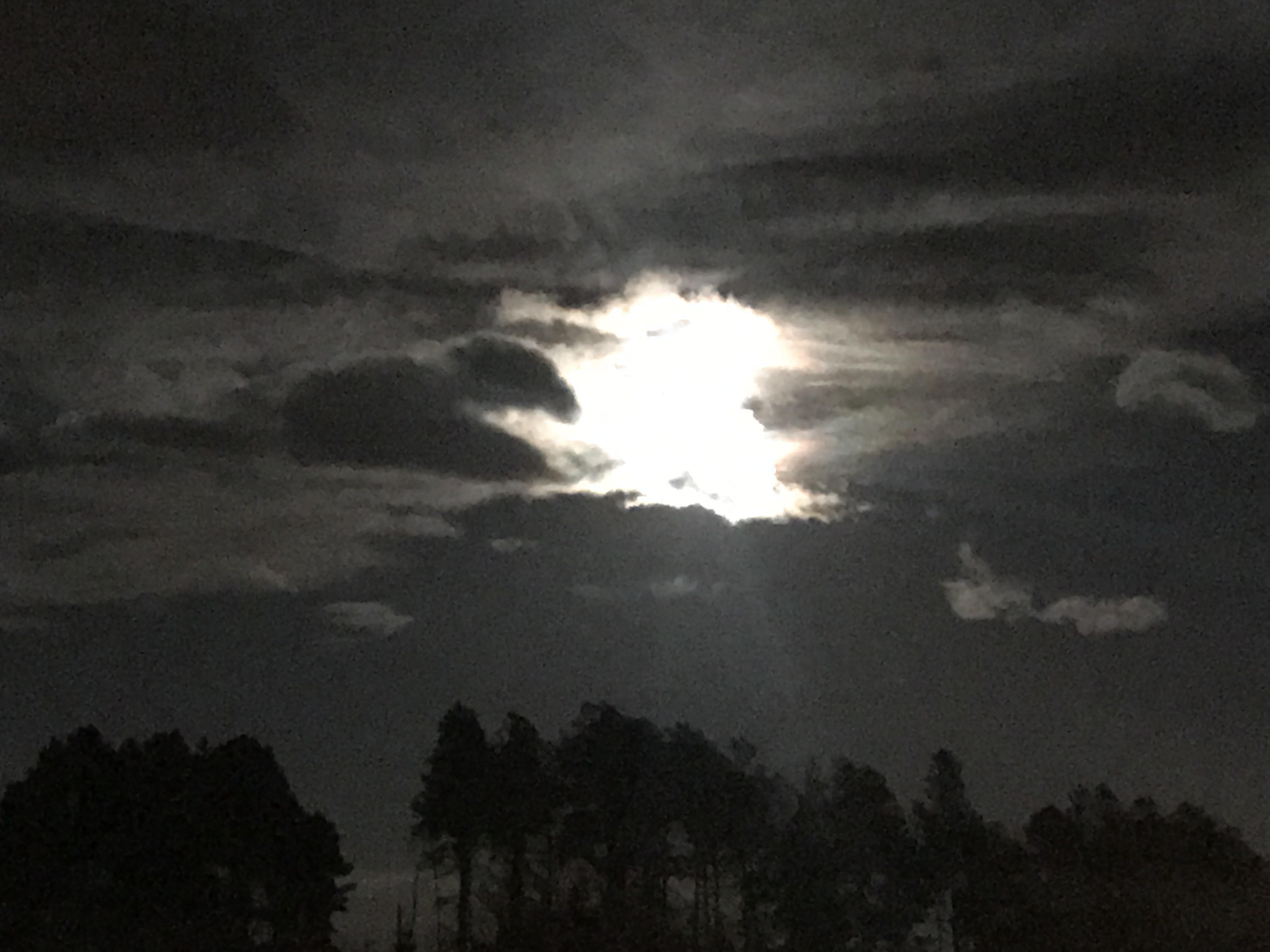
We all have the responsibility to live honestly—whatever that means.  Over many years, I’ve circled around the concept of living “unselfconsciously”  to alleviate fear and self judgement and second guessing about what is and what could be.  Which brings me to my idea to go back 5 years and post raw material from my 2018 notebook and, as I wrote, to unselfconsciously listen to my life.

I planned to lift the words out of the pages of that notebook and into the blog without striving to find the perfect word to describe whatever internal story I was spinning.  The truth is that in my last blog (December 7, 2023) I changed 2 words that I couldn’t seem to say again.  They seemed tired and out of touch with what was my deepest desire.  

In my old notebook was the familiar trope, “to have a successful and meaningful life.”  Even though I said I would not edit the old writing entries except to include context, I changed those words.  I changed the words “successful and meaningful” to “good?” with a question mark as another letter.  

I suppose the question mark was my own disclaimer that “good” isn’t any clearer than “successful and meaningful” and that is definitely not what I hoped to describe.  The idea that we hold the ability to strive, achieve, and “make” a life is a mistaken one.  Sure those things happen but they aren’t the consequential parts.  Perhaps, our life is response, moment by moment, born out in loving and honest relationship.

And as it happens, I was reading Mary Oliver’s book of essays, Winter Hours.  On pages 19-20, she writes,

For [inherited responsibility] is how I feel, who have inherited not measurable wealth but, as we all do who care for it, that immeasurable fund of thoughts and ideas from writers and thinkers long gone into the ground— and inseparable from those wisdom’s because demanded by them, the responsibility to live thoughtfully and intelligently.  To enjoy, to question—never to assume, or trample.  Thus the great ones (my great ones who may not be the same as your great ones) have taught me— to observe with passion, to think with patience, to live always care—ingly.

a worthwhile response to what we have been given 
December 12, 2018

Johanna grinned. “The natural thing would be to worry, fret over him, try to make things easy… So I have to choose to let him walk the path he wants to walk. Choose to be confident that I raised him with the principles that will save him. Choose to believe in him. And ultimately choose to not worry— the ultimate unnatural act for a mother.”

“Faith,” Claire said.

“Courage,” Johanna said. “Faith is what we earn when we have enough courage to face what is in front of us.”


From Dream Wheels by Richard Wagamese


I remember somewhere I heard, “even though it didn’t really happen it is true.” It’s probably in Dennis Sumara's book, Why Reading Literature Still Matters. Richard Wagamese’s books do matte

This is true: Faith is what we earn when we have enough courage to face what is in front of us. It is like the words to the Taize chant, La Tenebre:
Our darkness is never darkness in your sight
The deepest night is clear as the daylight.


What does it mean to have courage? So much of what causes me to get stuck, to react, to not act, and ultimately to have a less than abundant life is the result of being afraid. My son asked me what I was afraid of —I said I didn’t know and then I confessed that I did.

I am afraid of the what if’s—- predicated by the worst case scenario more often than not. I am afraid of perception and judgement, other people’s but mostly my own. My own view of what constitutes a good? life that is skewed by the world of achievements, of relatively short lived trouble. The bottom line, maybe, is the illusion of control, being able to effectively manage a life.

There are lots of reasons to be afraid— but none of them are true.

Courage is choosing: choosing to let be, choosing to trust others to make choices as they see their lives unfolding, choosing to believe in each other without fear.

As I’ve been with my adult children, I realize so painfully how my fear did try to protect and rescue, how my fears limited possibility and my acceptance of the person. That is not quite an accurate reading of the world or even what is before me.

In the novel Dream Wheels, (and in my own life), the mothers Johanna and Claire see the immense challenges that a life altering accident and life altering moral choices that have given them every reason to worry, to fret over their children, to coddle and protect. Having the courage to let another walk the path he wants to walk, to believe in the possibility.

There is another world view— where what seems weak, unreasonable, inexplicable that we can pay attention to is filled with holiness. God is with us. That is the truth.

I write every day in my “notebook” that serves many purposes. 

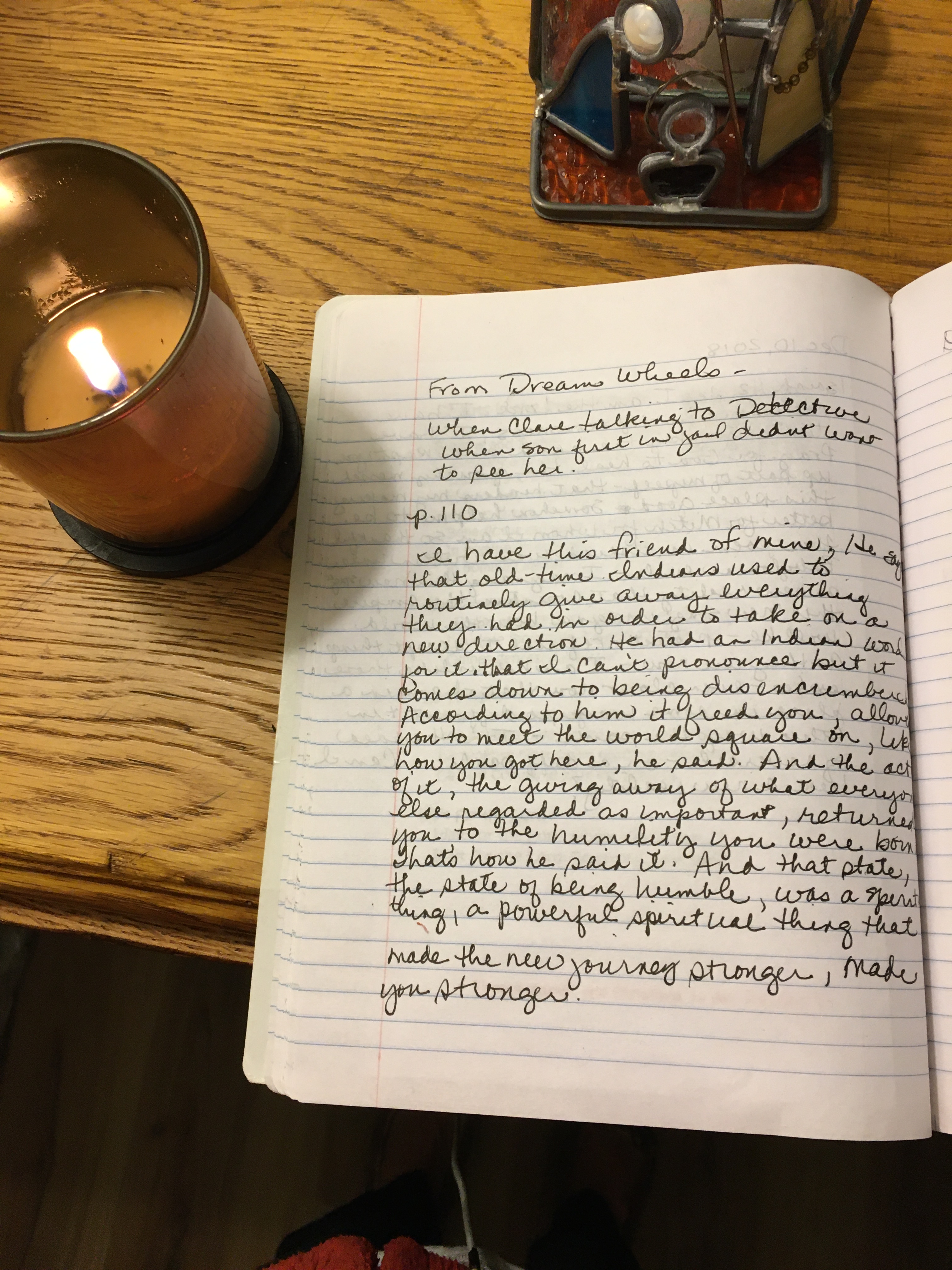
I record circumstances of my life, other people’s stories I hear, what I’m thinking, what I my wonder about and my prayer-like reflection.  I also use my notebook as a “commonplace book” where I copy snippets of other people’s words from whatever I am reading.  Sometimes I remember what has captured my attention and often, when I look back, I’m again surprised how those words help me make sense of my world again. That was the case when I saw the quote from Richard Wagamese’s novel, Dream Wheels.  This is what I wrote 5 years ago:

December 11, 2018

Claire is talking to a Detective when her son in jail didn’t want to see her — Dream Wheels, by R. Wagamese

I have this friend, he says that old-time Indians used to routinely give away everything they had in order to take on a new direction. He had an Indian word for it that I can’t pronounce but it comes down to being disencumbered. According to him it freed you, allowed you to meet the world square on, like how you got here, he said. And the act of it, the giving away of what everyone else regarded as important, returned you to the humility you were born in. That’s how he said it. And that state, the state of being humble, was a spiritual thing, a powerful spiritual thing that made the new journey stronger, made you stronger.

I think of things— things that seem right and then I talk myself out of them. Do I really trust God if I second guess the things that seem like ideas from my heart? No, I rely on my own understanding.

Psalm 25: 4-5 Make me to know your ways…lead me in your truth, and teach me.

I will learn by responding to the things put before me— kind of a paradox—let go of figuring things out.

Now, as I look back, Claire’s words speak a little differently to a five year older me.  Perhaps, giving away everything— what everyone else regards as important— could also mean giving up expectations or former ways of being in the world, like our profession or doing what we think counts.  Do I spend more time wondering how to live my life instead of actually living it?  

Mitch asked a question in his sermon this week that seems to fit me here: “Will we be so caught up in meeting expectations that we miss the hope that God offers to us?” …disencumbered, to meet the world square on.