The Rules

The rule teaches us to listen to the circumstances of our own lives. We have to begin to face what our own life patterns might be saying to us… When we are afraid, what message lurks under the fear…? …When we find ourselves in the same struggles over and over again, what does that pattern say…?

Joan Chittister, Wisdom Distilled from the Daily

 In her book about living the Rule of St. Benedict today, Joan Chittister is explicit about the possible patterns that the circumstances of our lives might reveal. Am I terrified of failure? Am I trying to cover up my weakness? Do I panic at the thought of public embarrassment or the sense of valuelessness that comes with the loss of approval?   Do I always begin things with great enthusiasm and abandon them before I am finished? Am I reluctant or afraid to change no matter how good or right the changes might be? Do I keep imposing the same unsatisfactory relationships with people from my past into the present ones? Have I ever really given myself, down deep, to anything except myself? What patterns do the circumstances of my life reveal?

In the quiet of my morning, I have times of insight, repentance, and gratefulness—then I go back to being the person who gets stuck in my own solitary world and am irritated or afraid when other’s inadequacies mirror my own. I ponder and even plan the perfect life I will live—in the near future, when I have established my house or have landed in a particular setting.  I long for a beautiful view and a big table to engender conversations and welcome for all kinds of people that just happen by. I imagine a life where I will have meaningful work to do at leisure. You know, that’s what I kind of thought before I moved here, to this place and house and people where I live now, at this moment.

I remember over 30 years ago, we lived in a newly built house with light blue carpet, south of a large metropolitan area. I remember writing in my journal that I wished for a house with hardwood floors on the other side of the city. Aside from the wooden floors, the houses on the other side of town were older, smaller, and required sweat equity to match the ease of lifestyle to which we were accustomed in our suburban neighborhood. I’m not sure what I was really searching to gain.

My last three houses have had hardwood floors: one with worn-out narrow oak planks, the next one gleaming newly refinished, and now the pine floors where we live have comfortable dog scratches already built in. Listening to the circumstances of my life might tell me that I sometimes imagine my life looking toward the next stage or location or configuration, particularly when those circumstances are challenging. I could also surmise that the substance of the floor I walked upon had little impact on how I lived beyond that surface.

I continue to encounter parallels between the wisdom of spiritual traditions that similarly require living the paradoxes. My life of faith moves unevenly between life and death, promise and struggle, solitude and community, and this present moment and the next. In his insightful look at The Promise of Paradox, Parker Palmer writes

Contradiction, paradox, the tension of opposites: these have always been at the heart of my experience, and I think I am not alone. I am tugged one way and then the other. My beliefs and my actions often seem at odds. My strengths are sometimes canceled by my weakness. My self, and the world around me, seem more a study in dissonance than a harmony of the integrated whole.

Dissonance. There is an attitude of mystery in the universe that guides every conversation and every common act. A contemplative awareness is possible that sanctifies the here and now when we accept the complexity and contradictions of our lives in contrast to the illusion that things are simple and we are in charge. Parker goes on to reflect that God sees through our illusions and delusions and meets us on the other side when it becomes clear that something has been leading us all along.

I’ve encountered this wisdom, over the years, in different forms. The Rule of Benedict challenges me to expose my ideas to the critical voice of wiser hearts, to seek community beyond my quiet morning reflection. In solitude and into community, we work out our connectedness to God, to one another, and to ourselves. The last few months I’ve been reading the words of an Ojibwe author, who has extended my community.  In one of his memoirs, One Native Life, Richard Wagamese recalls teaching from his Spiritual Elder:

Through the ceremony of the medicine bowl, he taught me how to pray in gratitude, to ask for nothing, to be thankful instead for all that was present in my life right then and there. Then he told me to take the spirit of that ceremony out into the world with me.

Anyone can be spiritual in a quiet room, but out in the world is where the challenge presents itself.

It’s the knowledge and acceptance of the mystery that surrounds us—and the awareness that allowing it to remain a mystery, celebrating it rather than trying to unravel it, engenders humility and a keen sense of the spiritual.  

Sister Joan Chittister adds to this mystery that the real monastic walks through life with a barefooted soul, alert, aware, grateful, and only partially at home.

Therefore the Lord waits to be gracious to me—the very contradictions in my life, the dissonance, are evidence of God’s mercy and mystery. Blessed am I when I wait; when I don’t strive to manage, figure out, and react to the noise of the world. My teacher will not hide. My eyes shall see my teacher, and my ears will hear a word behind me saying, this is the way, walk in it (Isaiah 30:21).

Listen and celebrate the mystery.

Listening for Home

img_0722It is easy to know what is good for someone else. It is difficult to listen and let them define themselves.
Joan Chittister, Wisdom Distilled from the Daily


The Walton’s.  I faithfully watched the show growing up, longing for a John-Boy, or maybe more truthfully, hoping that I was the John-Boy in my own family. I wanted that multigenerational experience that celebrated the bond of love despite each member’s individual expressions of living. Contrary to that close-knit household on television, in my mind, I separated myself from the woes of my own family. While I pretended large with my Aunt Bessie’s discarded elegant dresses and high heels, spray painted silver for my garage variety shows, I was suspect of her vivid storytelling, and the way she arrived at our house: her hulk of a car carelessly pulled up on the curb and her fifth of vodka safely tucked into her generous purse. As a teenager, I never wanted to not be in firm control of my life, as I perceived those closest to me who, like my Aunt Bessie, reacted to or escaped life’s tenuous balance.

It is easier to watch the show that is someone else’s life and to think that I know for certain how I would live that life, while not giving attention to my own.

I’ve been slowly working through Joan Chittister’s Wisdom Distilled from the Daily: Living the Rule of St. Benedict Today and reflecting on the weeks I’ve spent with each of my adult children over the past few months. The Rule involves listening to others needs and also teaches us to listen to the circumstances of our own lives.

I know how to meet life’s basic needs. I cooked and cleaned and consoled the weeks I stayed with my son and then my daughter during their own transitions. I also admit that I struggled to not say how I would manage any number of daily dilemmas that inevitably surface when you spend a few weeks with someone else. I am also aware of how I listened to the other person’s account of his or her day and made hidden judgments about the why or how or when or how much and all the while I was struggling to figure out my own why and how and when and how much.

Now that I have returned to the other world of my own house, I don’t quite know what to do with myself. I anticipated coming home and renewing my intention to live in the abundance of this, my new home.  I was reminded of the beauty of this island as the plane circled before landing. I thought I was ready.

I had (and have) plans to explore this unique city, to visit the Benedictine sisters on Shaw Island, to pursue a volunteer opportunity at The Contemplative Society, and to inquire how I might respond to a request to support the youngest readers at the Chinese church preschool. I do relish the opportunity for my own reading and writing and pondering, but also recognize the inwardness that I’ve hidden inside instead of seeking community.

All is not lost, though, in the days since my return. I have rearranged our dresser drawers, cleaned out and organized one kitchen drawer, did the laundry, and cooked one suspect and one glorious new recipe.  We attended our first Rabbie Burns Day Dinner (Scottish immersion) on Saturday and I was enveloped in the care of church folk who celebrated my return on Sunday. I’ve been invited to coffees, dinners, and an artsy group in the coming weeks. Yet, the truth is that I don’t know how to lean into this new life I’ve been given.

My truth is that I know how to keep knocking on the closed doors of the past year and  I know how to worry about the definition of my family that has also been re-invented in recent months. I’ve been trying desperately to survive the changes. I’ve been figuring out what is good for other people instead of listening and letting them define that for themselves. I’ve been figuring out what is good for other people because I don’t know quite what to do for my own life—this isn’t the same path I have coerced my way through the past few years.

One my plane trip home on Thursday, I was astonished by words that I’ve read before, yet heard for the first time. I cannot define or live another’s life and I am perplexed, again, how my human best tends to be at odds with the holy best.

To do for yourself the best that you have it in you to do—to grit your teeth and clench your fists in order to survive the world at it’s harshest and worst—is, by that very act, to be unable to let something be done for you and in you that is more wonderful still. The trouble with steeling yourself against the harshness of reality is that the same steel that secures your life against being destroyed secures your life also against being opened up and transformed by the holy power that life itself comes from. You can survive on your own. You can grow strong on your own. You can even prevail on your own. But you cannot become human on your own… the one thing a clenched fist cannot do is accept, even from le bon Dieu himself, a helping hand.

The Sacred Journey

I cannot manage nor imagine  “more wonderful still.”

I wasn’t just the oldest child in my family, like John Boy Walton. I thought I was the only adult, many times. I had to take charge of my own life.

Maybe it’s time to soften my jaw, to unclench my teeth, and to listen to and let be—all kinds of relatives.

Advent Listening for a New Year

2018 was a year of change. I turned 65, I lost my job, and we sold our beloved home, moved 4 times, welcomed and lost close family members and communities – events that offer an opportunity for deep listening.

I’m learning about my new home in British Columbia. Cascadia, the Pacific Northwest region of Oregon, Washington, and British Columbia, boasts that residents are spiritual and not religious, a distinction that shapes a way of life with the natural world. I also discovered that The Contemplative Society, that encourages Christian wisdom tradition, is based in Victoria, BC. I attended an Advent Silent Mini-Retreat this group co-sponsored with the Interfaith Chapel at the University of Victoria on a recent Saturday.

Being a bit cautious about riding the city bus for the first time to the University from my house and thinking the retreat started at 9:00 instead of 9:30, I arrived about 8:45. As synchronicity would have it, I helped Liz and Henri, who were leading the retreat, get the space ready. They welcomed me as an insider rather than as a first-time participant. We set up the kitchen area for a break and a light lunch, arranged tables in the outer areas, and carried chairs and pillows to the chapel space. Liz even asked me to greet people as they arrived when the time came, thus encouraging me even more to belong.

I risked entering into the day in this spirit of welcome and brought my most inward practices into community. And in that unfamiliar sense of community, I did newly experience familiar patterns I’ve cultivated over the years. I participated in chants in the style of Taizé, which were new to me, and familiar centering prayer and contemplative reading. A prayerful and reflective walk through the exposed shapes of the winter garden next to the chapel expanded my understanding of possibility in a season not usually associated with growth.

IMG_1938

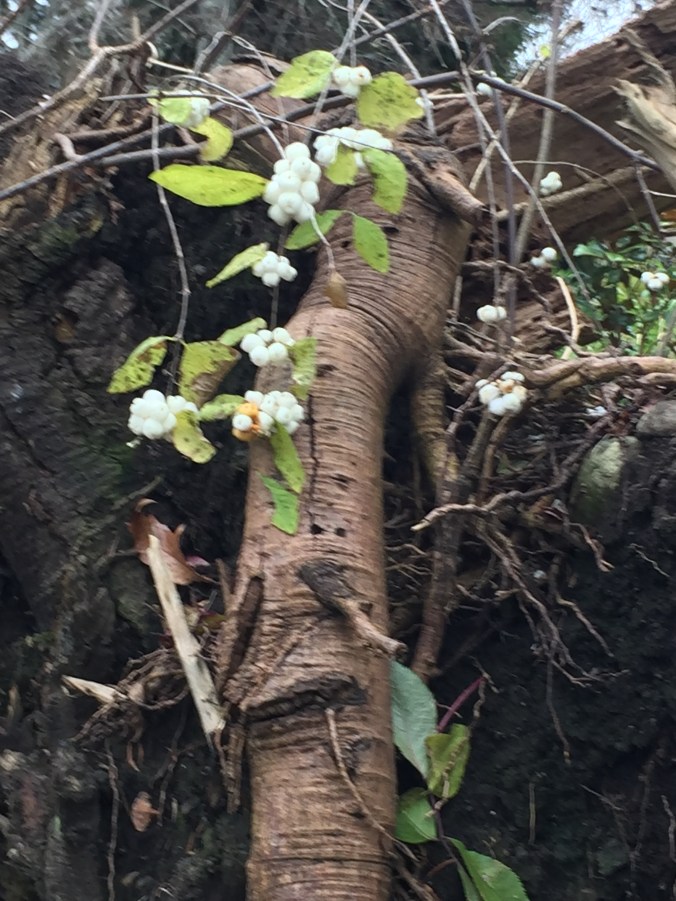
Snowberries in Finnerty Garden, University of Victoria

I’ve nurtured a way of reading and meditating on scripture, Lectio Divina, for many years. On this retreat, sharing that experience with others, I had to consciously listen, since I wasn’t the one reading to myself as is my usual custom. Liz, one of the retreat leaders, read Luke 1: 26-28. Slowly and deliberately, she read the scripture multiple times. I didn’t have the opportunity to see the words, so I noticed more acutely the ideas that stood out to me as I listened to this Advent story of Mary’s visit from an angel foretelling her role as the mother of Jesus.

I heard that Mary was favored by God and asked to do something she had never done before. For maybe the first time, I heard Mary question how this could be so, she wasn’t even married yet. Then I heard those familiar words, nothing is impossible with God, which I usually associate with Sarah’s, Hannah’s, or Elizabeth’s stories of the miracle of conception when that was their deepest wish, prayer, and impossibility. I heard clearly Mary’s answer, “Here I am Lord, let it be done to me according to your design.”

In the penetrating gift of silence that followed my hearing, I was able to attend to my own life alongside Mary’s experience. Here, in my new place, I also am being called to something else, something I’ve never done before. I said that, in so many words, last November and December and January and February and even March when I knew I wouldn’t be continuing in my job at the University. I knew my loss forced me to embrace newness.

But then, I lost sight. I got bogged down in the uncertainties when I knew where we might be going. How crazy is that to have that awareness of newness when I didn’t know where I would be—but then to lose that sense when the way became clearer that Mitch would take a job in Victoria.

When my last semester was completed in the spring, I was disoriented. I went through both the pain and great hope of graduation as my own ending. I was thankful for Tom Long, the graduation speaker, whose words were life-giving: go deeper, abundance, reversal, and confrontation.  I was thankful for colleagues who acknowledged my sadness with steadfast care and respect. I was thankful that I had the foresight to decide to do what I knew was right even at the last minute, to have the courage to go to graduation when I said I wouldn’t because I thought it would be too painful.

And then, in that quiet place, my heart wasn’t quiet as the veneer of anticipating newness began to buckle under the weight all that unknown—significant life changes for both our adult children, revisiting Victoria in anticipation of moving, the agony of planning another physical repositioning. I met these changes with brace rather than surrender to the newness being offered.

I lived the uncertainty anxiously, perseverating over the details of planning an international move. As I pondered what to give away or keep, what parts of life, as I knew it, would be coming along, my decisions were uncertain. I continue to second guess and hold old visions too tightly. I am still somewhat unwilling or unable to claim this place as our own—my own—my dwelling place for this time. The freedom to be able to make unplanned trips to be with family in their own states of change and challenge has actually made the separation of things and place even more acute—the unsettledness and disorientation renewed.

In my new home, I have passed over the signs of new life. The beauty of the island is muddied by my old dream of hardwood forests on old mountains that soothed my mind’s eye. Even with the fast and sure friendship of two women my same age and the unusual cast of characters who have generously shared their stories with me in my new home, I don’t know if I’ve given in—let my guard down so to speak. I lack the surrender to newness that keeps me apart and uncertain.

And now I come to this day, facing my impossibility. What do I hear? What is God’s word to me as I listen? I reread that scripture with my own eyes in the shadow of that new contemplative community I experienced at the retreat.

But she was greatly troubled… (v. 29)

Another translation says Mary was perplexed. Mary’s response bears similarities to my own of this last year – disorientation, not knowing, being afraid, even wondering how this can be.

How can this be since… (v.34)

Mary, too, is giving God a reality check. This thing you are telling me can’t be possible and here is the reason—this doesn’t make sense. However, it

…will be holy… (v.34)

What is happening to me is holy, of God, and not entirely my own doing.

Nothing is impossible with God. (v. 36-37)

The angel gives evidence of Elizabeth’s impossibility taking shape. Notice and lean into what God is already doing.

Here I am…let it be done to me… (v.38)

Mary simply was willing, available, and consented to God’s presence and action in her life. I’m reminded that these mothers celebrated the impossible that was right in front of them even though they could explain none of it. Even though I have not done so simply, am I able to let old certainties make way for the impossible?

The lesson is not new. In this life situation, whether I view it as a threat or an opportunity, I responded with brace, hardening, resisting and blinding myself to the unknown. Mary’s response was to accept the impossible as a willing and available participant in newness.

The chimes in the chapel garden called me back to the community following my listening walk. Keep listening.