Spaciousness. A word and idea I’ve been hearing a lot lately.

IMG_0987

View of Olympic Mountains from a high point just a few blocks walk from our house.

In the last few days, I’ve been looking at pictures that Mitch, my beloved partner in life, takes in the park, in the woods, or on the shore of the Pacific Ocean in the city where we live. We want to enlarge a few. When I am looking at them I am reminded of the spaciousness of the landscapes we view here. The expansiveness of very old cedar trees that have towered toward the sky for hundreds of years, the expansiveness of our ocean view that even stretches to the Olympic Mountains that are another country away, or the sea of flowers that take our breath away in a local yard or park open us up to the breadth of the natural world. That sense of spaciousness cannot be captured. The pictures only remind me of the awe I experienced at the moment when I was standing at that spot.

The spaciousness of this place is tangible and being open to what is beyond my physical surrounding is a kind of spaciousness, too. I am narrowed by my thinking that I don’t do the right thing or I waste the time I have. I am narrowed by expectations that cause me to think less of my own life or the lives of others.  I am expanded when I cultivate another view from the inside as well.

I’ve read the verses from Phillipians 4: 6-7 thousands of times. I’ve repeated over and over, days on end, “with prayer and supplication, with gratitude” to remind myself how not to be anxious about living. A few days ago, I used these verses for Lectio Divina, and I learned again that the spaciousness of God reverses the narrowness of trying to figure everything out when I am anxious. The time I spend in silence and gratitude cultivates God’s spacious presence.

The lesson came in an unexpected way last Saturday.  My friend traumatically lost her husband a couple of weeks ago. As we gathered at her house for a meal after the celebration of his life, I witnessed the kind of roominess that is engendered by God’s opening of our spirits.

My friend is known for her baking—supplying, in this case, a most elegant chocolate cake that was filled with memories for this family. Her 10-year-old nephew reminded her that he would “decorate” the cakes. She gently replied that there might not be any decorating on this day.

But then, when the time came for the cakes to be served, I witnessed her and her nephew Matt standing side by side at the kitchen counter that faces out on one of those expansive views of the Pacific Ocean.

My friend removed the chocolate cake from each springform pan and placed it on a plate. She loaded the top with hand-whipped cream and fresh raspberries.  I supposed that was probably her intent for readying the cake for serving on this difficult day.

However, Matt stood beside her with the professional pastry bag with the fluted tip in place. He loaded the bag with more of the whipped cream and deftly decorated the top of each cake with another layer of sculpted cream. The pair seemed to work effortlessly through 5 cakes lovingly prepared for gathered family and closest friends.

Maybe at some point in time, she showed him how to do this task—but I saw none of that at this time.  I watched her just seamlessly offer him the next step to finish what she had started, without saying a word. No “good job” or checking to see if he needed more cream or directing in any way; just giving space to be in that moment.

To live in spaciousness, our responses aren’t reasoned out, even in the most challenging circumstances or in the daily hum. Thomas Kelly, in Testament of Devotion, says that the Light within revises our reactions to the world so that they are “spontaneous reactions of felt incompatibility between the world’s judgments of value and the Supreme Value we adore deep in the Center.”

There is a wideness in God’s mercy from this spacious view.

The Hum of Home

I heard someone on the radio say that just as Hebrew is to Judaism and Arabic is to Islam, the body is the language of Christianity. I’ve been sitting with that wonder for a few weeks.

A sacred language is the particular language of revelation. In An Altar in the World, Barbara Brown Taylor says that wearing our own skin is not a solitary practice but one that brings us into communion with other embodied souls. She goes on to assert that God trusted, and I would add still trusts, flesh and blood to bring divine love to earth, maybe even using a body as an instrument of divine revelation.

What would it be like to know “more God” instead of “more about” God in our bodies?

 The Word incarnate. There is something precious and non-negotiable about this world and a divine heart within it. There is something profoundly to be noticed here, wonder’s presence. There is another way of conceptualizing the Word incarnate.

In a reflection on John 1: 1-14, Father Thomas Keating contemplates a material all-powerful vibration of the Eternal Word of God,

Now that creation has evolved and life itself has occurred, it seems that this initial vibration of the Word is still going on at the deepest level of everything that exists. This is the Word with whom every human being from the beginning of time has been in contact. This is the Word whose body, so to speak, is the universe, and in a more particular way, the human family. The eternal creative Word penetrates all creation as a kind of primordial “hum”. (You can almost hear it if you are quiet enough.)

Over the years, several physical practices have deepened my communion with God and my own body in this world. I write every day on paper using pencils and pens of varied colors and millimeters of ink that change the sensation and emphasis of the script. I write out each letter by hand, thoughtfully cross out the word that doesn’t represent what I am discovering, decide where to leave white space and page breaks, and mark up an emerging insight that I didn’t intend.

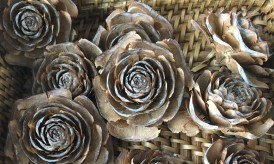
When I walk the dog, I stop to touch the smooth red and green underlay of the peeling bark on the arbutus trees that are native to this area. I pay attention to the unusual royal blue flowers that line the walk of my neighbor’s house. I pick up wooden rose pinecones and take them home for safekeeping before passing cars crush them. These seemingly ordinary things are, borrowing the words from Barbara Brown Taylor, “drenched in divine possibility.”img_0051.jpg


At the Luminous Wisdom School retreat I just attended, I’m thankful that Fiona, a participant like me, shared what seemed like a simply personal and particular physical challenge—that she was experiencing tinnitus and found herself filling each moment at home with music or a podcast to deaden the annoyance. The leader of our retreat and teacher of contemplative practices suggested that Fiona use the ringing in her ears as her “sacred word” during centering prayer. In centering prayer, one chooses a sacred word or another symbol of consent to God’s presence and action within. Returning to the word when our mind wanders and physical distractions occur. Fiona wondered aloud what it would be like to make sacred something that she found debilitating. I wondered what it would be like to imagine that sound as God’s presence.

In my case, I first noticed the cicadas in my ears several years ago. Initially, I only heard them later in the evening when I was reading in bed. I thought the sound might be some kind of utility buzz from the inner workings of the 50’s era house where we lived or maybe an odd noise from the decades-old television antenna that towered near my bedroom window. It wasn’t long before the ear insects showed up in church, too, in the beginning silence of prayer.

Over time, I’ve normalized the sound I hear that is always there, especially in the quiet. Most of the day, I don’t pay much attention to the gentle hum. When my mind is engaged in listening to something else, like the voices in my head, I don’t even know it is there. So, when Cynthia suggested that that sound could be the sacred word for prayer, I decided to try that alongside Fiona.

Astonishingly, the usual strain I experienced to choose and keep my focus on one sacred word melted away. I could physically feel the nano-second of release of other thoughts that my mind chose to grab and the seamless return to the noise that is always there awaiting my return. The insect-like noise doesn’t hold hidden meanings like my own wordsmithing of a sacred word does. Often, when I repeated my sacred word I found that more thoughts rushed in to further elucidate the meaning or justify my choice and both undermined the intention of centering prayer—to let go of distractions and to abide in God’s presence.

Could I listen, really listen, to that hum in my physical body to know “more God” instead of “more about” God?

In Richard Wagamese’s final novel, Starlight, the protagonist, Frank, is nurturing Emmy’s relationship with nature in which Emmy learns “to walk into the land fully open” and for the land to enter her. To me, the idea is akin to abiding in God and God abiding in me. After lessons on seeing, Frank expands the lesson to include deep listening.

…when you push your listenin’ out you can hear everything, I kinda figure it’s on accounta ya open yourself up to it all…

You get connected to what you hear. You become a part of it. It becomes part of you.

 In the deep listening, Emmy finds her calm center. God’s presence is a place to belong. That hum I can hear in my body is a tangible place, a spacious place to rest.

Listening to ringing in my ears is simple but not easy. This kind of listening requires no judgment, no analysis of what God is saying; it is simply consenting to and resting in the presence and action of the spirit. Maybe that is the ending of my story of the hum for now—that listening to whatever is God in us is to seek that presence in our body and to experience the spaciousness of creation. I can hear the hum.