Lost and Kind

Everything we write reveals a bit of the life behind it.

Even my grocery list reflects where and how I live.  My eating and cooking habits have gradually changed over the years and especially this year since I spend more time cooking and looking at recipes. I had never tasted the sweetness of spot prawns caught in British Columbia waters. I’ve learned about different kinds of salmon: sockeye and Coho, Chinook and Pink. I painfully watched the salmon spawn at Goldstream Park near me in early November, imbuing gratitude to witness their struggle for new life.

Victoria is filled with small grocers and I shop at one, The Root Cellar, housed in a primitive building with large black tent-like structures attached and filled with an abundant array of fresh produce.  The only frozen vegetable I buy now is peas. Green peas my husband calls them.  That is a story, too.  When we first met I learned his family ate black-eyed peas and my family only ate peas—the round green ones.  That distinction remains on the grocery list, a reminder of the shape of family, after 42 years of eating together.

What I also know is that writing holds lives that are rewritten by the reader. 

In another blog, I wrote about kindness and I intended to include the poem, Kindness, by Naomi Shihab Nye.  I feel like I know her, even though I don’t really, since her writing has been around me often in my teaching life.  Her poetry needed a place of its own. here. And, the story that brought the poem with it. 

I listened not long ago as Naomi Shihab Nye told the story that gave this poem to her.  Naomi and her husband of one week were traveling through Popayan, Columbia.  The young couple planned to stay in South America for three months.  At the end of their first week, they were robbed of everything and a man on the bus they were riding was killed.  Life was interrupted.

Naomi recalls their shock, “And what do you do now? We didn’t have passports. We didn’t have money. We didn’t have anything. What should we do first? Where do we go? Who do we talk to?”  

As they sat on the plaza of that unfamiliar place, a man came up to them and was simply kind. He must have noticed their distress and asked, “What happened to you?” They attempted to retell their experience and he responded, “I’m very sorry. I’m very, very sorry that happened,” and he went on.  

As her husband left to go to a larger town to find help, Naomi recalled that she “sat there alone in a bit of a panic, night coming on, trying to figure out what I was going to do next, this voice came across the plaza and spoke this poem to me — spoke it. And I wrote it down.”

Before you know what kindness really is

you must lose things,

feel the future dissolve in a moment

like salt in a weakened broth.

What you held in your hand,

what you counted and carefully saved,

all this must go so you know

how desolate the landscape can be

between the regions of kindness.

How you ride and ride

thinking the bus will never stop,

the passengers eating maize and chicken

will stare out the window forever.

Before you learn the tender gravity of kindness

you must travel where the Indian in a white poncho

lies dead by the side of the road.

You must see how this could be you,

how he too was someone

who journeyed through the night with plans

and the simple breath that kept him alive.

Before you know kindness as the deepest thing inside,

you must know sorrow as the other deepest thing.

You must wake up with sorrow.

You must speak to it till your voice

catches the thread of all sorrows

and you see the size of the cloth.

Then it is only kindness that makes sense anymore,

only kindness that ties your shoes

and sends you out into the day to gaze at bread,

only kindness that raises its head

from the crowd of the world to say

It is I you have been looking for,

and then goes with you everywhere

like a shadow or a friend.

That’s how kindness is medicine, a “balm in Gilead” as the old hymn goes.  We are healed a bit in the moment we receive or give kindness because we’ve been broken or lost, and we all have.  And just like the stories of our lives that rest behind our words, if we are kind, we must see each other and ourselves with our imagination as well as with our eyes.  We must listen for the stories behind the faces and actions we sometimes don’t understand and maybe never will.

Then it is only kindness that makes sense anymore.

The Best Medicine

Be kind.  Be calm.  Be safe. 

For a year now our Provincial health officer, epidemiologist Dr. Bonnie Henry, has repeated these three imperatives at the end of every daily update. The three adorn t-shirts, billboards, and tea towels. A close friend, for whom the pandemic has only compounded significant life challenges, said that’s what seems most important to her right now—kindness.

In an interview in our local paper this week, Dr. Henry elucidates how kindness is not just about being nice. 

Kindness is about understanding that we’re all connected, there is a common suffering, and we can’t always know how someone else is holding themselves together.  Some have support, while others don’t.  Rather than reacting, we need to take a breath and have compassion.

Maybe connection is kindness. 

Each week I email a Sunday lesson for the children in our congregation.  We are fortunate to have a curriculum that emphasizes contemplative practices.  A couple of weeks ago, one of those practices was to help us think about God by remembering God’s creation and by observing God’s way.  Each evening, we remember what we did and saw that day using these suggestions:

I’ve been ending the day answering these questions myself most evenings and noticing matters.

  • Sit quietly for a moment.
  • What beauty do you remember seeing in the world today?
  • Give God thanks for creating the beauty in our world.
  • When did you see someone showing God’s love to someone else?
  • Give thanks for teaching us how to be loving and kind.

The street where I live has no sidewalks and is only accessible to enter from the north end except for walkers and cyclist.  So, it not unusual for people to literally walk down the middle of the street and that is what I observed as I set out with the dog in the late afternoon.  Two men (I am assuming dads) and two tiny girls were walking; the girls in the middle of the street, holding each other’s hand.  They were dressed appropriately for the cool day in long pants and jackets and a tulle skirt happily bouncing as they walked.   As one of the girls turned, I noticed the tiny cloth mask (pandemic style) she also wore. I couldn’t help but smile. 

As my dog and I approached, the dads alerted the girls to move over so we could pass.  It was a privilege and joyful to walk behind them, but we passed and went on down the street, lighter and kinder, too.

That evening when I reflected on those questions from our Sunday lesson, I smiled again as I remembered that moment—beauty and kindness walk hand in hand. I live in an astoundingly beautiful part of the natural world and on this day, those two little ones walking offered me, simply an observer, a gift.    

Robin Wall Kimmerer, plant ecologist and author of Braiding Sweetgrass, understands kindness as a medicine that arises out of vulnerability.  The medicine in that vulnerability is an awareness that regenerates kindness and compassion.

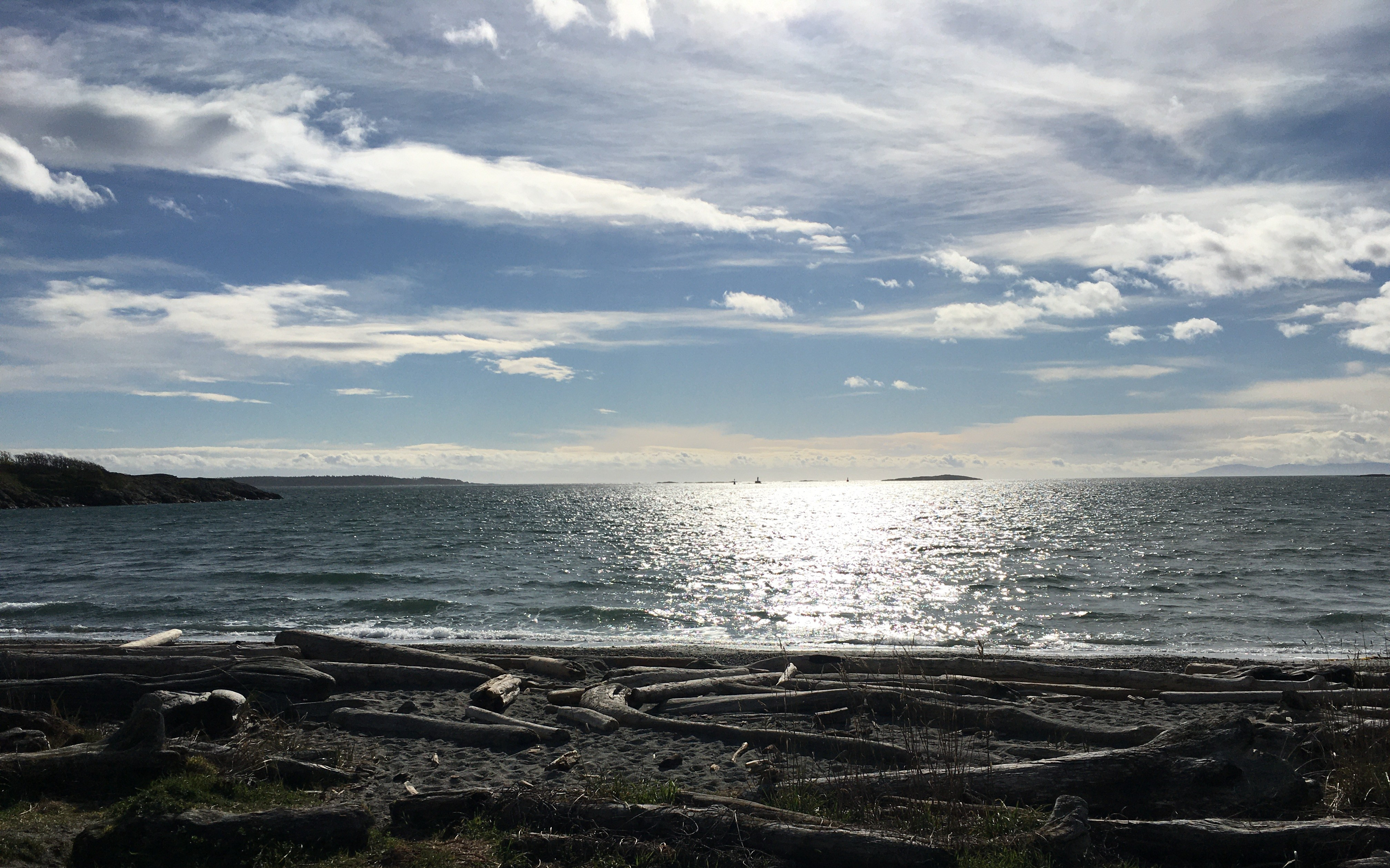
It is cherry blossom time in Victoria.

Listen and Hear

I listened to my husband Mitch tape his meditation for Good Friday.  I co-opted his insights because I need them right now.  I write because I’m the one who needs to hear. 

Mitch considered what the Romans, the Jewish leaders, the disciples, and Jesus’ family may have heard when Jesus said, “It is finished.”  But Jesus said those words to mean something for us.  The Greek word used in “it is finished” evidently means accomplished.  Jesus was saying it is finished for us; the struggle of worrying about all those things that we worry about—and for me today, suddenly that became a lot of things. 

When I was tidying up the kitchen this evening, I got an overwhelming feeling of worry, of being afraid about things I can do nothing about, really. At that moment, the urgency and impossibility of a myriad of what if’s and actual circumstances converged.  And that is what I heard Mitch say, that is what Jesus accomplished. 

It is finished is what Jesus meant when he said: “Do not be anxious about tomorrow, for tomorrow will be anxious for itself.  Therefore, I tell you do not worry about your life…can any of you by worrying add a single hour to your span of life?  Let not your heart be troubled, believe in God, believe also in me.”

I need to hear that again and again because I forget or maybe I don’t believe my life today.

Listen and hear, Jesus say, Peace I leave with you; my peace I give to you. I do not give to you as the world gives.  Do not let your hearts be troubled, and do not let them be afraid. Listen.

Mitch ended saying that Jesus’ last words and the spirit of those words declares that life’s greatest obstacles, even death itself, no longer need to have power over us. 

As Buechner writes to me, “unclench the fists of your spirit and take it easy.”

It is always something.

It is always something.

There was a line in Mitch’s meditation this week that got my attention. (The 8 minute meditation replaced the Sunday sermon, the new normal.)  It was one of those moments of recognition when we read something that describes or illuminates our own experience, an experience we haven’t really had the words to accept. 

The Israelites were first afraid of Pharaoh and his punishment, then the army chasing them, then the wilderness where they were headed.  Notice how their fear moved from place to place, person-to-person, and event to event.

I know what it means to lead with fear.  “What if’s” catch me before I do seemingly inconsequential and radical things. I’m afraid of how I will be perceived; I’m afraid of not doing enough. I am afraid of not knowing the ‘right’ thing, the most beneficial thing.  I don’t have to go back too far to recognize my own pattern.

When we lived in rural North Vernon and began planning our move less than 50 miles away, I was so afraid to tackle the housing market.  I did nothing to look for a place, even when I was there for school several days a week.  I was afraid of the cost and competition in the larger university town. I was afraid of the risk of living into that new unknown.

In a year or two, I was afraid Mitch’s job would end and then what would we do next?  Then I worried about how we would physically move two States away when I was the one with the new job and our dog had surgery, our daughter got married, and a close family member was critically ill.  And like all the times before, people, places, and events unfolded in time not my own.

Oddly, when my job ended at that next place, I wasn’t afraid of what was ahead. Maybe I was leaning in to the in-between with openness instead of fear, if only for a while. Until, I knew what was next.  Until, I knew that we would be moving across the country and into the next.  Again, I was afraid that we wouldn’t find a place in a city with competitive and costly housing, immigration challenges, and an island with no roads to get there.

I could go on – all the fear of being settled or not, of immigration unknowns, of getting older, of distance from our family. I never thought about a pattern of fear moving between people, events, and places.  And again, where will we be next?  There is always a next.  And maybe, that vulnerability is what I ‘m most afraid of.

I never named my anxious presence fear.  I intuited that I am just trying to get it right, this one life. I long to belong, to find my place, to be settled, to be home. 

“What would my life be like if I wasn’t afraid?” might seem the logical question to ask.  But maybe, I can see my way through by asking, “how do I fall through the fear to the other side?”

I can feel a wee bit of panic coming now, and I can feel it go. Moment-by-moment, I have the ability to let go of control, let go of security, let go of my desire to change the situation, and open to the spaciousness of acceptance.

In a prayer routine I wrote for myself more than ten years ago is this step: take counsel with my certitudes, not my doubts and fears.

I’m not exactly sure where I found that phrase, but it doesn’t matter.  It is true. 

I am certain that in all those transitions of my life, I have always had enough to take the next step.  I am certain that God is taking that step with me.

Moses answered the people, “Do not be afraid. Stand firm and you will see the deliverance the Lord will bring you today…. The Lord will fight for you; you need only to be still.” 

It is something.