Living Questions

An unanswered question is a fine traveling companion.

It sharpens your eye for the road.

Rachel Naomi Remen

That’s the tricky part—being able to hold fear and release, sadness and joy, assurance and mystery— that is surrounded by unexplainable hopefulness. 

How do we experience God and humanity, not as a rescuer or fixer or even a comforter, but as an abiding presence?

Rachel Naomi Remen reminds us of the power of questions that confound our lives.  My wondering today is an evolution of that question that has been with me for most of my life: What is my responsibility for my life and what is God’s and what just happens?

Again and again I bump up against what eludes explanation, the aligning of freedoms of choices: God’s, mine, and stuff that doesn’t fit into that binary.  I’m faced with facing what is, trusting in the moment without second-guessing what is already done, and at the same time, I am still trying to control outcomes that are not in my control.  How do I let go of boundaries of time, of expectations, of accomplishments, and whatever else occupies my attention in a state of brace, instead of giving space to what I cannot predict or even imagine?

Well, this seems to be one of those times.

Most of the things I do have been radically altered.  I actually like being home and released from the tug of social obligations—even though most of those encounters are life-giving.  I didn’t have to choose where to meet my friend for coffee or whether to invite her to my house instead.  I didn’t have to figure out a meal suitable to take to a friend or whether to invite another to my house because that is not comfortable for anyone right now.  I didn’t have to plan the English class I lead or wonder what my responsibilities are for Sunday church.   I didn’t have to feel guilty about deciding to skip my yoga class or dreading a trip to the grocery store for things that I didn’t really need anyway.

In the wake of all this release, I have actually been sleeping soundly all night.  The imaginaries that visited me at 3 a.m. have vanished or taken on a new perspective.  

I have been concerned that our immigration paperwork—that makes it easy to travel to see my family—expires in July.  Even though we know Mitch has a contract extension, I had conjured up all kinds of scenarios about what could and might happen during the renewal process.  Without knowing the “real” requirements, I have agonized over an imagined time line and the ill effects of delays. 

In order to stabilize the procedure, we were frantically preparing for an English test we were to take, even though English is our first and only language.  We sent our education credentials for a costly “official” review, knowing we have advanced degrees.  I applied for a job at the local University and was encouraged by the response and at the same time terrified of the possibility. I even imagined where we might live if it wasn’t where we are and couldn’t even come up with a place that made any sense.

The English test has been canceled.  The degree review is delayed because the company employees are working from home.  The University interview was canceled because there are so many unknowns about when classes might resume and how.

We are part of the fabric of this community and the formal paperwork doesn’t seem as pressing right now as I previously imagined.  We are grateful that Mitch’s job pays him to continue transforming what it means to do his job in unforeseen circumstances. We are grateful for simple encounters with people that matter. I’ve made more phone calls and reached out to more people this week and it has been without fear or obligation.  

Whether it is God’s choice, my choice, or someone else’s choice, or the aligning of freedom of choices, I don’t know.  My question hasn’t changed but I have been forced to let go of some boundaries and what might be possible that kept me looking and longing instead of living into what is.

That’s the tricky part—being able to hold what is and abide in the presence of Love where fear and release and sadness and joy don’t require resolution.  And the future is pure mystery.
Earth is Messaging

“Is God trying to send us a message through this Coronavirus pandemic?” That’s what a member of our Lenten study group asked.

“No, but the earth is.

I thought that was a wise and wonder provoking answer from our guest leader, Paul Galbreath. Clearly, the unprecedented changes and challenges of the last few days have gotten our attention.

At the very moment I am writing this, my husband is at our church, meeting with a group of elders who are wondering how to be the Church without Sunday worship.

The discussion of the elders will include how to care for each other during this time. Ours is an aging congregation like many so-called mainline denominations. However, we are all vulnerable.

Martin and his wife live on his dishwasher’s salary. They are gifted musicians from another continent. On Friday, he was sent home from the restaurant, indefinitely, because there are no dishes to wash.

Paul is a young man waiting for a kidney transplant. I noticed he often comes from the balcony to the downstairs washroom about halfway through Sunday’s service. He has green hair and a joyous smile.

Andy is a thirty-something climate scientist who had never been to a church until he showed up on a recent Sunday morning. He wears a suit and slips into the back row. A lady in the choir thought he was Justin Trudeau visiting and wondered about his security detail.

Jee Yoon and her two sons are far from their home country. She wanted to expand her young sons’ opportunities and education. They cannot go home safely now. She is drenched with so many questions and so many gifts.

There is a lot to wonder about these times. But in our Lenten study, our conversation took a different turn than I expected; unveiling the messages we might hear.

We might pay attention to the earth in scripture, our leader suggested. How does the text associate with our landscapes?  Victoria, our city, is the Garden City, with resplendent ocean and mountain views. Yet, our J-pod of orcas and the salmon that spawn in Gold Stream Park and the Garry Oaks that line the Camosun College grounds are in peril.

Victoria is Canada’s busiest cruise ship port-of-call. With the season officially delayed until July, 120 ships will not visit our city. The promise delivers a crushing economic impact and more jobs like Martin’s will be compromised. And yet, slowing the surge of cruise ships, airplanes, and all kinds of travel might save our planet.

When I walk past the homeless man and hear him cough, I am reminded that his health is as important as mine. The strong public health system of Canada and the more limited public offerings in the United States will shape our collective response.

Toilet paper has come to represent our most basic need for luxury. Is there more to hear than the call of consumerism that says our needs must be met at all costs?

Earth shares a message with the Lenten season—to die and live is earth’s refrain.

What will rebirth look like?

fullsizeoutput_489

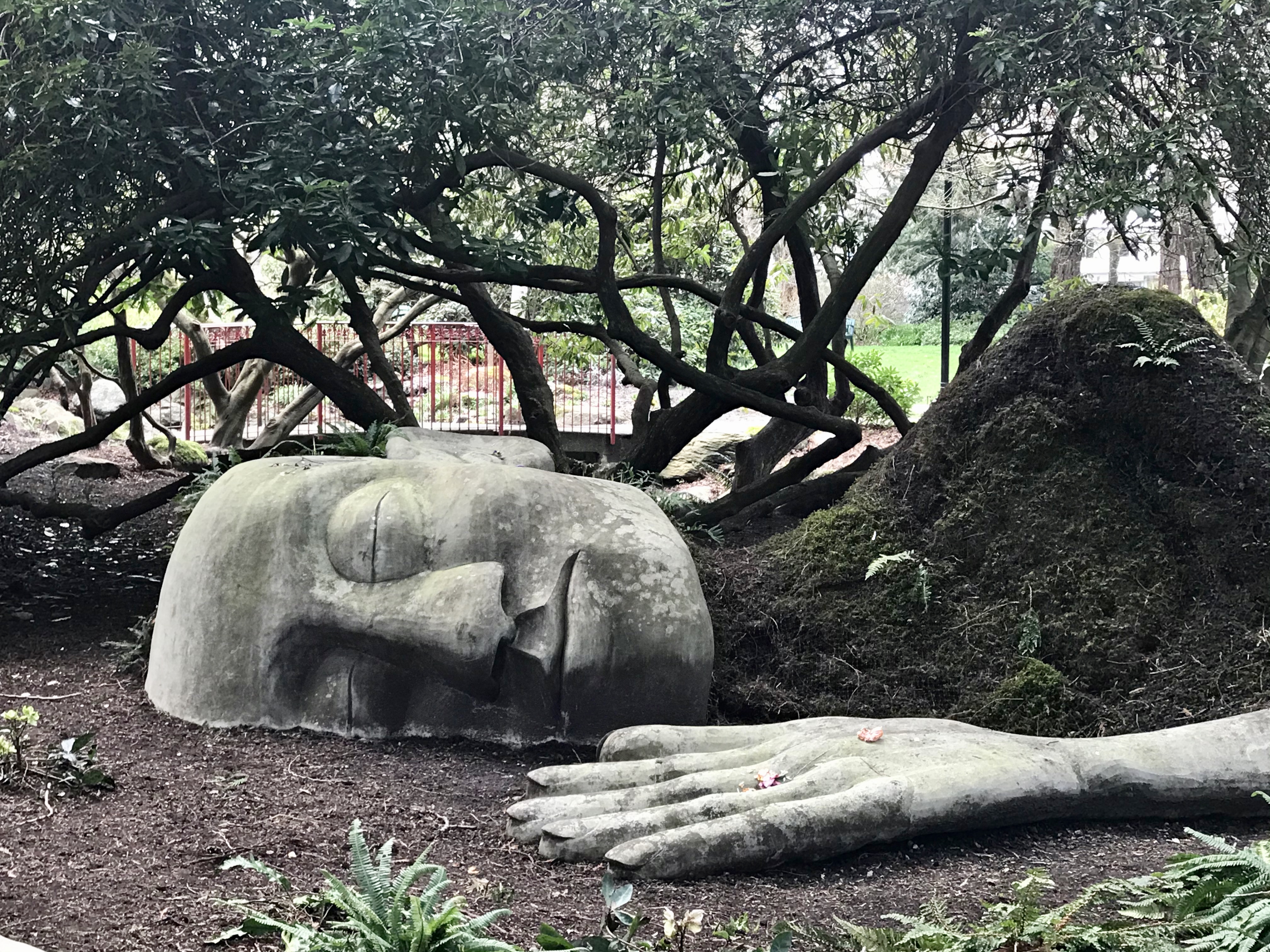
Moss Lady at Beacon Hill Park, Victoria, BC     Photo by Mitch Coggin

Neither the end or the beginning…

The story isn’t finished; the stories I connected in my last blog, that is. The story in the movie It’s a Beautiful Day in the Neighbourhood, the story behind the Jewish teaching Tikkun Olan (to repair the world), and my own story are linked in an odd conflation of time. I realize how life unfolds, not “in order,” but it emerges in disorder, maybe even haphazardly at times. The disorder engenders reflection and wonder when I pay attention.

My adult son asked me to expand upon the idea that systems of public education celebrate submission to standardized thinking and dictate acceptable social roles and norms. It was a tall order. Looking back through some of my own academic writing, I uncovered this story about a young man I tutored more than ten years ago. There is more to see here.

Along with the part of town where he lived, Michael was seen as lacking.  Michael didn’t measure up to either the academic or social expectations of his teachers or community leaders. He wore labels that schools generate and use to describe deficiencies and predict outcomes for a lifetime.

Michael’s dad, John, beamed that Michael had failed the test to qualify for a special class as a prospective high school freshman. His son was “too smart,” he said, to be accepted into the class that would separate him from the mainstream. John was looking for a tutor to teach 15-year-old Michael to read before school began that fall.

The director of the Neighbourhood Center contacted me to ask if I might help find a tutor for Michael. I had a long history with the community and knew the family. I decided that the tutor could be me.

During June and July, Michael and I met twice a week at the Center. He regularly brought a book of stories about his favourite cartoon characters, books from the library about dogs or famous people (like Albert Einstein) and his cell phone as reading material he wished to share. Considered a “non-reader” in school, Michael admitted he let teachers read aloud to him as he navigated his way through the school day, in and out of the special services resource room for extra help.

In our time together, Michael found his way to online reading sites (he particularly enjoyed Greek mythology for early readers), read signs in the driver’s manual I thought would be of interest to him, and played online family feud, one of his favourite games. He told stories about cruising the neighbourhood on his bicycle and about the 1964 Ford Galaxy he and his dad had recently purchased to fix-up. Together, we wrote down a few of his adventures to use as familiar texts that supported his rereading. To find another way for Michael to share his stories, I encouraged him to photograph the car he’d been telling me so much about.

Michael used his photographs to create a digital story that he wrote as a short narrative, read as a voice-over, and completed with country music he remixed to add to his video. We made an official-looking CD to share with his family and the Neighbourhood Center’s staff. Michael’s dad watched the video, listening to his son read with tear-filled eyes.

How Michael actually used literacy did not neatly conform to the linear standardized conceptions of what counts as “meeting expectations” at his new school. In contrast to the school community’s perception of Michael as a failed literacy learner, finding Michael in his own stories allowed me, his family, and the community center staff to see Michael in ways that counted in his life.

Yes, it was a Fred Rogers kind of finding. Michael’s story articulates a discourse of possibility that is what Fred Rogers had mastered.

At the end of the summer, I was preparing for a new semester and arranging for Angie, a community volunteer, to take over my weekly meetings with Michael. In our conversations, I eagerly shared: “he likes… he knows… he wants to find out about… he’s really good at… no, he doesn’t like to… he’s kind of scared about.”

Angie was enthusiastic about possibilities, not just for Michael as a reader—we both knew his strength and his struggle—but for Michael as a young man, growing into his strengths. Angie ended the conversation with:  We spend too much time remediating and not enough time encouraging.

Yes, to capaciously find the hidden light in each person; to lift it up and make it visible once again restores wholeness to part of the world that we can touch.