Choosing Each Day

Choosing life.  Choosing each day whom and what to follow.  Choosing each day how to pay attention and respond to what is and even seeing it as what could be.  I do believe this is a choice I make each day that counts.  There aren’t wasted days or days with nothing important that happens really.

This truth flowed through these words from Mitch’s sermon last week about Moses.

Why didn’t Moses get to enter the Promised Land?  If anyone had earned some time in the land of rest, it was the one who had worked more tirelessly than anyone to get the people there.  So why was he left on the outside looking in?  If that were the end of the story we would have have have to say that the summation of his life would only involve “He didn’t make it.  He missed out.”  You never see an obituary like that.

This sermon, based on the old testament story from Deuteronomy 34, recounted Moses’ final look at the promised land before his death and then his “obituary” if you will.  Mitch titled the sermon “An Unfinished Life” imagining that Moses would say he wasn’t “finished” with this life when he died. However, the lesson is how he lived his days not how he finished.

Part of [his story] Moses could tell and part would have to be told after he died.  First, the part he could tell.  You’ve heard about Moses and the burning bush; of enduring the plagues in Egypt before Pharaoh allowed the people to leave; of being chased by the Egyptians into the Red Sea and crossing on dry ground; of surviving the people’s grumbling, moaning, complaining, hunger and thirst in the barren wilderness when they all thought they were going to die as they marched toward the Promised Land. More mumbling, groaning and complaining, “Why did God send us out here just to die, we should have just stayed back in Egypt.”

Then God complied, “I’ll give them water.  Speak to the rock and from the rock it will come.” Moses mad, frustrated, and tired of people’s complaints at anything and everything– didn’t speak to the rock, but instead hit the rock.  In fact he lashed the rock. The people got water and Moses got heartbreaking words.

The heartbreaking words, that he wouldn’t go into the promised land are heard for me to hear.  I want happy endings.  But if I focus just on this part, on this disappointment however great, I miss the more important story.

After his death, what people remembered, or at least the writer of Deuteronomy chose to record for all time, was that Moses’ “eyesight was stellar and his energy never wained.”

…I think it means that Moses saw things that others didn’t see and that he didn’t give up when others gave up long ago. His obituary continues. His influence with other people was far reaching.  He had been an influence in Joshua’s life; so much so that people of Israel respected and followed Joshua because of what Moses had meant to Joshua and taught Joshua.

These verses indicate that the Lord know Moses “face to face”, knew him intimately and personally.

Do you think knowing the Lord face-to face means that you begin to look like God?  To resemble God’s character, to become similar in actions, attitudes and behavior?  Read on…He was unequaled for all the signs and wonders the Lord sent him to perform and for the mighty deeds and displays of power that he did perform.  Does that seem to mean that he did what God asked?  Even though he didn’t make it to the Promised Land, people were changed and people’s lives were influenced because of who he was and what he did.

This part wasn’t in the sermon but a few chapters before the writer of Deuteronomy reminds: We have set before us each day life and death, blessing and curse; therefore choose life.  These are choices that matter.
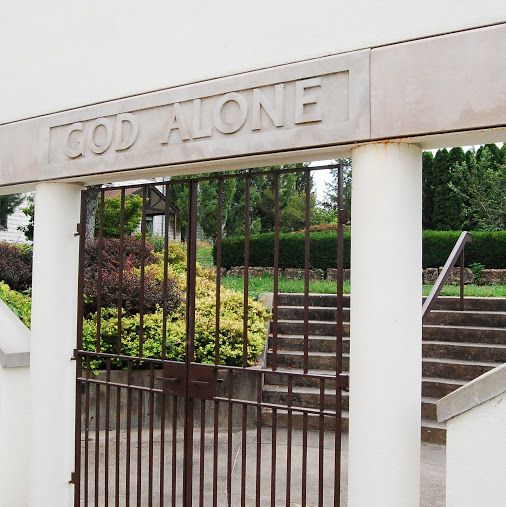
God Alone

god alone

This gate is the entry to the monks’ side of Gethsemani, the trappists’ monastery in Kentucky where I spent Mother’s Day weekend this year.  I was on the waiting list and this weekend was the first opening and perfect timing for my retreat there.  I didn’t think too much about these gates that were visible out my room’s window.  Instead I often looked at the small pond that was at the top of the steps in the photograph, a beautiful garden where I never saw a monk.  Actually, I entered the retreat house door that was directly across from this gate, a gate that was not open to me as a guest.

What strikes me now are the words “God Alone” that I came across in my morning pages from early in June. I’d already spent the weekend at the retreat house with the monks of the Abbey and was reading The Practice of the Presence of God, a compilation of writings of Brother Lawrence, a Carmelite monk in the 17th century.

On the day I wrote the pages I was avoiding something that was uncomfortable, that challenged my ego– or how I “looked” to others, feeling out of place, inadequate or self concious. Thinking about my resistance I wrote, “when I feel self-conscious or scared I’m thinking too much about myself;” quite a revelation for me.

Part of Brother Lawrence’s wisdom is that when he had an “outside” (he lived in a monastery) duty or upcoming event he didn’t think too much about it beforehand. He developed a satisfaction with what he did in God’s presence.

His example teaches people like me not to perseverate, as I sometimes (I changed from ‘often’ because I am learning) do, about what I will do and how it will go or even if I should go.

Brother Lawrence’s work as a monk was for God alone. To do something for “God Alone” I think means to take the human out of it, which I didn’t get at first and is becoming clearer.  To take the human out of my action means to take myself out of it…whatever the “it” I am doing.  To be unselfconscious– to not consider how I will look or what will happen to me or how/what it will do for me but to pay more attention to the people and the task before me.

To let God alone be in charge of the outcomes.

Decisions

Yesterday I had a big decision to make.

Well, actually it seemed like a big decision but it wasn’t. You see the washing machine wasn’t working…most of the time. The repairperson came, on time. He quickly accessed quick fixes like the machine was unbalanced on the sloping basement floor.  The basket couldn’t spin properly bumping up against the front of the machine. And, there is a problem of too much soap; filling the cap full, a learned practice reinforced by the size of the cap. Why didn’t the manufacturer change the size if that is all you are supposed to use in newer machines? Does anyone read the directions on a bottle of detergent?

Now to the decision. Technically, according to the diagnostic computer assessment, there was nothing wrong. “From my experience,” he said, “the control panel is going out. You can replace it with a new one or with a refurbished one, that will work fine—it is refurbished in the same factory with the same warranty as a new one—for $291.13.”

However, “the machine seems to working fine now. You can pay $84.00 service charge and If… and then…” more decisions within the decision. Simply fixing the washing machine wasn’t so simple.

Does it really matter what choice I make? I could spend $300 and the machine could work for 91 days (1 day past the guarantee) or I could spend $85 dollars and the machine will run for 2 more years or many, many other scenarios that easily clutter my mind.

Overthinking. Trying to make the “right” decision (that means I have control of the situation). Holding this small inconvenience, or even a big one, too tightly doesn’t strengthen my grip but weakens it.

Have no anxiety about anything...seems too glossy here, but true. Today is a new day full of possibility, even that the washing machine will work.

Certitudes

We take counsel with our certitudes, not our doubts and fears.

George Buttrick’s words, an excerpt from Prayer, have accompanied my own meditative time and even my thoughts throughout the day for a time now– most often when doubts and fears are my initial reaction to the day, the news, the new turn of events. Taking council with our certitudes is kin to “dwell on these things” from Philippians 4: 8 that frames this blog.  Whatever is right and true are certitudes.  That I am a beloved child of God who is always present in my life is a certitude.

Knowing that in my head is not the same as living that truth.  It is so easy to pay attention to my doubts and fears; to the what if’s or even the what is that seems to be true. These things seem more real. What if my application for a new job is just a few days too late?  What if they already have someone else in mind, someone they already know for the job?  I am unknown to them.  I don’t meet every single criteria on their wish list.  This and this and that and that would have to “work out” for that to even be a possibility.

Time for another certitude.

God equals abundance.  There isn’t one job or one book or one solution to each challenge. Certitude is beyond this one moment.  Coming into this Presence of certitude, of faith, Buttrick says is best as a by-product of a mind focused on God. It involves the work of living with the certitude of another realm that as one of my friends said is deeper than my hopes and dreams and values.

The crazy truth here is that there is a place of divine consciousness that is beyond time or circumstance where this kind of certitude meets my everyday living; where I are intimately connected to God’s presence. It takes time and work to get there and attentiveness.

This Presence will make itself known, writes wisdom teacher Cynthia Bourgeault, not by the principle of linearity– that is in my time and logic– but by the principle of synchronicity: meaningful patterns of coincidence.  Traveling mercies.

Traveling Mercies

I have been going more than usual this summer.  I’ve been to Ohio for a few days on three different occasions and to New Jersey, Arizona, and California.  That’s a lot for someone who really just likes to be home.  However, the time has been restorative and fun– to be in another place and time.

Traveling mercies.  People in my church travel to faraway places often so it isn’t unusual for requests for traveling mercies– which I interpret as safe travel, getting there and back home without too much incident.  When I was a young single adult and went to visit my dad in another state, he would pray a brief prayer as I was going out the door for traveling mercy.  And I guess that was answered because I always arrived safely even when the brakes went out on my car and I drove using the emergency brake for almost 100 miles.

Even after all my years, I struggle with the idea. What does asking really mean?  I do believe that God is with us– always.  I cannot rationally explain why planes crash.

I’m rethinking traveling mercies.

I am always traveling.  Trying not to stay in the same place I’ve been. Giving up old habits that don’t serve me and taking up new ones that do. Traveling through difficulties that do get resolved in unpredictable ways, often unimaginable ways. The joy is that there is a presence of hope, of possibility, of safe traveling–even when it doesn’t feel safe– that is noticable through this life and even into the next…

infinite time - clock

This image is titled “infinite time-clock.”  I do not know the original source. I first encountered it in a digital story created by a sixth grader, age 12, considering his life in the future.  He situated the image as going back in time wondering if he could do better in his life. I found the image again when I was searching for “eternal time,”  a concept that transcends chronological time.

I think a lot about time.  How long some things take and how quickly this past week went by.  Today I drove for four hours on the interstate that seemed like forever.  The truth, I think, is that time doesn’t matter– at least not the way I measure time.

To save time today I drove a little bit faster. I left clothes in the dryer. I only walked the dog down the street and back–not around the block or through the park.  I used that apple corer thing to cut my apple into wedges instead of a knife.  I still had to use a knife because I couldn’t get the “core” straight in the nice round hole.  So what did I do with all the time I saved?  I don’t know.

Maybe I need to pay attention to what I am doing in time rather than what I am doing with time.

One Day or Night

Therefore do not worry about tomorrow, 

for tomorrow will worry about its own things.

Sufficient for the day is its own trouble.  Matthew 6:34

Each day holds joy that will escape you if you are preoccupied with tomorrow or even an imagined tomorrow that may never come.

In the daytime, I can usually manage. But the middle of the night is a different story. Why do things– everyday conversations, an upcoming picnic, a job interview, my family troubles, the dog’s bad leg — become demons in the middle of the night?  The conversation is possessed with hidden agendas; I rethink my answer to every interview question; the dog dies and family troubles are born anew, and no one brought charcoal for the cookout. Irrational thoughts or worries?  And they aren’t the day’s troubles, they are between the days.

One thing I am learning is that the more I practice centering my thoughts during the daytime, the easier this is to do at night.

For several months I have been practicing centering prayer.Screen shot 2015-07-29 at 10.35.52 PM And yes, there is an app for that, that actually has been very helpful.  One of the encouragements on the app says “to persevere in contemplative practice without worrying about where we are on the journey.” I need to know that.

For this prayer choose a word or phrase to evoke God’s presence and action within and meditate on this word.  Just like in the night,  it is difficult to focus my thoughts on one word or phrase for even a few minutes. Guidelines for centering prayer remind me that when other thoughts come, similar to those errant intruders in the middle of the night, to return “ever so gently” to the sacred word or phrase.

I don’t practice centering prayer in the night, it is for the day, but the joy of this sustaining presence disciplines my memory. In the nighttime, when my own demons race around, to focus on a word or phrase, an image, or even the steadiness of my own nourishing breath helps me surrender to rest and let tomorrow’s troubles go.

A Vacation State of Mind

According to the urban dictionary, “suspension of disbelief” is the point at which you must give up all skepticism, and just accept what goes against all that you think you know.  We do that during a magic show or reading fantasy or even a happily ever after tale, and maybe even on vacation.

I just returned from several days, actually 9, at the beach with family.  On the way, I attempted to finish some work that I thought needed to be turned in before I left.  It didn’t and after my first day, even when it was cloudy and raining in sunny southern California, I didn’t think about it again.

On another day I heard some disheartening news. I was concerned, but realized I was powerless in the situation, except to send my love. The concerns were backgrounded as I turned my attention and thankfulness for the gentle breeze and sunshine floating on the surf.

How does that happen?  Maybe it is a mind trick or maybe it is another form of suspending all the belief I had about what is important or necessary at that moment.  Maybe it is freedom to pay attention to the gentle breeze instead of the family storm. Maybe the key is the “all that you think you know” part.  All that I think I know isn’t what could be or even what is. Henri Nouwen in Bread for the Journey says

Mostly we have just enough light to see the next step: what we have to do in the coming hour or the following day.  The art of living is to enjoy what we can see and not complain (and I’m adding worry) about what remains in the dark.  When we are able to take the next step with the trust that we will have enough light for the step that follows, we can walk through life with joy and be surprised at how far we go.  Let’s rejoice in the little light we carry and not ask for the great beam that would take all shadows away.

I can see what is before me: a magnificent sunset, my precious sister, a loving husband, a delicious piece of strawberry pie.  I could choose to see: work that is still not finished, what might be happening thousands of miles away, wallow in the what if’s.  It is a choice.  It’s not running from shadows that are real or pretending that the tensions aren’t visible.  It is “sustaining reality,” what is before me, right now, that is worthy of my attention.

Imagining God With Me

Imagining is a powerful way to practice the presence of God.  Particularly in the last year, imagining to know that God is going before me, not to carve out just one path, but many, has encouraged me.  Isaiah 30:27 reminds and reassures me of the kind of presence that a centering joy, the deep down presence of God, allows.  “And when you turn to the right or when you turn to the left..”  that doesn’t seem like indecision to me, it seems like there is more than one way to find God in our worlds.  No matter where I am, “your ears shall hear a word behind you.”  Ahhh, behind me and before me, I can rest in that image that God surrounds me, going before me to drop bread crumbs for me to follow and going behind me, like today, when I know I will leave much I do, unfinished.  But even if I am unsure, unfinished, the word behind me will be saying, “this is the way walk in it.” I imagine God’s whispering or turning my head in the right direction that shows me a way.  The trick is to trust that presence, to imagine God’s hand upon my shoulder, guiding, comforting, inspiring, lifting, a real presence that I can rest in, even when I am busy doing.