I might have been in grade 11 when I wrote my most ambitious paper for English class. I explored the question, “Is honesty always the best policy?” I have vivid memories of weaving through the stacks in our school library (after visiting the card catalogue) and intently trying to walk both sides of an answer. This wasn’t a casual topic choice for me and I can’t actually say what life experience fuelled my fascination with honesty. I still remember the wondering and researching but looking back I didn’t have an inkling about how reading and writing were, quite honestly, saving me.

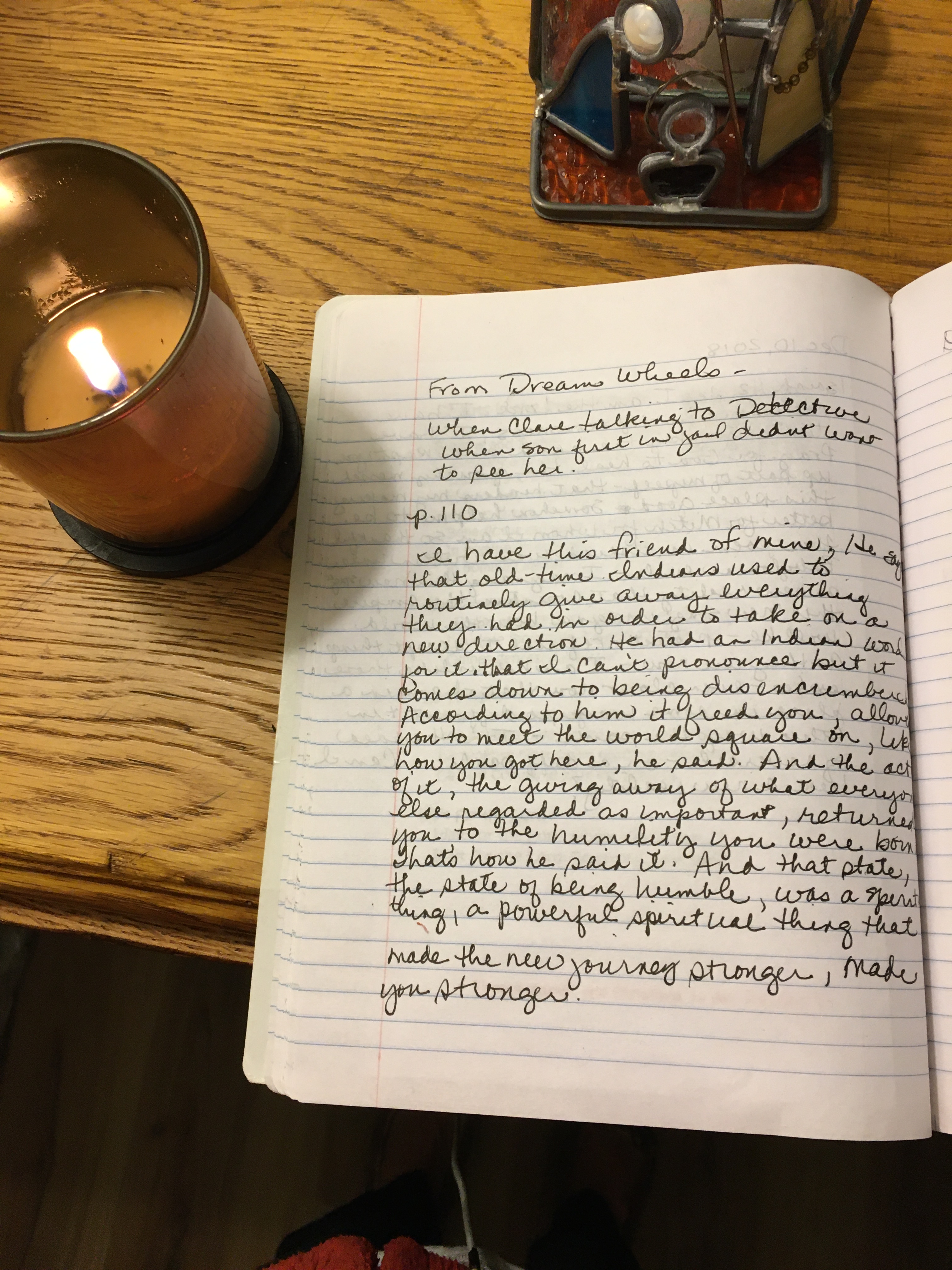
We all have the responsibility to live honestly—whatever that means. Over many years, I’ve circled around the concept of living “unselfconsciously” to alleviate fear and self judgement and second guessing about what is and what could be. Which brings me to my idea to go back 5 years and post raw material from my 2018 notebook and, as I wrote, to unselfconsciously listen to my life.
I planned to lift the words out of the pages of that notebook and into the blog without striving to find the perfect word to describe whatever internal story I was spinning. The truth is that in my last blog (December 7, 2023) I changed 2 words that I couldn’t seem to say again. They seemed tired and out of touch with what was my deepest desire.
In my old notebook was the familiar trope, “to have a successful and meaningful life.” Even though I said I would not edit the old writing entries except to include context, I changed those words. I changed the words “successful and meaningful” to “good?” with a question mark as another letter.
I suppose the question mark was my own disclaimer that “good” isn’t any clearer than “successful and meaningful” and that is definitely not what I hoped to describe. The idea that we hold the ability to strive, achieve, and “make” a life is a mistaken one. Sure those things happen but they aren’t the consequential parts. Perhaps, our life is response, moment by moment, born out in loving and honest relationship.
And as it happens, I was reading Mary Oliver’s book of essays, Winter Hours. On pages 19-20, she writes,
For [inherited responsibility] is how I feel, who have inherited not measurable wealth but, as we all do who care for it, that immeasurable fund of thoughts and ideas from writers and thinkers long gone into the ground— and inseparable from those wisdom’s because demanded by them, the responsibility to live thoughtfully and intelligently. To enjoy, to question—never to assume, or trample. Thus the great ones (my great ones who may not be the same as your great ones) have taught me— to observe with passion, to think with patience, to live always care—ingly.
a worthwhile response to what we have been given
 Attentive to Joy