Unsheltered View

I read a lot, all kinds of books.

I haven’t read The Midnight Library by Matt Haig. I learned about the book from one of those “lists” that proliferate this time of year: books most checked out in the Public Library.

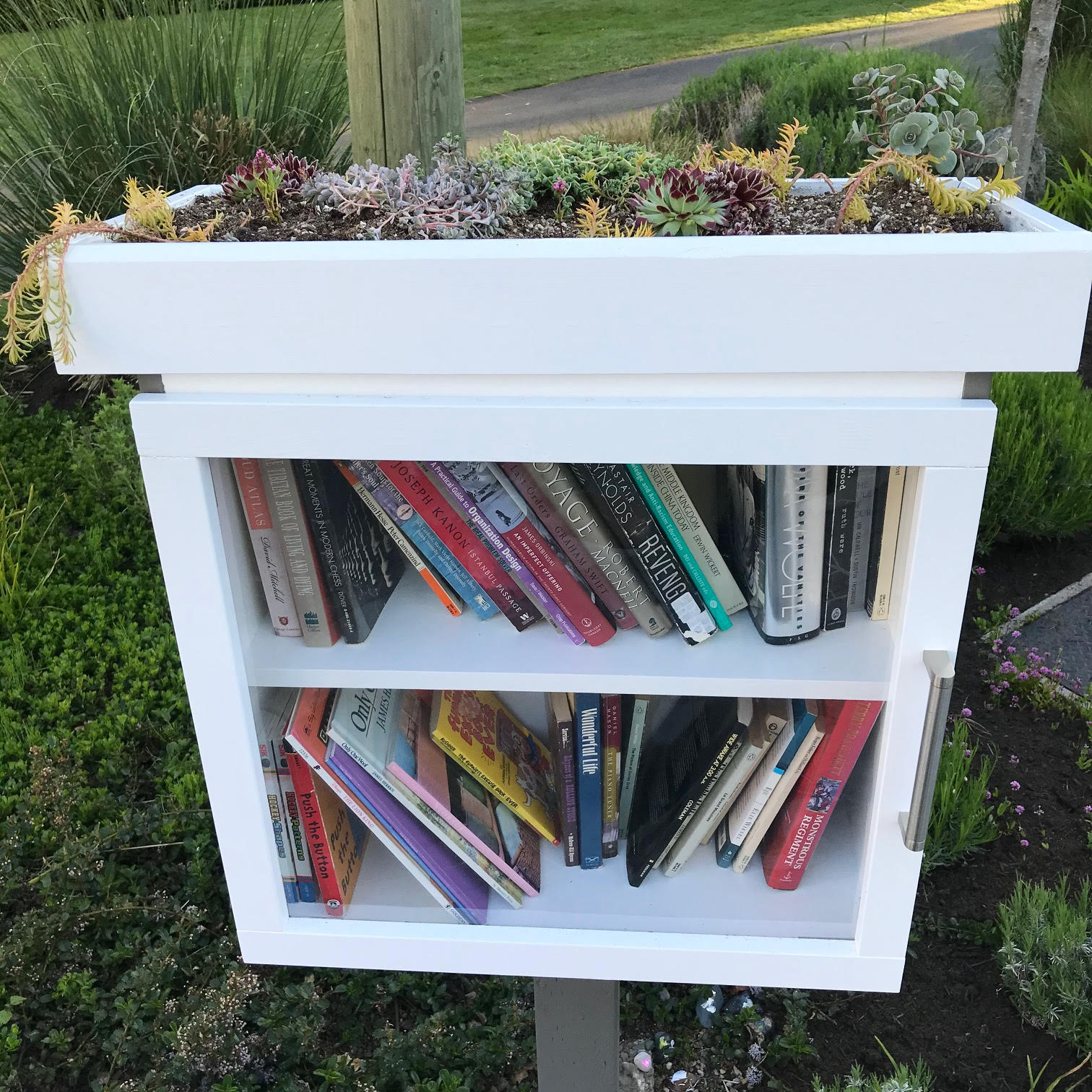
Any library is my good friend. I’m rarely in my public library for more than a few minutes. I pick up my books that are “on hold’ and maybe glance at the “fast reads” that, along with self checkout, are just steps inside my local branch.  My city also has over 300 “little libraries” that are homemade book exchange boxes in front of homes, schools and businesses. We have two on our block.

Linkleas Avenue Little Library

I recently picked up the well-read title, Educated,(that i’ve avoided for years) and award winning 419 by Will Ferguson (yes, brilliant) from the little library nearest me.

Okay, back to not reading The Midnight Library.  I overlooked the sci-fi/fantasy genre label as I read this hook:

Between life and death there is a library, and within that library, the shelves go on forever.  Every book provides a chance to try another life you could have lived.  To see how things would be if you had made other choices…  

Why do I read so much? It is more than to live another life through the story—real or imagined or the fine line in-between. I read because other peoples’ words and experiences name a little tiny bit of the mystery of my life.

I just finished reading Barbara Kingsolver’s Unsheltered, the integrated and parallel tale of two eras. It’s not unusual for me to fall in love with a book like this, but what was it exactly?

More than writing.  Barbara Kingsolver has a gift, not only with words, but in her ability to express things I cannot or do not easily name, not just with words, but with nuances of relationship between husband and wives, between adult children and parents, between mother’s and daughters, and between me and worry and the security of “home.”  In this novel, she subtly unfolds belonging I desire but can’t easily express.

The way the protagonist Willa sees her children, now adults, somehow made me see through the puzzlement of my own experience.  Willa’s sense of them evolving—the illusion of her son Zeek from childhood as accomplished and driven and her seemingly wild and untethered daughter Tig.

Touch your own mystery in this conversation between Willa and Tig, mirrored in what Mary Treat told her neighbour, Thatcher.

[Willa] “My mother used to say when God slams a door on you, he opens a window.”

Tig gave this two seconds of respectful consideration before rejecting it.  “No, that’s not the same.  I’m saying when God slams a door on you it’s probably a shitstorm.  You’re going to end up in rubble.  But it’s okay because without all that crap overhead, you’re standing in the daylight.”

 “Without a roof over your head, it kind of feels like you might die.”

“Yeah, but you might not.  For sure you won’t find your way out of the mess if you keep picking up bricks and stuffing them in your pockets.  What you have to do is look for blue sky.”

Along side this conversation is Mrs. Treat’s wisdom: 

“Without shelter, we stand in daylight.”

Either way, I figure, I have to look for the light in the blue sky and let go of my own bricks.

Oh, and I put The Midnight Library on hold at the Greater Victoria Public Library, Oak Bay Branch.  I’m 84th on the list but there are 42 copies—evidence that I made a compelling choice, but I will see in a few months—unless a copy shows up in one of the little libraries I might pass.

The Rightness of My Life

My prayer this morning or maybe it is a hope—I guess I’m not sure of the difference—is that I am learning to trust God and other people. 

Trusting enough to know, as Frederick Buechner writes, “the deep down rightness of the life God has created for us and in us” no matter how all the things I am concerned about unfold.  That I can let go of my self and maybe let go of my conceptions of God and what life should be, to risk both doing and not doing.

Right now, I will finish the laundry I started and be grateful for this place we’ve been entrusted with for a time. 

I will pray for my family with the Ephesian prayer to know the Love of God, to be strengthened inside, and that Christ may dwell in our hearts as we are being rooted and grounded in Love. 

And the greatest and surest risk may be to trust that the power at work with us is able to accomplish abundantly far more than all we can ask or imagine.  

The Thread

The Way It Is by William Stafford

There’s a thread you follow.  It goes among

things that change.  But it doesn’t change.

People wonder about what you are pursuing.

You have to explain about the thread.

But it is hard for others to see.

While you hold it you can’t get lost.

Tragedies happen; people get hurt

or die; and you suffer and get old.

Nothing you do can stop time’s unfolding.

You don’t ever let go of the thread.

I came across William Stafford’s poem in April, almost half a year ago. I began wondering, what is my thread?  I wasn’t sure it had a name. Oddly (or maybe not) what came to my mind was when my parents were dying and I suspended everything else to be together, my sisters and I, and whoever happened by in those weeks.  I’ve always measured other significant experiences alongside these.

I couldn’t name the “it” of the weeks I spent with my Dad when his cancer seemed to take a turn.  I had visited him several times after his diagnosis.  We’d get Pizza King’s cheese pizza and talk on the way there and back.  I was “in the driver’s seat” literally now, a listener, and a caretaker. We shared our love of pizza that took me 40 years to know. 

Growing up, I often had a contentious or non-existent relationship with my Dad. After he retired, he moved back to central Indiana, where I had also returned after years away. When I dropped everything and drove the two hours to his house on a Tuesday without plans for when I might return home, I was surprised the going seemed so natural. 

For the next five weeks, I was an intimate observer of my Dad’s life and his death. That was an extraordinary gift; I was simply present with him. I didn’t remember my job that someone else was now doing for me.  I wasn’t concerned about my husband and young adult children.  I didn’t remember the harsh words my sister and I had shared or my younger sister’s distance from extended family affairs.  Now we spent our days together as the family we never were.

We weren’t aware of the gratitude that held us. At first my dad joined our easy conversations about uneasy subjects until it was only with his eyes that he loved us, a fact we now believed. We rested in those who brought food and medical care and the steady presence of my Dad’s youngest brother.  Gratitude was the divining rod that moved among us that made God’s faithfulness visible.

That’s the uncanny thing.  I was taken beyond my circumstance. I wasn’t too concerned about what I should do or think or be or wear or eat or worry about.  I imagine now that I held the thread of the possibility for something else, a wholeness that lies beneath even my greatest fears.  I somehow opened up to some goodness that was beyond my usual view. 

How do I grab on to this thread?  I’m not sure but I know it is possible, if even for a moment.

If even for a moment, to grab hold of the thread that frames a different way of seeing.  I don’t get lost or react to whatever is happening in my life.  And as my compline prayer reminds me: be present, O Merciful God AND Me …so that we who are wearied by the changes and chances of this life may rest in your eternal changelessness; through Jesus Christ our Lord.  Amen.

The Good News of Not Enough

I guess you would say this blog includes a “guest writer.” I asked my dearest friend, my husband Mitch, if I could include his meditation from Sunday’s service (2 Corinthians 12:2-10, Mark 6:1-13) in this blog. I’m not sure why this week seemed especially impactful for me. So, I’ll just say to you what I hear him say often, “listen for a word for your life.”

I should have been relieved.  But when I heard restrictions for church services had been lifted for phase 3, I was suddenly overwhelmed with all of the “what if’s.”   We’ve been in a bubble that felt safe and controlled. What I thought was a safe zone, I would no longer have.  I feel comfortable and in control when I wear my mask and physical distance.

In Mark 6,  Jesus goes back to Nazareth and preaches in the temple.  The hometown crowd  was initially impressed with Jesus’ fame  but the more he talked, they took offence with what he said and did. How could this man they knew as a boy say and do these unconventional  things? Jesus was amazed at their unbelief, but his focus was on the disciples.

Jesus sends the disciples into the villages two by two and he gives them their first instructions.  Here is what you take, this is what you don’t take.  Here is how you respond to people who aren’t receptive to you.

I call Jesus’ instructions the  good news of not having enough.  Jesus provided limitations and boundaries to help them do their job of ministry.  He ordered them to take nothing with them but a staff. The staff was to help them walk but also to ward off animals. Take no bread, no bag, no money in their belt, wear sandals but don’t wear two tunics.  When they entered a house they were to stay there until they left the place.  If no one would welcome them, they were to shake the dust off their feet and move on. 

It is important to focus on not taking more than we need.  Wherever you are, that [moment]  is your focus. Do not look around or look out, do not depend upon things outside of yourself.  Don’t rely on what is in your hands but what is in your heart. For 18 months, we’ve had to focus on the present because the only future we could grasp was day by day.  Was that a weakness?

2 Corinthians is really about boasting of your weakness. Paul talks about being given a thorn in the flesh and asking that it be removed. Paul was reassured by God  that  “my grace is sufficient for you, my power is made perfect in weakness.”  Paul is content with his weakness; knowing that when he is weak, God is strong.

Throughout 2 Corinthians, Paul balances his struggles with God’s sufficiency.  In almost every chapter,  Paul describes his  despair:  he’s been hard pressed, but he hasn’t lost heart; he’s been struck down, but not destroyed.  He has been able to endure, he’s been able to sustain persecution and hardship. 

Part of Jesus’ challenge to the disciples is not to take more than they needed. As humans, we want to be prepared.  But Jesus would have them consider that the good news of not having enough is that Jesus’ ability and power is made perfect in weakness.  God’s  sufficiency is made perfect in our weakness.

The disciples might have thought they needed two tunics and money for the journey. Our caution moving forward is us filling our backpacks with what we feel we need  because it is what we needed before.  Our challenge is not just to go back to the way it was because that was comfortable.

How do we learn from this moment?  If all we’ve done is wait until we “go back to normal” then we have wasted this time.  What has this time taught us about feeling insufficient or not knowing what was around the corner?  What do we really need? 

Frederick Buechner tells about meeting Agnes Stanford, a layperson who was well known for her prayer practices.  He recalls,

The most vivid image she presented was of Jesus standing in church services all over Christendom with his hands tied behind his back and unable to do any mighty works there because the ministers who led the services either didn’t expect him to do them or didn’t dare ask him to do them for fear that he wouldn’t or couldn’t and that their own faith and the faith of their congregations would be threatened as the result. I recognized immediately my kinship with those ministers.

The crowd that knew him too well and couldn’t understand his authority tied Jesus’ hands behind his back. Jesus prepared  his  disciples for the rejection that they were sure to receive  because he knew that their hands would be tied just like his hands were tied by unbelief.  Jesus  cautioned the disciples  about tying their own hands by filling them with things that were comfortable and familiar and would  give them confidence and assurance they had what they needed.  It’s not your own resources  that will  prepare you, it’s the things that happen on the journey.  Trust your own perceived weakness, trust your own insignificance because as Paul taught throughout 2 Corinthians, it is our weakness and our struggle that makes perfect God’s strength and power working in us to do what needs to be done.  The good news of not having enough.

Dandelions and Daisies

‘God knows our timetable,’ that’s what Mitch said this morning.  It was about finding a different place to live.  We have to move because our landlords are moving back to Victoria and will live in this house.  We knew this would come and yet, we also didn’t think we would be here longer than three years and we are.  This adventure (another word for unpredictable turn in our lives) has been a kind of fly by the seat of your pants kind of unfolding.  Mitch’s assurance to me was about our move to another rental, however, it illuminates a wider look around.

I still get anxious or over invested (another way to say the controlling and figuring out story of my life that doesn’t serve me well) in thinking about one thing. I get lost in the managing instead of a healthy surrender to the unfolding.  I live in that one place or one circumstance that I perceive or imagine is possible.  My fretfulness is a black out curtain that keeps me from seeing the majesty and grace right in front of me. 

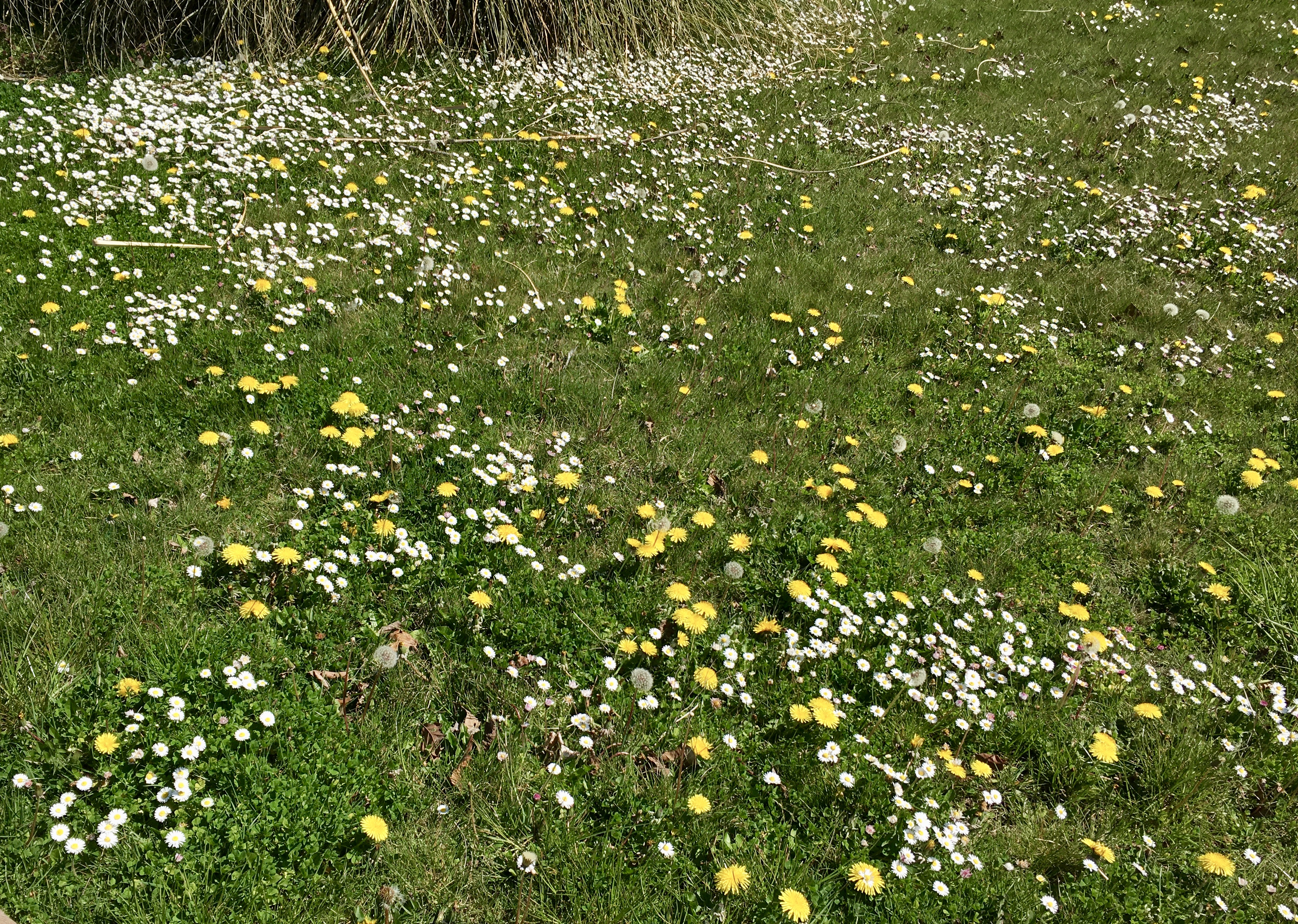
I don’t appreciate yard work.  My dad had three daughters and my job was lawn care. Specifically, I dug up dandelions with a long fork-like tool.  Like cleaning the bathroom, weeding dandelions is never really accomplished; bits of root hide in the dirt and those perennial seeds blow from the near and far.  Weed is an arbitrary designation—for dandelions and for those cute little daisies in the unkempt yards and wild places near me.

Earlier this spring, I stopped to take a picture of the yard at the corner of my street where an elderly couple live.  I’ve rarely seen anyone tending the natural growth surrounding their house. One the day I took the picture, the sunny yellow heads among the white petite ones were a happy and beautiful surprise of spring that comes without planting or planning.  All anyone has to do is not interfere, not work to pull them up because that doesn’t work anyway—the roots run deep.

So why are they called weeds? 

I learned that the dandelion plant isn’t actually technically considered a weed although the average person would probably describe it as such. Even the USDA’s Federal Noxious Weed List doesn’t consider dandelions a weed. Dandelions are incredibly hardy plants that grow well in most soil types and even though they prefer fertile soil, they have a high tolerance for nutrient-poor soil too. I read in our local newspaper that every part of the dandelion is edible (yes, for humans) and dandelions are an important food source for many creatures we may not notice.

I guess we might say that dandelions in the yard are wild and they can’t be easily contained. They are part of the natural environment.  Maybe dandelions are even countercultural since they don’t conform to our image of a well-maintained garden. And yet, those yellow flowers brighten the yard and the puffs of seeds they turn into capture most children’s imaginations.  In our adult efforts to manage, we lose sight of the wonder and beauty and usefulness of these wildflowers.

So, my months of daily attention to the rental sites online yielded lots of frustration and laments that also needed some reimagining.  We own a “big dog,” for example, that was a greater nemesis to property owners than a cat or a small yappy lapdog (don’t take offense). What might I take forward from the untended and unintended bounty at the corner of my street?

Part of our calling as humans, I believe, is to hold the dissonance between naming weeds or flowers.  The world offers itself to our imagination. We have an opportunity to be open and filled with wonder at what we cannot control, that we might name weeds.  Like the unfolding story of the house we will rent soon that was not on the rental market.  We glimpsed a possibility looking out of the corner of our eye, instead of peering straight into the conventional places. Again, I can stand back; I can think a little differently, and maybe even appreciate and awe in the beauty.

Lost and Kind

Everything we write reveals a bit of the life behind it.

Even my grocery list reflects where and how I live.  My eating and cooking habits have gradually changed over the years and especially this year since I spend more time cooking and looking at recipes. I had never tasted the sweetness of spot prawns caught in British Columbia waters. I’ve learned about different kinds of salmon: sockeye and Coho, Chinook and Pink. I painfully watched the salmon spawn at Goldstream Park near me in early November, imbuing gratitude to witness their struggle for new life.

Victoria is filled with small grocers and I shop at one, The Root Cellar, housed in a primitive building with large black tent-like structures attached and filled with an abundant array of fresh produce.  The only frozen vegetable I buy now is peas. Green peas my husband calls them.  That is a story, too.  When we first met I learned his family ate black-eyed peas and my family only ate peas—the round green ones.  That distinction remains on the grocery list, a reminder of the shape of family, after 42 years of eating together.

What I also know is that writing holds lives that are rewritten by the reader. 

In another blog, I wrote about kindness and I intended to include the poem, Kindness, by Naomi Shihab Nye.  I feel like I know her, even though I don’t really, since her writing has been around me often in my teaching life.  Her poetry needed a place of its own. here. And, the story that brought the poem with it. 

I listened not long ago as Naomi Shihab Nye told the story that gave this poem to her.  Naomi and her husband of one week were traveling through Popayan, Columbia.  The young couple planned to stay in South America for three months.  At the end of their first week, they were robbed of everything and a man on the bus they were riding was killed.  Life was interrupted.

Naomi recalls their shock, “And what do you do now? We didn’t have passports. We didn’t have money. We didn’t have anything. What should we do first? Where do we go? Who do we talk to?”  

As they sat on the plaza of that unfamiliar place, a man came up to them and was simply kind. He must have noticed their distress and asked, “What happened to you?” They attempted to retell their experience and he responded, “I’m very sorry. I’m very, very sorry that happened,” and he went on.  

As her husband left to go to a larger town to find help, Naomi recalled that she “sat there alone in a bit of a panic, night coming on, trying to figure out what I was going to do next, this voice came across the plaza and spoke this poem to me — spoke it. And I wrote it down.”

Before you know what kindness really is

you must lose things,

feel the future dissolve in a moment

like salt in a weakened broth.

What you held in your hand,

what you counted and carefully saved,

all this must go so you know

how desolate the landscape can be

between the regions of kindness.

How you ride and ride

thinking the bus will never stop,

the passengers eating maize and chicken

will stare out the window forever.

Before you learn the tender gravity of kindness

you must travel where the Indian in a white poncho

lies dead by the side of the road.

You must see how this could be you,

how he too was someone

who journeyed through the night with plans

and the simple breath that kept him alive.

Before you know kindness as the deepest thing inside,

you must know sorrow as the other deepest thing.

You must wake up with sorrow.

You must speak to it till your voice

catches the thread of all sorrows

and you see the size of the cloth.

Then it is only kindness that makes sense anymore,

only kindness that ties your shoes

and sends you out into the day to gaze at bread,

only kindness that raises its head

from the crowd of the world to say

It is I you have been looking for,

and then goes with you everywhere

like a shadow or a friend.

That’s how kindness is medicine, a “balm in Gilead” as the old hymn goes.  We are healed a bit in the moment we receive or give kindness because we’ve been broken or lost, and we all have.  And just like the stories of our lives that rest behind our words, if we are kind, we must see each other and ourselves with our imagination as well as with our eyes.  We must listen for the stories behind the faces and actions we sometimes don’t understand and maybe never will.

Then it is only kindness that makes sense anymore.

The Best Medicine

Be kind.  Be calm.  Be safe. 

For a year now our Provincial health officer, epidemiologist Dr. Bonnie Henry, has repeated these three imperatives at the end of every daily update. The three adorn t-shirts, billboards, and tea towels. A close friend, for whom the pandemic has only compounded significant life challenges, said that’s what seems most important to her right now—kindness.

In an interview in our local paper this week, Dr. Henry elucidates how kindness is not just about being nice. 

Kindness is about understanding that we’re all connected, there is a common suffering, and we can’t always know how someone else is holding themselves together.  Some have support, while others don’t.  Rather than reacting, we need to take a breath and have compassion.

Maybe connection is kindness. 

Each week I email a Sunday lesson for the children in our congregation.  We are fortunate to have a curriculum that emphasizes contemplative practices.  A couple of weeks ago, one of those practices was to help us think about God by remembering God’s creation and by observing God’s way.  Each evening, we remember what we did and saw that day using these suggestions:

I’ve been ending the day answering these questions myself most evenings and noticing matters.

  • Sit quietly for a moment.
  • What beauty do you remember seeing in the world today?
  • Give God thanks for creating the beauty in our world.
  • When did you see someone showing God’s love to someone else?
  • Give thanks for teaching us how to be loving and kind.

The street where I live has no sidewalks and is only accessible to enter from the north end except for walkers and cyclist.  So, it not unusual for people to literally walk down the middle of the street and that is what I observed as I set out with the dog in the late afternoon.  Two men (I am assuming dads) and two tiny girls were walking; the girls in the middle of the street, holding each other’s hand.  They were dressed appropriately for the cool day in long pants and jackets and a tulle skirt happily bouncing as they walked.   As one of the girls turned, I noticed the tiny cloth mask (pandemic style) she also wore. I couldn’t help but smile. 

As my dog and I approached, the dads alerted the girls to move over so we could pass.  It was a privilege and joyful to walk behind them, but we passed and went on down the street, lighter and kinder, too.

That evening when I reflected on those questions from our Sunday lesson, I smiled again as I remembered that moment—beauty and kindness walk hand in hand. I live in an astoundingly beautiful part of the natural world and on this day, those two little ones walking offered me, simply an observer, a gift.    

Robin Wall Kimmerer, plant ecologist and author of Braiding Sweetgrass, understands kindness as a medicine that arises out of vulnerability.  The medicine in that vulnerability is an awareness that regenerates kindness and compassion.

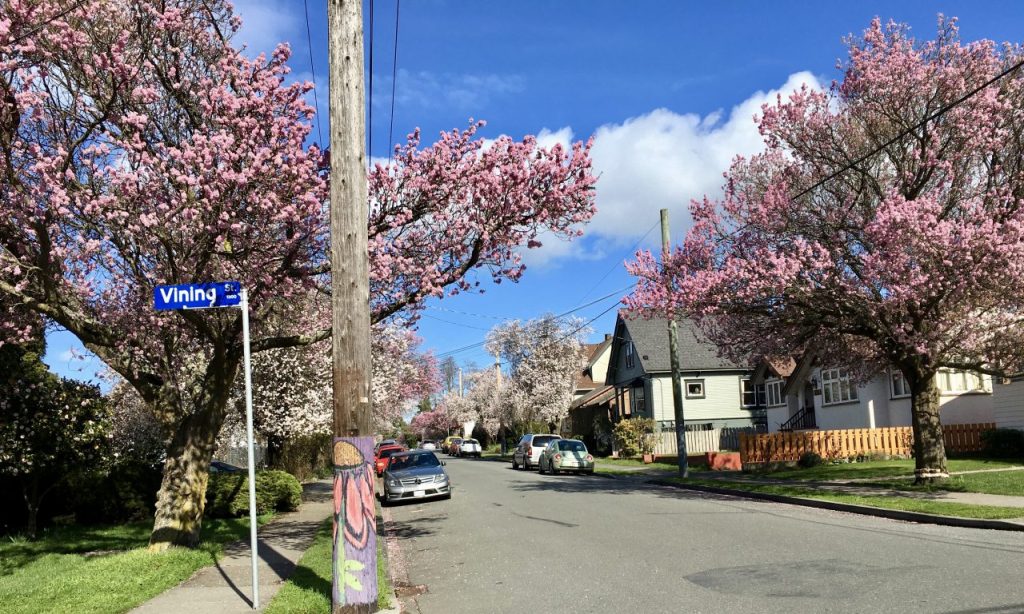
It is cherry blossom time in Victoria.

Listen and Hear

I listened to my husband Mitch tape his meditation for Good Friday.  I co-opted his insights because I need them right now.  I write because I’m the one who needs to hear. 

Mitch considered what the Romans, the Jewish leaders, the disciples, and Jesus’ family may have heard when Jesus said, “It is finished.”  But Jesus said those words to mean something for us.  The Greek word used in “it is finished” evidently means accomplished.  Jesus was saying it is finished for us; the struggle of worrying about all those things that we worry about—and for me today, suddenly that became a lot of things. 

When I was tidying up the kitchen this evening, I got an overwhelming feeling of worry, of being afraid about things I can do nothing about, really. At that moment, the urgency and impossibility of a myriad of what if’s and actual circumstances converged.  And that is what I heard Mitch say, that is what Jesus accomplished. 

It is finished is what Jesus meant when he said: “Do not be anxious about tomorrow, for tomorrow will be anxious for itself.  Therefore, I tell you do not worry about your life…can any of you by worrying add a single hour to your span of life?  Let not your heart be troubled, believe in God, believe also in me.”

I need to hear that again and again because I forget or maybe I don’t believe my life today.

Listen and hear, Jesus say, Peace I leave with you; my peace I give to you. I do not give to you as the world gives.  Do not let your hearts be troubled, and do not let them be afraid. Listen.

Mitch ended saying that Jesus’ last words and the spirit of those words declares that life’s greatest obstacles, even death itself, no longer need to have power over us. 

As Buechner writes to me, “unclench the fists of your spirit and take it easy.”

It is always something.

It is always something.

There was a line in Mitch’s meditation this week that got my attention. (The 8 minute meditation replaced the Sunday sermon, the new normal.)  It was one of those moments of recognition when we read something that describes or illuminates our own experience, an experience we haven’t really had the words to accept. 

The Israelites were first afraid of Pharaoh and his punishment, then the army chasing them, then the wilderness where they were headed.  Notice how their fear moved from place to place, person-to-person, and event to event.

I know what it means to lead with fear.  “What if’s” catch me before I do seemingly inconsequential and radical things. I’m afraid of how I will be perceived; I’m afraid of not doing enough. I am afraid of not knowing the ‘right’ thing, the most beneficial thing.  I don’t have to go back too far to recognize my own pattern.

When we lived in rural North Vernon and began planning our move less than 50 miles away, I was so afraid to tackle the housing market.  I did nothing to look for a place, even when I was there for school several days a week.  I was afraid of the cost and competition in the larger university town. I was afraid of the risk of living into that new unknown.

In a year or two, I was afraid Mitch’s job would end and then what would we do next?  Then I worried about how we would physically move two States away when I was the one with the new job and our dog had surgery, our daughter got married, and a close family member was critically ill.  And like all the times before, people, places, and events unfolded in time not my own.

Oddly, when my job ended at that next place, I wasn’t afraid of what was ahead. Maybe I was leaning in to the in-between with openness instead of fear, if only for a while. Until, I knew what was next.  Until, I knew that we would be moving across the country and into the next.  Again, I was afraid that we wouldn’t find a place in a city with competitive and costly housing, immigration challenges, and an island with no roads to get there.

I could go on – all the fear of being settled or not, of immigration unknowns, of getting older, of distance from our family. I never thought about a pattern of fear moving between people, events, and places.  And again, where will we be next?  There is always a next.  And maybe, that vulnerability is what I ‘m most afraid of.

I never named my anxious presence fear.  I intuited that I am just trying to get it right, this one life. I long to belong, to find my place, to be settled, to be home. 

“What would my life be like if I wasn’t afraid?” might seem the logical question to ask.  But maybe, I can see my way through by asking, “how do I fall through the fear to the other side?”

I can feel a wee bit of panic coming now, and I can feel it go. Moment-by-moment, I have the ability to let go of control, let go of security, let go of my desire to change the situation, and open to the spaciousness of acceptance.

In a prayer routine I wrote for myself more than ten years ago is this step: take counsel with my certitudes, not my doubts and fears.

I’m not exactly sure where I found that phrase, but it doesn’t matter.  It is true. 

I am certain that in all those transitions of my life, I have always had enough to take the next step.  I am certain that God is taking that step with me.

Moses answered the people, “Do not be afraid. Stand firm and you will see the deliverance the Lord will bring you today…. The Lord will fight for you; you need only to be still.” 

It is something.

Another Foot

I believe that living here is a gift.  Sometimes the offerings come, like in this case, sheltered in a lush stand of trees in the midst of an ordinary day.

“Since Jesus came into my heart” is a phrase and a song I heard often growing up.  Likewise, I was told we are the hands and feet of Christ in the world.  The language of my Christian faith oddly seemed to be wrapped up in my physical body and seemed to contradict the evil nature of the human form that I was also taught. I think I never quite believed that the later assertion was really the whole truth.

I took a walk with my friend Liz last week. We turned off Shelbourne Street and onto a path between a large grassy green space and a stream full of winter rain. Liz calls the path through a stand of trees “The Cathedral.” 

We have walked this path before in silence, to savour the mystery of this hidden sanctuary. When we walked last week, Liz was telling me about a poem she’d memorized.  She asked if I’d mind if she recited the words as we walked.  I didn’t mind.

She began, “We awaken in Christ’s body, as Christ awakens our bodies. There I look down…”

She was in front of me a bit and we were keeping our safe distance.  I was looking down and as my foot maneuvered the tree roots I heard, “He [Christ] enters my foot and is infinitely me.”  I felt tears come and self-consciously willed them away, realizing Christ was in me, not just “with” me, as I often imagine. 

The next words I heard were scattered: whole, in His light, the beloved, in every last part. 

The hymn, as the poem is called, were written by Symeon the New Theologian (949-1022), a Byzantine Christian monk and mystic, who believed that we have the capacity to experience God’s presence directly.  We are being “oned” into our Lord Jesus, as Julian of Norwich also expressed, a few hundred years later.  Isn’t that the same union with God that the bible is leading us toward when we say we ask Jesus into our hearts and act as God’s hands and feet in the world?

I’ve been trying to memorize the lines of the hymn myself and wake up to the words I know each morning.  I am reminded to open my heart, even though I sometimes close it up by evening.  I listen to hear again that everything that is hurt, everything that seems to me dark, harsh, shameful, maimed, ugly, or irreparably damaged is in Him transformed, and in Him, recognized as whole

And that kind of frees up my day.

We awaken in Christ’s body,

As Christ awakens our bodies

There I look down and my poor hand is Christ,

He enters my foot and is infinitely me.

I move my hand and wonderfully

My hand becomes Christ,

Becomes all of Him.

I move my foot and at once

He appears in a flash of lightning.

Do my words seem blasphemous to you?

—Then open your heart to him.

And let yourself receive the one

Who is opening to you so deeply.

For if we genuinely love Him,

We wake up inside Christ’s body

Where all our body all over,

Every most hidden part of it,

Is realized in joy as Him,

And He makes us utterly real.

And everything that is hurt, everything

That seemed to us dark, harsh, shameful,

Maimed, ugly, irreparably damaged

Is in Him transformed.

And in Him, recognized as whole, as lovely,

And radiant in His light,

We awaken as the beloved

In every last part of our body.

Saint Symeon the New Theologian