Whatever is true, whatever is honorable, whatever is just, whatever is pure, whatever is lovely, whatever is gracious, if there is any excellence, if there is anything worthy of praise, think about these things.
I have to confess that when I had the idea to blog excerpts from my old notebook I kept 5 years ago, it seemed like a good one. Then, today, the idea didn’t seem as engaging when my doubts surfaced. I’m going to stick with it, though, because I have learned that fear robs me of joy even when I’m not exactly sure what I’m afraid of.
My notebooks over the years are a respository of my interaction with what I am reading. From scripture to the latest novel, other peoples’ words teach, encourage, challenge, and surprise me and I record these conversations in my daily writing. It is difficult and generative for me to not edit those conversations and let them be. So here is…
Monday, December 3, 2018 (part 2)

The title of today's Advent reading (Celebrating Abundance by Walter Brueggemmann) was "Outrageous God."  The scripture, Isaiah 65:17-19

What I will learn to trust.

The first verse began, "I was ready to be sought out by those who did not ask, to be found by those who did not seek me."

I want that for XXXX-- to find God's spirit amid the recovery of self.  And for me, too.  All of us "walk in a way that is not good, following our own devices."

These verses seem to be words of judgement and consequences that are difficult to hear.  I want the fairy tale.  Yet, God is always present in our lives whether we ask or know or not.

The first verses of Isaiah 65 are our rebellious lives and the consequences but then there is a turn.  In verse 16-- blessing and faithfulness-- where "former troubles are forgotten and hidden from sight."

My re-writing as I let the poetry of verses 17-19 seep into my bones and heart and vision.

For I am about to create
   new reality for you
The former things you fear will
   not be in the forefront or
   come to mind
Be glad and rejoice forever
   in what I am creating
   for I am about to create
   your life as a joy
   and its people as a delight
I will rejoice in the new
   reality and delight in my family
No more shall fear be the
   basis for my relationships
No more will fear be my
   dwelling place.

The poem in Isaiah is outrageous, Walter B. says, and mine is too.  And I'm learning from the stories of Advent I am not the one who decides or orchestrates what is possible.

What I hear in Walter Brueggemmann's words is that in Advent we receive the power of God that lies beyond us-- the gospel's resolution to our spent "self- sufficiency," when we are at the edge of our coping.

It is good news that counters our cynicism that imagines no new things can enter our world.
Another snippet from my notebook I started closest to 5 years ago. As I said in the last post, this was a year of great change. Mitch and I moved from the southeastern United States to Vancouver Island in British Columbia, Canada. Both of our adult children also experienced significant changes in their lives that year.
The notebooks I’ve kept over the years are sometimes journal like and also are records of all kinds of reading and pondering. Just so you know, I’ve practiced my own version of the Ignatian spiritual practice of The Daily Examine and I write that in my notebook, too, and that’s what I did a bit on this day.
December 3, 2018

So what can I be grateful for in the past 24 hours?  Mitch-- who steadily calls me back from worry, from ignoring my own life, the part of his sermon on Sunday when he said, "We are not in charge or even know what is possible."

Mitch asked a question in his sermon, "How do we prepare ourselves to again birth the impossible into our lives and into our world?" Sometimes I feel like it is my job to provide God, myself, and my family a reality check.  Me thus deciding what is possible or not--actually I don't even go to fairy tales anymore.

I am grateful for a renewed sense of living my own life in Christ, even in the pain of now.  I am thankful for learning my way around this community and for this home.
When I was in my teens, I made decisions framed with this question: “How will this matter in 5 years?” As the eldest of three girls in a broken apart family, I became my own guardian angel. I imagine that five years must have seemed both a lifetime and, perhaps, foreseeable. The question levelled rocky terrain.
I’ve been stuck lately between too many ideas that seem too grand for me. So I decided to blog snippets from the notebooks I’ve faithfully kept for almost 20 years. Holding true to my five year frame, I will begin with the notebook that I started closest to 5 years ago and also happened to be a year of great change. My hope is to return to my intention when I began this blog— to unselfconsciously listen to my life—in public.
Katherine Paterson, whose novels touch a deep place in me, said in an interview about her novel, The Great Gilly Hopkins:
I wrote it as a confession. These stories don’t work unless you find yourself in them…that the deeper you go inside yourself, the deeper the reader is going to go. I was writing about my own fears and questions… Writers are very private people who run around naked in public.
Even though my blogs are publicly available, I don’t often share that I am a writer because it seems too private and even seems like a selfish thing. As I share raw footage from my old notebooks, I will listen again to go deeper inside and yes, run around naked in this little bit of public. I hope you will find yourself here, too.
Note: I was reading Walter Brueggeman Advent devotional, Celebrating Abundance.
December 2, 2018

Today I read that Advent is preparation for the demands of newness that will break the tired patterns of fear in our lives.  That is what I so desperately need to break out of the straight jacket of darkness, as Buechner calls it, that keeps me reactive and meeting challenge with brace rather than surrender and openness that allows for God to be present.

The prayer is for me.

God, visit me so that I might get carried away
to do obedient things that I haven’t done before
— kingdom things that I didn’t think I had in me.

Break the fear and inwardness that keeps me bound.  May I be ready to enter the place you have already prepared.
But whoever is joined with all the living has hope… Ecclesiastes 9:4a
We shall all, in the end,
be led to where we belong.
We shall all, in the end,
find our way home.
From The Beatryce Prophecy by Kate DiCamillo
Telling stories is integral to listening to our lives. We make sense of some aspect of living in other peoples’ stories we read. Months ago in the little library on Sea Ridge Drive —those side of the road libraries are another thing to love about Victoria– I discovered The Perfection of the Morning. Subtitled “An Apprenticeship in Nature,” Sharon Butala’s memoir is the story of how she “felt as if [her] soul had found a home” in a place she didn’t seem to belong.
Early in the book, Sharon mentions that books just seemed to come to her. Maybe that is true for her book and me. Five years ago at an unlikely time in our lives, we moved to Victoria, British Columbia, from the Southeastern United States. Moving from the foothills of the Appalachian Mountains to this island in the Pacific Northwest made possible a tangible new view of the world.
A world away from my view from Vancouver Island, Sharon ButaIa lived in the Western Canadian Province of Saskatchewan. She considered herself a city girl from Saskatoon, the largest city in the Province, population around 300,000. In her 30’s she married a second time and moved to the isolated ranch-land in southwestern Saskatchewan, a place she never even knew existed.
In awe of that extreme landscape and the loneliness to find social footing among the rural society, she came to realize how her life was informed and shaped by Nature in ways she couldn’t have consciously imagined. Sharon explained to a reporter that her husband, a true rural man, “understood the world in terms of wild things.” People and place form complex relationships.
So what would I say about my relationships of belonging in the world? I asked my husband Mitch for his perspective and I immediately sensed our answers would be in parallel universes. We read the same newspaper, sometimes the same books, walk down the same streets, live in the same house and neighbourhood; but how we see, how we feel, and what we remember are not always the same.
Perhaps, the gift of The Perfection of the Morning is that I looked back at how place has shaped and informed my life in ways I hadn’t exactly noticed. I have a sensory memory of walking with my Grandma Hollis along tree-lined River Road where she lived. I feel the majestic trees and mischievous squirrels and, yet, have no memory of the Wabash River that flowed alongside where we walked. I remember the biggest snowman, snow angels, snow forts, and my mom’s insistence that we play outside in every kind of weather. I was awestruck by cornfields of fireflies and suspicious of Bishop’s Wood’s briars and dark shadows. And as I grew older, there have always been trees: almost perfect oak trees, tall pines, a lone thorny locust, and friendlier hardwood forests.
The places I live are more than a mere background to my life. For me, it has not been one place that is part of me and I am part of it— all the places I’ve been have taught me and become part of the geography of me.
My reading of Sharon’s memoir became a prayer of gratitude for the landscape of the Pacific Northwest where I, too, came unknowingly. I have discovered a relationship, as Butala writes, “in a place where words stop” alongside the Salish Sea, Arbutus and Garry Oaks, and massive rock full of life. Finding The Perfection of The Morning opened a door to view how place shapes and sustains me.
Sharon Butala reflects on the turn in her relationship with the prairies,
Now when I looked out over the rolling hills and grassy plains I began to see, in place of emptiness, presence; I began to see not only the visible landscape but the invisible one; a landscape in which history, unrecorded and unremembered as it is, had transmuted itself into an always present spiritual dimension.
Is it possible that my longing to belong— the settledness that has eluded me over my life— has gradually been found in the landscapes that have sheltered me along the way? These relationships transcend whatever place I am physically part of and also weld me to the natural home of the created, the dwelling place that is larger than one city or region or country. How is it possible to belong not only to the visible landscape but to belong to the places of awe and wonder and humility where words stop?
Perhaps, as Sharon Butala reflects, “I’d been missing something from my understanding of the world and this new understanding involved more than other people and more than my intellect, but was also physical, somatic, an intermingling place and person.” I have experienced a shift that comes by living into imperceptible insight. Perhaps, instead of searching to belong, I live in the present, paying attention to what is— that can be seen and unseen— and leave room for what I cannot explain.
In his book of meditations, Places Along the Way, Martin Marty reflects on the story in Genesis 46-47 of Joseph’s brothers move to Egypt. The land of Goshen, “the best part of the land” was a place that promised hospitality to Jacob and his sons who considered themselves aliens in the new land. Marty writes that Goshen is still here for us: a place of refuge in beautiful surroundings. He warns that we would do well not to get attached to any place connected with human promise. We are to enjoy our surroundings without thinking of them as lasting.
Perhaps, Victoria is a “Goshen” for me: a beautiful place where we have more than been provided for, another respite along the way?
That is what I cannot know. I do know that this place of welcome, of challenge, of lessons, of fresh breath keeps us as we experience the invisible landscape that is beyond words.
On that Friday, I happened to read Mary Oliver’s poem “Invitation” which begins, Oh do you have time to linger for a little while out of your busyand very important day…
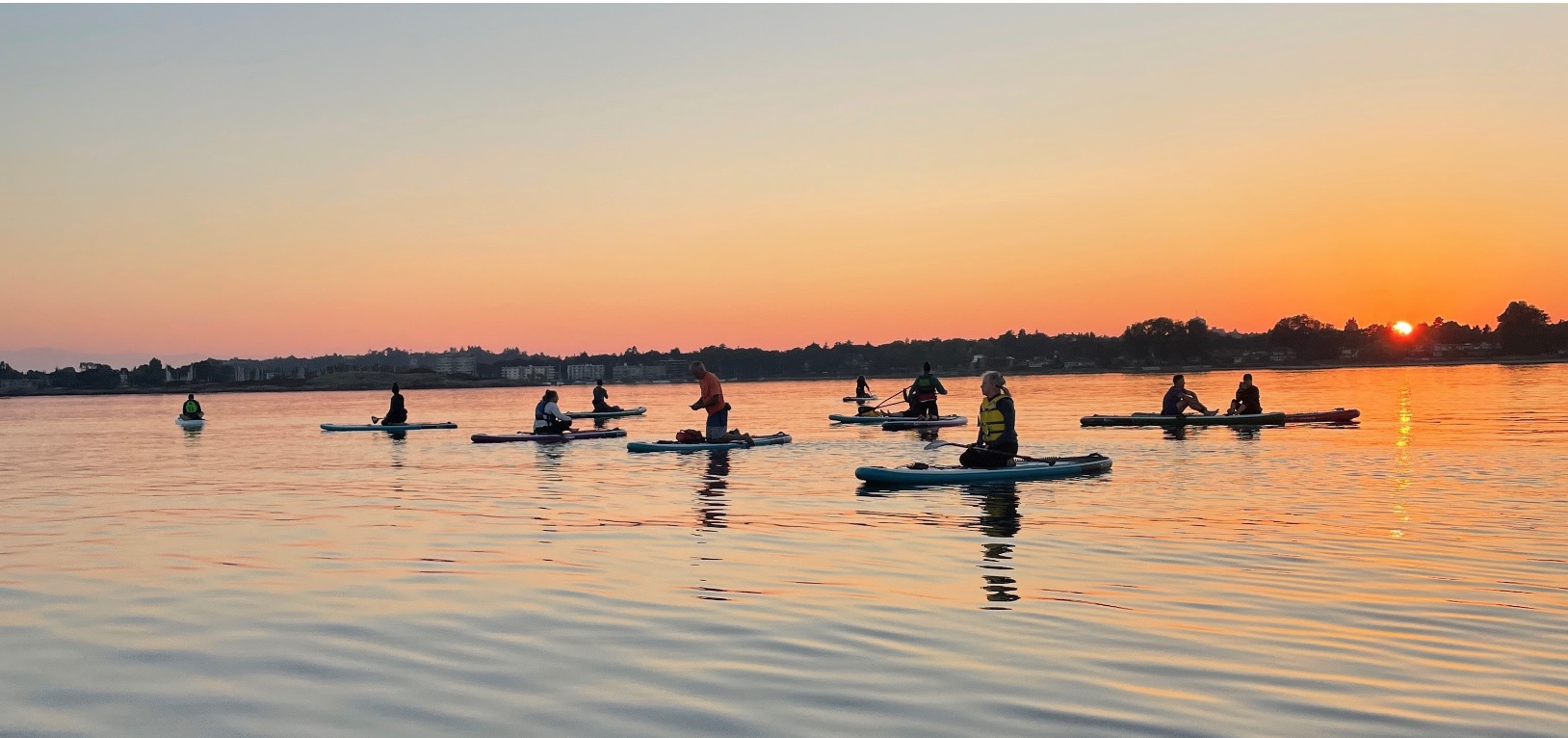
A couple of hours later, I arrived at Willow Beach for a morning paddle. I would be going out with three accomplished paddle boarders which caused me a moment of pause. As we left shore, Brian said we should go to Great Chain Island and Merisa agreed noticing it was a calm morning. I knew I would be challenged to keep up but I also knew these were kind people and it was a glorious day.
Great Chain Island as seen from another point in Oak Bay
And I did keep up. We went from buoy marker to marker pausing to assess the currents and scout our next crossing. I relied on the others who knew how to navigate those currents and knew how to find a resting place between eddies.
We crossed Mayor’s channel with the Great Chain Island at our right and the Chain Islets, 18 of them, to our left. There is no way to capture what greeted me that appeared otherworldly and loud and smelly. The spectacle of hundreds of birds and the magnitude of their voices was deafening. I lived Mary Oliver’s words that reminded me to take time to linger for the birds’ “musical battle” that they strive for melodiously, not for accomplishment, but for sheer delight and gratitude.
How can I paddle and the other things I will do today— calling a neighbour, cooking a meal, watering the lingering flowers—with that same awe and delight and gratitude instead of the anxiousness that I won’t be able to keep up or whatever other bits (or boulders) of worry rob me of that way of being. Sounds so easy. Why is it so difficult to pull off?
When I paddled through the current and came to all that noise—the wonder of all that was there—the sea, the seals, the one black shiny one who watched me pass with his head proudly above the water, and all those I could see resting on the islet in the distance. Below the clear water, I caught sight of the flamboyant orange sea cucumbers and the seal’s tail that darted past as we slowed and kneeled on our boards to go between the large rocks near the island’s steep shoreline.
We came around to the other side of the island and I felt the lightness of being held on the water. All the way back to Willow Beach, I was grateful for this wonder that took me out of my everyday life and oned me with the whole of life that surrounds me. As Mary Oliver describes,
I was surprised by the date of my last blog and that it was Barbara Kingsolver’s poem, How to do absolutely nothing. That seems like a lot of inactivity ago. My daily writing practices have dwindled this summer. Several times I’ve resolved to be more disciplined because writing changes me. However, I write a few lines in my notebook and then I simply try to get to the other side of whatever is looming.
I’ve been traveling for family things and tagging along during Mitch’s work trips. And, I’ve been reading a lot. From the middle of May until late July, I was gone for a month and a half of days. That’s disruptive for my body and mind imagining the safety of home. The stories I read along the way provided a comfortable place to be.
I found two lines from a much longer poem by W. H. Auden in a mystery novel I was reading. The lines felt right despite not knowing the larger context.
And we are introduced to Goodness everyday,
Even in the drawing rooms among a crowd of faults.
From “Herman Melville” by W.H. Auden
I would like to meet Goodness every day, among my own crowd of faults.
A wise professor I knew many years ago warned our class about “cherry picking,” lifting up the part from someone else’s work that meets our own needs. While that may be true in citing research, I don’t believe that admonishment holds for poetry or any literature for that matter. Language is malleable and shifting and illuminates what we cannot exactly see or name in our own crowd of distractions.
Traveling puts many of my faults on display—uncertainties—too many of them without the comforts of home. The furniture is too unfamiliar for me to settle in. When I am always on alert, it is not easy to relax. And then, I am tacitly reminded of the faults of others that divert my attention away from my own.
Anticipating uncertainties, whether known or unknown, is one of my challenges. I anticipate time with family will rekindle my failings. Daily routines are obscured by someone else’s schedule. I’m unsure how to “help” when helping, which probably means I’m trying to fix rather than support. I forget to just listen. The trouble is that I tend to turn all those uncertainties into problems instead of possibilities.
Why are my frailties my default mode? I’ll give you an innocuous example. This summer, I have Willow Beach weather conditions on speed dial (actually a click on my cell phone.) You see, I believe that even a prediction will protect me from the unknown if I’m going out in the water, where I need reassurance. Last year, when I finally got the courage to paddleboard instead of longingly watch, I just went. I put on the clothes I already had that seemed cold water-worthy and trusted the process.
Now, in addition to checking the temperatures and wind speed, I search the water when I arrive for signs of water movement. Is the tide high or low? Does the water look dull and gray or bright and inviting? Are there ripples on the water and a swell toward the shore? Is the hotel’s flag still in the distance or blowing in the wind? Granted I need to be safe but my diligence steals the wonder of my surroundings that are full of life.
The truth is that I paddle with people and places I can trust. If it is too windy, we change our location to the more inland waterway. If the wind comes up while we are out, we adjust our route to hug a shoreline or stay on our knees. I’m never alone and the few times I have fallen, I’ve gotten back on my board with kind encouragement.
Perhaps, I do not appreciate the rhythms of my life after all these years of self-conscious fretting; concerning myself with what isn’t mine to hold or figure out.
Whether Auden’s poetic phrase came from his own or another’s experience, the words help me make sense of my own.
Introduced suggests newness that is not of my own making. And I am introduced to Goodness every day, not because I am looking but because God’s Goodness is looking for me.
What caught my attention was the shape, an inverted right triangle of words nearly perfect on the page. I admit that I read it several times to appreciate what this poem held for me. Could I? Would I do that?
To borrow Eugene Peterson’s insight about the poetic language of the Bible, I’d like to say that this poetic language also “both means what it says and what it doesn’t say.” The first time I read the poem, I relished the actual words becoming the shape. I had a hunch that there was a how-to-lesson for me hidden in what the poem doesn’t say. Are these lessons I learn over and over, troubling things I do over and over?
How to Do Absolutely Nothing – Barbara Kingsolver from How to Fly (In Ten Thousand Easy Lessons)
Rent a house near the beach, or a cabin
but: Do not take your walking shoes.
Don’t take any clothes you’d wear
anyplace anyone would see you.
Don’t take your rechargeables.
Take Scrabble if you have to,
but not a dictionary and no
pencils for keeping score.
Don’t take a cookbook
or anything to cook.
A fishing pole, ok
But not the line,
hook, sinker,
leave it all.
Find out
what’s
left.
I remembered and responded:
If I have on sandals will I be able to hike where there are rattlesnake warnings? I walked the length of Whiffin Spit in the same shoes I wore to the wedding party.
Do I want to have lunch where there is a dress code? My favourite jeans have ink marks and bleach spots and my happy pants (the real name) have baggy knees.
I lived 40 years without a cell phone or the internet. But, what if a Tsunami is coming or democracy fails?
I do need a dictionary. I don’t always have to keep score. I let go of many cookbooks because “close enough” recipes are online. Is that just more work? I don’t fish but I do ponder my need for the “hook, line, and sinker” on most days.
The real trouble is I think too much.
In Where I Live Now, Sharon Butala writes about what I believe is true for me.
I think too much, I go over and over events from the past as if by re-thinking and re-thinking them I can finally tease out from between the strands of memory, intertwined as they are, the real meaning, the answers to the questions that I don’t even know how to ask.
I go over events before they happen in addition to rethinking what has already happened. I anticipate what someone might say or think or do and what I could say or think or do. My strands of memory are laced with future speculation or, perhaps, wishful thinking. What am I looking for?
There are moments I think I do nothing. Except, I cannot-not think about it. How do I stop all those words that pile up in not-so-pleasing arrays?
The truth is; I’m not sure. I will find out what is left when I leave the words behind.
Watching for the full moon as the sun sets near Willow Beach. I hope my mind was watching.
In God’s name, in God’s name, sell and buy at once.
Give a drop and take this Sea full of pearls.
Rumi, translated by Kabir Helminski and Camille Helminski
Language does have its limits.
Eugene Peterson was talking about the poetic language of the Bible when he said,
A metaphor is a really remarkable kind of formation because it both means what it says and what it doesn’t say, and so those two things come together, and it creates an imagination which is active. You’re not trying to figure things out, you’re trying to enter into what’s there.
For me, Eugene’s wisdom fits my experience here. Perhaps metaphors reframe what is right in front of us from a different perspective.
On Saturday, before Palm Sunday, I attended a contemplative wisdom retreat at the University of Victoria Multifaith Center. I’m not a note-taker so my remembering might or might not be exactly accurate, but it is true for me. Heather Ruce, our teacher, used the imagery of the ocean and the water inside our bodies as she discussed our conflicting human and divine nature; our physical bodies and spiritual being that we separate or see as two different parts of us. How does this water naturally flow together?
I thought immediately of the ancient prayer I say many mornings, “I awaken in Christ’s body as Christ awakens my body…” as a way of expressing this reciprocity. We say that we are not alone; yet, we speak of our divine companion in another reality. Our language belies the truth.
When I learned to paddle board, I was instructed to look toward the horizon when I stand up on the board. If I look down, I was told I would probably fall. This isn’t intuitive.
Even after I’m standing up, when I gaze ahead and take in the spaciousness, I see the world differently. When I steal a quick glance down to see if my feet are where they should be or notice the dark deep cold water and remember I’m far out from the shore, fear and uncertainty separate me from the grandeur.
Then on Monday of Holy Week, after Heather’s words activated my imagination, I read Rumi’s words,
Listen, O drop, give yourself up without regret, and in exchange gain the Ocean.
Listen, O drop, bestow upon yourself this honour, and in the arms of the Sea be secure.
Perhaps the Ocean was wooing me. On the cold and windy Monday, I copied Rumi’s poem on a scrap of paper and headed to Willow Beach. I walked down the first residential street with “beach access” to begin my communion in the water on the quiet end.
I sat down on a rock and took off my wool socks and hiking boots, rolled up my two layers of pants, and walked in at the water’s edge. The sea was clear and shockingly cool. When I walked looking out toward the horizon, I won’t say I didn’t notice the cold but the shock faded as I took in the expanse before me. Every now and then, I met another brave soul whose feet numbed in the wetness. Every now and then, a seal popped up to remind me of the abundant life here.
Repeating one line at a time, I walked into Rumi’s call to me, the drop, to listen to give myself without regret in exchange for the Ocean. Listen and receive this honour to be secure in the arms of the Sea, this Sea, that I could know in my physical body, the blustery refreshment for the worries I brought along.
This same water stretches across the earth. I, too, am part of that expanse. In her memoir, The Perfection of the Morning, Sharon Butala writes about these moments, “This is the place where words stop.” How can I keep looking out to the majesty and vast unknown and embrace the promise that holds me, that surrounds me in the same moment as the danger I perceive? Sell and buy at once, surrender my drop, and accept the abundance.
Listen, O drop, enter in the metaphors that are beyond words.
Here I am—in all kinds of angst this morning, selfish angst, not knowing how to be right now. It doesn’t matter the circumstances that I am so tempted to lay out before you. Those reasons for my discontent will be replaced on another day by other woes.
The redeeming part of this story is that I know to sit in my red chair and open to another way. Just the day before, I wrote in my notebook how I am here in the midst of lives around me that are making their way through. I wrote that I have seen the “obscure glimmering through of grace” in the lives of those I hold close. However, I seem to cave in to the news of the day, to an imagined outcome, to a real concern. I know I’ve been here before, more than once or twice. And I know what is needed: to surrender to the life force around me, to take a day at a time, to not feel such consequence, to let the click and clack unfold, to know I am not the fixer of anything.
My view from the chair at McNeil Bay
So on this day, I open what I’ve been reading and see the title, “Until,” before a few verses from Psalm 73. That Psalm begins,
Truly God is good to the upright,
to those who are pure in heart.
But as for me, my feet had almost stumbled;
my steps had nearly slipped…
Clearly this day, I am stumbling. I certainly don’t see myself as any version of upright or pure in heart. I just had a conversation with someone about their struggle. I thought I listened until I recognized that I was jumping into the exasperating narrowness of trying to explain my own (mis) understanding of things.
Until. In the middle of the Psalm, I listen,
If I had said, “I will talk on in this way,”
I would have been untrue to the circle of your children.
But when I thought how to understand this,
it seemed a wearisome task,
My life seems precisely like a worrisome task, overcrowded with thoughts of how and why and when and, oh yes, what if. And the things that are cluttering my way are of little consequence to the whole. I cannot see around the corner of my own self-interest.
Until I went into the sanctuary of God;
Then, I perceived their end.
Outside my dining room window, I see green. A large evergreen and prickly holly leaves shelter my view. Spring is showing; this is the city of daffodils and cherry blossoms. A friend left a bouquet of tulips at my door. The light fills this room.
Until I pause to look at the life that is in plain sight. Whether it is the sun shining brightly into my living room today or the rain the day before that greened up the grass and glistened on the dandelions.
Until I see the whole—the gift of God’s presence in this very place that I see only through my experience of gloom. Looking into the smallness, the dark corners that I’d backed myself into.
Until I turn around and see the vastness of the world and surrender to that spaciousness.
“It is because of this tender love that I need not ask anything of God for you. All I need to do is lift you up before his face.”
Many years ago, I came upon this truth that changed how I prayed for my children. They were becoming young adults and for me, their mother, they were in my circle of concern but not necessarily under my influence. They were forging their own ways in the world and I realize now how little I actually understood about their “inside stories.”
Those inside stories are how we interpret our experiences, form ways of seeing the world around us, and, yes, our mysterious imagining about how and what we become and do. We might be aware of this inner weaving or not. We don’t think our way into becoming ourselves, and that is true.
Prayer is another curious thing—particularly praying for those we love up close, like our children.
Perhaps Catherine of Genoa’s way of praying has always been with me—when I held those two precious lives as infants and knew they belonged to God and I couldn’t control their entrance and way in this world.
I imagined as a parent, many times that I did know what was best, but I didn’t really know. Now that my children are adults, a saint from centuries ago reminds me, again, that I don’t have to know. All I need to do is lift you up before his face. I don’t need to read God the dire news of the day or circumstances as I see them. I simply see my beloved ones as whole.
And so, I come to what Eugene Peterson says, “prayer is not a tool for doing or getting, but for being and becoming.”
“A shovel is a prayer to the farmer’s foot when he steps down and the soft earth gives way,” Carrie Newcomer sings. Prayer is fleshed out in many individual expressions. My writing and reading in God’s presence are a way of prayer as I listen for God’s voice in the unfolding of my life each day. Prayer summons my own “living” water.
In this kind of prayerful becoming, I learn to hold my adult children in a new light. I am not asking or suggesting or fixing or trying to change the people they are or their circumstances. Although, I do wish I could soothe their own learning and becoming. I can only open myself to seeing my children as God sees them, whether they recognize that presence or not.
I open myself to see the glimmers of grace and goodness that sit alongside the challenges, I too often envision. Love binds these things together and redresses them with new strength to draw upon for whatever lies ahead.
Now I must confess, I have prayed for my children all their lives, and who knows how that has impacted those lives. However, I am learning how praying for them is an act of my faithfulness, quelling my anxiousness about the details of our lives. Like the farmer’s foot on the shovel, prayer is my surrendering to a possibility that is out of my control or management.
Prayer is a doorway, an opening for another voice to spea.




 Attentive to Joy