Trading Talents

I love to think deeply and wrestle with all kinds of ideas. I have accomplished many things because of my ability. Reading over these blogs as I write (or other academic writing I do), I see how the thinking is sometimes confusing and I do wonder how all this matters. Thinking is also my shadow side. Overthinking, re-thinking, rehashing and even an abundance of ideas challenge me to be attentive to the moment. Overthinking, re-thinking, rehashing and even an abundance of ideas cause me to compare, doubt, defend, and be overly self-conscious. And somehow God speaks into the chaos.

In a newly released collection of Buechner’s writing, A Crazy Holy Grace, as Buechner’s words do, he offers another way to consider what I’ve been pondering. About the Parable of the Talents from Matthew 25: 14-30, he reflects:

I don’t know how you read it, but I take the talents—one gets five, one gets two, one gets one—as whatever it is that life deals us.

We are all dealt a hand of race, gender, family, place and even pain that we are to be stewards of. That’s what Buechner is personally writing about, being a good steward of pain. He recounts his father’s suicide and how his mother, brother, and he stewarded that pain. For me at this time, oddly, it is difficult to be a steward of my accomplishments that result from all that thinking.

How do I take the hand I’ve been dealt, the deep thinking self and maybe even those resulting accomplishments and do something that builds up the kingdom of God? How am I a good steward of those accomplishments? Is that thinking too much of myself?

Buechner goes on,

God does not sow the field of our life. He does not make these things happen…he doesn’t move us around like chess pieces. He does not sow, but he expects that out of whatever the world in its madness does to us, we will somehow reap a harvest…he expects us to deal with these things in creative and redemptive and life opening sorts of ways.

 Creative, redemptive and life opening sorts of way—that is key and might not mean the visionary off in the wild blue yonder (or internal yonder) kind of pondering I tend to do.

When I remember the time right after and even before I finished my Ph.D., I was focused on finding a job that validated my accomplishment. I thought that I needed a title from which to stand. I needed to put a “place,” an institution, behind my name. What or how that denoted worthiness, I am not sure. I keep bumping up against the emptiness of this kind of thinking, of centering my life on accomplishments. Why can’t the platform just be life? Is it possible to give up the I. I am trying to protect? Maybe I don’t have the guts to do…it.

I was reading an old journal yesterday that I came across while cleaning the bookshelf in my bedroom. Almost ten years ago, I grappled with many of the same issues that I live today. That was a year that challenged my accomplishments.  I had written, If I think of the risks I took today, it was with hesitation… I feel amazingly okay with leaving [my job] but still so much uncertainty, yet hope, about what will come next. And then, on another day, I remembered Buechner’s words that the question is not whether things that happen are chance things or God things—because they are both at once. There is no chance thing through which God cannot speak.

These questions I wrote ten years ago productively challenge my stewardship of accomplishments. How do I NOT make my work or what I do the criterion for my sense of self? How do I define myself or do I need to? How do I have a strong sense of call that minimizes my consciousness of my accomplishments and myself? Can I let go of the things that make me feel useful and significant?

Oddly enough, I was reading another Kathleen Norris book 10 years ago (I just reread parts of Cloister Walk because she was here at my University) and I wrote: Last night as I was reading The Virgin of Bennington, Kathleen Norris said, ‘I realized that doing what I needed to do meant giving up what I thought I wanted.’ That has happened to me, too, both then and now.

Richard Rohr, in Falling Upward: A Spirituality for the Two Halves of Life, says that the soul swims in a sea of abundance, grace, and freedom that cannot always be organized. I take comfort in that kind of chaos, that unknowing that is pervasive in my own attempts to keep my head above water like my ten years ago thinking and today’s wondering attest. I can no longer join in the kind of striving I once did. Of that, I am fairly certain. So is my life telling me that it is okay to go with my gut on this one and not push? How do I steward my accomplishments? Or is that still a concern?

The truth emerges that it is not just over thinking that is my shadow side but resting on the laurels of my thinking self. It is when I am counting on my outward credentials and accomplishments to make me whole, to save me. The life I desire is when I realize that these things that have made me feel secure or are protective boundaries have failed me. Looking forward, which I am already doing, and looking backward in my mind for explanations and consolations, cause me unrest.

Unrest is a good word, here—that kind of unrest that comes from overthinking.

I am not resting and attentive to God’s provision in this moment. I am trying to find reasons, even good ones, that accomplishments are not responsible for my life at its deepest and truest. How do I participate in living in my own unique soul that is deeper than my accomplishments? How do I trade, or risk, as the parable implies, without fear or concern —to live from a deeper place than my ego or intellect?

I don’t have any answers, yet. Maybe this requires living into rather than thinking or both.

A Hidden Wholeness

Your will is our peace. Deliver me from the false choices that come from self-interest, cowardice, and lack of faith in you and give me vision and strength to do your will.   Margaret Cropper, 1886-1980

The voice of true simplicity prompts us to discern the foolishness of looking out only for ourselves and thus overlooking both the common good and our own human limits.     Martin Marty, Peace

 Martin Marty, noted religious historian, authored a series of books that weave images, ancient prayers and scripture in a provocative reflection. This prayer and quote is from one of those books: When True Simplicity is Gained: Finding spiritual clarity in a complex world. “Common good” are the words that stand out to me. In this day when everyone seems to be out for himself or herself, when even people who are in positions to build that common good tout their own goodness, expertness, or contributions, it is difficult to see past our own interests.

I’ve been involved in a meeting for two whole days to ponder and act as an agent of change. The conversations are stimulating, actually affirming my own knowledge and practice. Yet, at times, I’ve wrestled with my defensive reaction to the complexity of the issues. There are tangible limits to my influence. The challenging twist is that I will not be the one to actually enact those changes, at least in this place.

As I think of what I have to offer in both spiritual and educational conversations, how do I get to a place that I am not conscious of my own contributions but unselfconsciously share from an abundance of living? Human limits draw me back again to ponder what is possible and the common good challenges me to consider “good” more broadly.

It is difficult to imagine the next steps in my life and that reality of unknowing calls for trust. Not that God is moving us and our lives around according to some pre-conceived grand scheme of things but that God is a creator—in all the fullest sense of that notion. We are participating in the process. I can take guidance from ways that close and not ignore my own limitations that continually blind me from seeing what is good and right and growing.

There is a twinge of recognition that I am moving toward something more whole—that this kind of wholeness wasn’t where I expected it to be or even imagined was possible for me–  to borrow an insight from Parker Palmer, a hidden wholeness.

Guide me to discern the foolishness of looking out for myself and thus overlooking both the common good and our own human limits.

Struggle and Grace

Even when I know what to do, I don’t. Yesterday was one of those days. I began the day with good intentions and somehow lost my way. Struggle and grace are recursively lived.

I used to get up in the morning and pray more overtly than I read or wrote. My oldest journals are merely dates, a record of scripture and occasionally a quote of something I was reading.

I used to pray in the presence of the almost perfect oak tree in my backyard (a few houses ago) or walking in the sparkling newness of the snow or noticing the sunset in the park. I was prayerful walking to work when I lived in Indiana, both when the purple crocus peeked through a mass of dead leaves in the spring and when the blazing fall color surrounded the same path.

Now I watch the sun come up through the massive tree in my front yard, occasionally sitting on the porch swing, appreciating the massiveness of the life of that tree and the Holston Mountain range that is visible beyond. Walking from the oval on the King University campus to my office in Kline Hall takes my breath away in any kind of day or season. Those are prayers that lift me up out of myself to see the goodness and majesty of God, to know the blessedness of living in this beautiful world, to feel the propitious presence of something greater than myself.

So what about today? Yesterday I missed that awe. Instead, I buried myself inside myself, knowing what I was missing. I paid more attention to the worlds’ gossip and trouble. I was concerned with how I measured up and lamented how I failed to be the person I somehow think I should be, all the while doing nothing to change the narrative.

To realize that God in the Holy Spirit is abundantly present even in those times is one I believe St. Ignatius was calling me to through his prayerful reflection, Daily Examen. In those moments when the way I am thinking or behaving does not match the way I want to be thinking or behaving—when I am stuck inside of myself—that is also a place of prayer.

Spiritual Muscle Memory

I have a tendency to share my opinion, even when it is not solicited. Telling someone else what I think when that person didn’t really want to know rarely affects the person or the situation, at least in ways I intended.

However, I’m struggling with a larger question. When do I speak out because what is in front of me is wrong (again, in my opinion)? When are there principles to uphold and when is it just my opinion? When am I complicit with the status quo by not saying or doing anything? And speaking of doing, is action always better than words or are both needed?

In a recent chapel, the speaker was a young graduate of our university. She had been a quite successful wrestler, an unexpected sport, and the title of her sermon was “Wrestling with Faith.” I appreciated her new perspective of a spiritual muscle memory that practicing our faith engenders and her timeworn reflection of the call to radical Christianity. She concluded with a poem by Wendell Berry as a prayer, Manifesto: The Mad Farmer Liberation Front. The words of the poem challenge me to consider how I develop a spiritual muscle memory from both quotidian and radical perspectives.

This is only a portion of Berry’s poem (it deserves reading the whole here):

So, friends, every day do something
that won’t compute. Love the Lord.
Love the world. Work for nothing.
Take all that you have and be poor.
Love someone who does not deserve it.
… Ask the questions that have no answers.
Be joyful though you have considered all the facts.
Practice resurrection.

I have no answer, really, for the questions I’m posing. Practicing is a process of showing up in fullness, not of always getting it right. And prayer might be a place of practice, where I will develop that spiritual muscle memory that the wise young lady wrestler considered.

Heidi De Jonge, whose blog I read recently, wrestles with a similar dilemma. Speaking of the “places” of prayer, she describes a place where paradox pervades understanding.

 … when one strong value in my life bumps up against another, this is the place of prayer. For example, when my commitment and desire to DO THE HARD THINGS bumps up against my commitment and desire to PARTICIPATE IN THE ABUNDANT LIFE OF JESUS and it just doesn’t seem like I can live into both of these values… this is the place of prayer.                        The Place of Prayer, THE TWELVE

One of my challenges, in my academic position, is to “find a right relation to institutions with which I have a lifelong lover’s quarrel” as Parker Palmer contends. I have a complex and sometimes contentious relationship with school. Words are difficult to come by that make sense of the passion I have for what could be or perceive should be that bumps up against the de-humanizing practices I interpret as I observe and experience school. Are even these kinds of dilemmas places of prayer? Yes.

So I will continue to wrestle with my strong ideas (aka opinions) that crash against my desire to practice resurrection, to find the grace of God that surpasses knowledge.

Breathing

Yin yoga is a still practice; the kind of thing where, while seemingly doing nothing, you are doing everything. It is, as I understand the practice, cultivating an internal awareness of our body: holding poses, breathing into some discomfort, knowing when to pull back, knowing when to breathe into an uncomfortable space and stay.  It’s actually quite complex.

Amy, my guide in Yin practice, noted that when we reach an “edge,” when we have tension but not quite pain, resolve to stay in the position. Let go and breathe into that awareness.  Let go and breathe.  Let go for the duration of the pose, in our case, 3-5 minutes. Staying with the pose strengthens and stretches the body’s connective tissue (tendons, ligaments, fascia) that bind the other parts of us together. Amy suggested that this letting go could be long-term, even, beyond this time on a mat.  Hmmm.

The last few days, for more than a few days, I have been on edge, anxious and angry, really, although I don’t want to call it that. I’ve focused more on how I measure up—my differences with people and in situations. Some of these people or situations have deeply affected me, people I love, and ideas I hold a little too closely. Some of these people and situations are of little consequence actually, however, they seem big at the moment.

Breathing into that space. Breathing into an awareness that this is not about being right or better or different when the situation is approaching painful. Breathing into an awareness of a higher power: the power of God, of relationship, that is more expansive than this moment. Letting go. Staying present. Giving attention, life breath, in response to anger and anxiousness—another kind of tension and un-comfortableness of my own making.

 There is a line in a book I am reading that keeps coming before me.

It [meltemi, the Greek name for the north wind blowing across the Aegean sea] soothes the desperate traveler’s brow, the traveler who has not yet traveled long enough to have left his future behind.                 Anne Michaels, Fugitive Pieces       

I have been a desperate traveler. Desperate is an apt description of my sense of proving my rightness, my stance, and my view of the world. What does it mean to travel long enough to leave my future behind? The paradox might be to let go of the positioning, striving, and building that accompanies our human conception of where we are going. To practice stillness, to live, by breathing into this present moment.

When I moved to Bloomington, I thought the move was a step to get to a future by completing a degree. Little did I know that the by-the-way relationships I happened upon were not preparing me for some unforeseen next but were enriching, building and blessing the present.

A Door Ajar

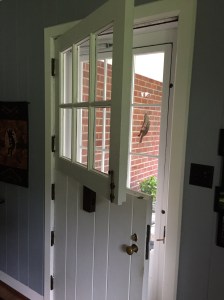
IMG_1324The struggle with knowing how to be in a place is, for me, how to be in this place.  This place is the Appalachian Mountains that have called me and welcomed me through out my life in one way or another.  This place is also an academic life that feeds and sustains my thinking and wondering self.  This place is also the evolving of the third chapter of my life, as Sarah Lawrence-Lightfoot calls the years between 50 and 75; the part of life that Richard Rohr calls Falling Up. These descriptions assume movement, however, not the kind of pushing and striving that characterize the first part of most adult lives.
In what seems on the surface known, in my struggle that doesn’t need to be a struggle, I realize how unknowing creates a tension that is necessary. The tension is necessary to keep possibility alive.

That is what I love about teaching. I am beginning a new semester with both a sense of the familiar, I’ve been here before, and the tension of the unknown; new combinations of people, ideas, and expectancies that walk alongside me to change and shape what we do and experience in this place.

Teaching is about knowing; yet, it is more rightly about creating a space to encounter unknowing, to push the door ajar.

I came across a poem I have been sitting with for some weeks now: “It is Enough to Enter” by Todd Boss. I discovered that Todd Boss, the poet, is also the founder of Motionpoems, which, of course, peaked my own interest in the transformations beyond words.

It is Enough to Enter

the templar

halls of museums, for

example, or

the chambers of churches,

and admire

no more than the beauty

there, or

remember the graveness

of stone, or

whatever.  You don’t

have to do any

better.  You don’t have to

understand

the liturgy or know history

to feel holy

in a gallery or presbytery

it is enough

to have come just so far.

You need

not be opened any more

than does

a door, standing ajar.

Todd Boss

It is enough to savor these words and the images, experience, and unknowing they uncover.  Indeed, there is room to walk around here.  No need for me to push too hard.

Becoming A Giant Ear

All words at all times, true or false, whispered or shouted, are clues to the workings of the human heart. Listen. You must, if you care to understand anything at all, become a Giant Ear.                                  Kate DiCammilo, Flora & Ulysses

 How to see life, as Frederick Buechner suggests the Good Samaritan did, as a poet or a child? In response to this question, I wrote in my journal: settle back more, let things come instead of pushing, be attentive, be available, be less defensive, listen to others.

 Yesterday, I heard on the radio that the author of the famed Eloise books, originally published in 1955, did not intend them to be “children’s books.” For me, the multi-layered-ness of many so-called books for children is the power in these stories, for all of us.

Kate Di Camillo does write for younger people. She captures and conveys not so childlike wisdom through her storytelling. I’ve given Because of Winn Dixie, her first novel, as an adult gift and again last semester I read The Miraculous Adventures of Edward Tulane, winner of the Christopher Award, established to affirm the highest values of the human spirit, aloud to my class of twenty-some-thing people. I decided to re-read Flora & Ulysses, after listening to her Newberry Acceptance speech—hearing the real story behind the written story. Maybe, her stories hold a key to seeing life as a poet or a child.

Flora & Ulysses is a hybrid format – part is traditionally written and part graphic novel. The story of Flora, a “natural born cynic,” and her unassuming squirrel friend Ulysses—turned super-hero—was not immediately appealing from these descriptions. Compelling, though, was Kate Di Camillo’s real story that involved her mother, a giant vacuum cleaner, and the capacious hand of God.

In the novel, it is Flora’s father who has a capacious heart and the giant vacuum cleaner that transforms the yard squirrel into a poet with super powers. The story is about Flora, her divorced parents, and a myriad of neighbors and objects who become friends and accomplices on her way to seeing her life anew. Through the wisdom of long-lived Dr. Meescham who resides across the hall from Flora’s father and the blunders of voluntarily blind William Spivey, her next-door neighbor’s nephew, and her mother’s beloved unusual lamp, Flora observes her own life through other eyes.   In fact, throughout the story, Flora reminds herself in her role as a young cynic, “Do not hope; instead, observe.”

Paradoxically, what Flora heard and observed as a giant ear was astonishing.

Now, back to my own musing in connection with Flora’s reminder. Settle back more, let things come instead of pushing, be attentive, be available, be less defensive, listen to others.

It’s not that I don’t hope—it is ceasing to participate in the kind of “hope” that is continually playing a purposed scenario in my mind.  This imagined scene controls how I am in the unfolding story and takes me away from the present moment. Letting things come is an expectant hope, not of my own making.

Likewise, working out my own defense, in the form of a response or justification, is working out my own worth. I don’t have to do that. Maybe, listening is a way of finding common ground rather than needing to shore up my own perspectives.

Kate DiCamillo says that the word capacious means “being open, more capable of seeing and receiving the wonders of this world.” That’s another clue to how a poet or a child observe their world.

In the words of Dr. Meescham, Flora’s wise friend, “There is much more beauty in the world if I believe such a thing is possible.” And listen with a giant ear to hear it.

An Eye That Sees More

While consuming my daily dose of Buechner, as usual, I found myself with more to ponder about the very thing I might be hesitant to claim. I’ve been struggling (in my head) with some professional relationships, trying to sort out why things might seem more complicated than they really are. I didn’t imagine that the parable of the “Good Samaritan” might provide some insight. Buechner reimagines the players in the story as he says,

I prefer to think of the priest and the Levite as less than really bad, more just half blind…

So that let me off the hook a bit, maybe, I’m not really bad for continually wondering what I sometimes wonder; I’m just half blind.  Mitch, my everyday minister, often, when his sermon revolves around a story in the bible, encourages us as listeners to find ourselves in or even in-between the characters.  We do locate our lives in all kinds of stories we both read and hear.  Other wise people, too, say that that is how we come to some understanding of the ancient stories when we find a bit of our own story there.

In the Good Samaritan parable, I most often identify—no—I am the priest and the Levite.  I seem to come by quite a few people lately who have some kind of obvious pain. I do think of and even pray for them.  Yet, I don’t actually tell them so or do anything that makes sure they are being cared for and I probably only notice some of the time.

Considering that the priest and Levite aren’t all bad, just half blind makes it easier for me to see my way past myself a little more clearly.

In the same way that Buechner calls the priest and Levite “less than really bad,” he understands that the Samaritan is “more than good.”  He prefers

To think that the difference between the Samaritan and the other two was not just that he was more morally sensitive than they were but that he had, as they had not, the eye of a poet or a child or a saint—an eye that was able to look at the man in the ditch and see in all its extraordinary unexpectedness the truth itself, which was that at the deepest level of their being, he and that other one there were not entirely separate selves at all.  Not really at all.

Beyond the extraordinary insight these words offer, the glimmer of myself in this version of the story is more difficult to hear.  The “extraordinary unexpectedness” for me is that the person I am passing is not a stranger on the road but someone I see often, whom I have made “strange” because she doesn’t think or act or live like I do.

How do I develop that eye that sees more?

Doing is Being Present

IMG_1205

It is natural for me to focus on the day or even the upcoming week, on events that I have been anticipating, on things I have to do.  However, I sometimes catch myself, knowing that this isn’t necessarily what I need to pay attention to and also knowing that will I will go back to anticipating.

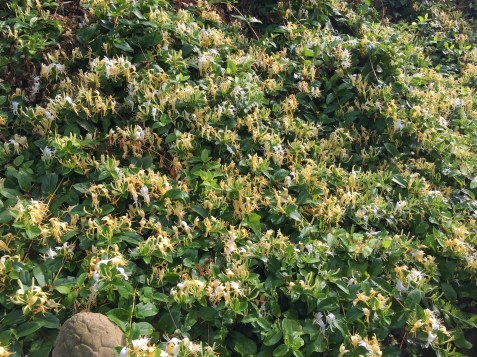
Even in the midst of this everyday stuff though, Buechner says that Jesus comes.  Like when I hear a passing comment that causes me to lean in, to listen differently or notice the honeysuckle growing wildly and wonderfully outside my bedroom window.  It is as if there is a message for me hidden in the words or scene and I ever so fleetingly pay attention.

Buechner calls these moments

the clack-clack of my life… The occasional, obscure glimmering through of grace.  The muffled presence of the holy.  The images, always broken, partial, ambiguous, of Christ.

That clack-clack, the everyday things, harbor glimmers of light that turn me toward noticing something. Today that noticing was the smell of the honeysuckle and sweet jasmine that was overwhelming as I walked the dog this morning.  In a starkly different scene, I noticed that my colleague’s response to my own pushing to get something done caused me to realize that I was trying too hard to get something done.  This kind of noticing, the smells of late spring or gentle reminders to offer grace, calls for an unusual response, an act of deeper listening.

Walter Bruggeman says that to listen is to resist autonomy, an intriguing option for me.  In his book, A Commentary on Jeremiah: Exile and Homecoming, from the chapter, “A Case Study in Fidelity” he says,

In our own time, these chapters (of Jeremiah) speak eloquently against the ideology of autonomy so powerful in modernity, against our notions of holding initiative for our life, and our mistaken notion of being self-starters.

The deeper kind of listening that I am being called into, how does that fit with my restlessness to get something done?  I’ve been reminded lately that my version of “getting things done” is for my own gratification.

In a meeting earlier this week, I was acutely aware – after the encounter was over—that I talked too much about what I do or think or understand instead of listening for how what I do or think or understand even matters. I’m pretty sure I was thinking of my own response, conscious of how I was being perceived, instead of listening deeply to my colleagues.

Maybe there is something better than doing.  And that something better, Parker Palmer says is “our gift of self in the form of personal presence attention, the kind that invites the other’s soul to show up.”

I realize that I am able to choose to notice all the subtle opportunities I have to pay attention, to listen more deeply, veiled in the fleeting words or actions or circumstances of another, whether the “another” is a person or the awe-inspiring honeysuckle outside my window.  And amazingly, no, by grace, things get done that are visible and invisible, without striving.

Put a Lid On That Frying Pan

Put a lid on that frying pan.

Living in any area, like the Appalachian valley where I live, people have sayings that color their talk.  It would be easy to note the uniqueness of the phrases and miss the wisdom.  Wisdom is indeed what I’ve needed lately.

I’ve noticed that it is too easy to get caught up in my own opinions.  Well, they’re not really just opinions—I know stuff.  A man I worked with many years ago once drew a volcano on a post-it-note and gave it to me.  Evidently, my opinions were often shared when they weren’t even asked for—and with passion.

And that is the trap I’ve fallen into again lately.  So, when I expressed my desire to consider some fundamental changes in a form our students’ are required to use, my wise colleague, who has grown up and lived in this area for most of his life, responded,  “Put a lid on that frying pan.”

Clarifying, he said that there were others who also had concerns; implying I should be patient…literally to put a lid on my own ideas until the proper time and place.  Like the volcano post-it-note, there isn’t a sense of urgency when it comes to opinions; nor are they productive when liberally shared.

Again and again, I come back to the question of what is important, what matters here?  Again and again, what I need to be reminded of comes from unexpected places—through my friend Gene’s colloquialism and from a character, Lillian, in Frederick Buechner’s novel, The Final Beast.

Nicolet is a parish minister whom Buechner literary critic Dale Brown describes as   “another Buechner character trying to decipher the darkest mysteries and looking for something like happiness…”  Nicolet encounters a woman of prayer, a faith healer of sorts, fashioned after Buechner’s real life encounter with Agnes Sanford, author of The Healing Light.  The Final Beast’s version of Agnes Sanford, Lillian Flagg, asks,

“Have you ever received the gift of the Spirit, Mr. Nicolet?  … The Holy Spirit… I don’t mean the frills.  I mean the real business…The life.”

Nicolet shook his head.

“I didn’t think so,” she said.  “You get so you can tell.  Pray for it, Nicolet.  Nothing else really matters, you know.”

That’s what I need to hear, what really matters.  Put a lid on that frying pan full of hot grease.  Don’t let it spatter on others, or myself for that matter.  Don’t let it be the substance I rely on to give me The Life.

Listening to continuing and troubling public rhetoric of blaming someone else, of being against, of choosing sides, of being caught up in power and privilege hasn’t helped. However, that is part of the grease that splatters.  I do that, too, comparing myself with others—to see if I am measuring up or even to see if they measure up to me—instead of building sustaining relationships. How to act “self forgettingly out of the living center” of whose I am “without the paralyzing intervention of self-awareness” (Alphabet of Grace).

She [Lillian Flagg] said it was amazing what God could do on his own sometimes…

Maybe that is enough to know today. Put a lid on my own frying pan and step back and notice what God is already doing here and be part of that.