
IMG_1806As I write this, the sun is coming up, again. It doesn’t look the same as yesterday; today is grayer, however, the light still comes.

I’ve been considering the time that has passed. The 25 days I spent with my family recently wasn’t necessarily or primarily chronological time. Particularly the time with my children, spent in incredible challenge and joy, was beyond time – a depth of time that distorts the mere passing of days.

I don’t really know how to explain it; I have lived this wonder before. The weeks I spent with both my Mom and my Dad when they were dying was an extravagant gift. The days went by with little recognition of the actual date or day of the week or time of day. Events of each day were both quotidian and sacred: waking up, making meals, physically caring for the most basic needs of another. Nothing that happened would qualify as noteworthy to a casual observer, yet, each moment held an abundance of extravagantly giving of ourselves that is evidence of how precious our lives are together. That same sense of Presence, a holy presence of each other and of an Eternal Presence, permeated the time I most recently spent with family in pain, uncertainty, and uncompromising joy in love.

The Eternal Presence expands the idea of time as past, present, and future conflated in each moment. God invites us to open our hearts to what spiritual writer Thomas Kelly calls “eternal now”—God’s eternal plan in each moment. Kelly writes,

But I am persuaded… there is a serious retention of both time and timeless, with the final value and significance located in the Eternal, who is the creative root of time itself.  …The possibility of this experience of Divine Presence, [is] a repeatedly realized and present fact, and its transforming and transfiguring effect upon all life… Once discover this glorious secret, this new dimension of life, and we no longer live merely in time but we live also in the Eternal. The world of time is no longer the sole reality of which we are aware. A second Reality hovers, quickens, quivers, stirs, energizes us, breaks in upon us and in love embraces us, together with all things… We live our lives at two levels simultaneously, the level of time and the level of the Timeless. They form one sequence, with a fluctuating border between them. Sometimes the glorious Eternal is in the ascendance, but still, we are aware of our daily temporal routine. Sometimes the clouds settle low and we are chiefly in the world of time, yet we are haunted by a smaller sense of Presence, in the margin of consciousness.

So this reimagined time is how we live, not thinking so much of this one moment yet being fully present in only this moment.

After he came home from a three-day evaluation at Betty Ford Center, my son said he wished things could go back to normal—but there is never the same normal again, as we build relationships and experience in this eternal now.   And I have also longed for some kind of settledness or sense of normal and realize that being present- in whatever is – is my life.

Do you remember the movie, Groundhog Day? The main character, Phil, lived the same day over and over. He came to know in his body and spirit what would happen. The result was that he was able to change how he responded to people in each moment he’d lived before. He remembered an old classmate’s name, he actually listened to an elderly lady at breakfast, and he stopped to play with neighborhood children in the snow. In doing so, Phil changed how he was in relationship with the people whom he reluctantly encountered for what he thought was one inconsequential day.

We can’t know like Phil did who would step off the curb into icy water or who would need his affirmation or how his work colleague’s hopes and dreams could be sensed, but I can be more present, recognize possibility,  affirm and confront appropriately – not reactively but lovingly. I can be in time with others, with the beauty of the sunrise and even be in the pain in ways that are beyond time.

I spent probably 6-7 hours making meals and freezing them for my pregnant daughter and her husband. I was totally immersed and invested in the creativity, the care, and the craft of making those meals that would provide good quality food and ease in the coming days. It was an act of love and while I was exhausted, especially after cleaning up all the mess, it was a good use of time, that extended time, and was and gave a gift of time.

I also spent too much time yesterday invested in trying to rescue, protect, and manage the lives of the people I love.

Today the sun came up and it is bright, bringing light and warmth to this new day. I have a new opportunity to choose how to be in it—to live my life at two levels simultaneously, the level of time and the level of the Timeless.
Learning to Walk With Grace

I am learning to walk with grace in the dark
I am learning to trust and to lead with my heart
When the old moon is gone into silence and sighs
It’s the one and only time a new moon can rise

Sometimes there is no reason, the moon waxes and wanes
It was the 100 year flood and you were in the way
Some things we find in daylight and we’re grateful to know
Some things we only learned where we did not want to go

I can’t tell you it will all turn out fine
But I know is there’s help in hard times

Carrie Newcomer, Help in Hard Times

 6:11 AM

That’s what my phone flashed when I awoke.

I did have the house ready. I cleaned. I went to the grocery store so there would be food here for Mitch’s return.

I met with our friend who was going to take care of our dog, Hunter, in between my early morning departure on this day and Mitch’s late night return.

I packed; laid out the clothes I would wear in the morning, and even took a shower to save time that next morning. The only thing I had to do was put the toiletries I used in the suitcase and get Hunter situated for the long day. My plane would leave at 7:30 AM so I set my alarm for 4:45, plenty of time.

So, seeing 6:11 on the clock sent me into a frenzied panic. I flew up the stairs, let Hunter out, and filled his bowl. He became anxious too, watching me as I flitted around.

I put on the clothes I’d carefully laid out. I opened the door to the dog run and left it open. I did not have time to let the dog out, again. I crammed my final things into the suitcase, not even bothering to brush my teeth or comb my hair, and put them in the car.

I went back in the house, pulled Hunter’s bed upstairs and plopped it in the living room. His treat—I went to the kitchen and in my haste kicked over the water bowl—another brief delay to fill it again.

Finally, I was on my way. And then it happened—the realization that it might be possible to make it in time. I needed to be calmer to make that happen. Paying attention to traffic, driving fast but not too fast, I arrived at the airport at 6:45.

There was still time? I ran to the terminal and entered. There was no one at the Air Alaska desk. Each self-serve kiosk had a paper sign that stated: temporarily out of order.

I asked unexpectedly at the neighboring airline’s counter whether checking in was still possible. The lady calmly reminded me that there was an hour cut off for checking in prior to departure time. “Just call the number listed at the desk for help.”  It was an 800 number so I wasn’t sure how that would help me now.

I resolved that I would miss this flight and it would be okay, somehow. The flight that Mitch and I had so carefully planned so that we could be at the airport in California at the same time. We carefully orchestrated flight times so that we could both spend some precious time with our son, together, before Mitch went back home and I stayed.

Now, my new arrival time would be 4:37. Mitch’s flight would leave at 4:45.

When I texted Mitch to let him know I missed my flight, he was in the emergency room. Our son had a broken jaw in two places from being hit by a metal bar when readying a helicopter for taking off in the early morning darkness. Mitch wouldn’t be getting on our carefully planned flight, either.

I’ve long been plagued (maybe that is not a good word) with what we do, what God does, and what just happens. I guess it is the “just what happens” part—part cosmic orchestration, or the goodness of people, or synchronicity, or the grace of God in our lives that I cannot explain. All of these are evidence to me that a force greater than us that undergirds this life is present.

I had time before my new departure time to go back home, take care of the dog and retrieve my glasses I’d forgotten in my earlier haste. The lady at the long-term parking window waved me on, my parking was free today she said. On my way back home and then back to the airport an hour later, I listened to Carrie’s song, over and over.

Our family had a gift of three full days to walk together: in the dark, to be present for each other in both pain and to witness glimmers of grace.

Some things we find in daylight and we’re grateful to know
Some things we only learned where we did not want to go

I can’t tell you it will all turn out fine
But I know is there’s help in hard times.
 

I am still learning to lead with my heart, not my head, with radical trust.

Silent Conversation

Sometimes I think we do all the talking because we are afraid God won’t.

Barbara Brown Taylor, When God is Silent

 In many conversations with my husband or my adult children, I say too much.

I want them to be informed or maybe even help them make a right decision and make sure I cover many nuanced perspectives. Even with my best intention, usually, my talk is not welcomed. My daughter recently asked for my advice and then gave me a choice by texting: #1 or #2? I guess at least she is still asking.

Right now, our family is in a heartbreaking situation and I am not there. So, my conversation is with God and I’m trying desperately to listen, not talk. Yet, I continually have to quell the scenarios that play in my verbal head.

The lives I am brokenhearted about belong to God, whether they use the word God or not.

This morning I listened to the podcast, On Being, with Krista Tippett that provided concrete insights for my challenge.  The episode was about conversation, specifically the difficult ones that the United States has been having lately.

At critical times like my family is facing, it is a struggle to put words around our deepest longings. Krista spends some time defining ‘conversation’ that evokes a vision of shared lives, not simply words.

She reminds that relational conversation is bigger than talk. Before any words are spoken, the space, tone, and frame for what might be possible are established. We also bring our shared lives into the conversation by listening. We bring a genuine curiosity (the opposite of posturing) and ask searching questions that make the conversation genuine. Significant conversations that are turning points in our lives have some other common elements: a lot of silence and trust that has most often been earned.

Sounds like these are tenants that apply to my ‘conversation’ with God. One that also transcends words. In fact, words are often hard to come by lately. Words that describe my deepest desire anyway.  Silence and trust are required.

My tactic has been to visualize the person or even use a picture to keep my mind stayed on her image in God’s light and love. I have been trying Catherine of Genoa’s admonishment that it is because of this tender love that I need not ask anything of God for you. All I need to do is lift you up before his face.

No words needed.

Holy Unknowing

I said, “I don’t have to know.” I want to mean that.

Just to be in what is—is a struggle.

The disorientation of not knowing – I’m not sure how to approach this feeling, other than being a little sad.

In Falling Upward, Richard Rohr states “spirituality is more about unlearning than learning,” and that our illusions must be undone to take us back to God. Both he and Parker Palmer write often about our return to our “true self.” How do I become my true self, giving up pretense and illusion?

Today (and yesterday), my intention is and was to go to yoga class. Even before I came to Victoria, I checked out yoga studios, so I know where to go. I just haven’t had the courage to get there. I have lots of good reasons.

I hadn’t moved to my “real” location here until September. I had to get settled. I had company for two weeks. We only have one car. I haven’t been to a yoga class since June so I need to ease back into practice. And yesterday, the reason was… it was raining lightly and dark and I had to do the dishes and I could go tomorrow.

So, giving up pretense and illusion might begin with this yoga class. Yin yoga, a still and challenging style, is at 7:00-8:15 this evening. I can go, try, and be willing to not be able, perfect, or even wrong. I can take whatever comes from the experience.

Rohr goes on to encourage that people who have learned to live in deep time, in the big picture, found true self. From my understanding, deep time is akin to eternal time that conflates our past, present, and future selves and experiences. This change of frame is what Jesus called living in the Kingdom. We have to let go of our own smaller kingdom to be there. We practice by choosing union freely—plenty of room for communion and no need for exclusion.

My ‘smaller kingdom’ is all the inside retrospection that isn’t bad in itself, however, it keeps me locked into myself. This pervasive inwardness keeps me from risking going to yoga class with people that I could risk getting to know (and letting them know me) to expand my world.

Not knowing makes life more spacious, I was told. The bounds of what I will do each day now are open to new experiences and relationships if I let them be. Holy sadness, Rohr explains, “once called compunction, is the price your soul pays for opening to the new and the unknown in yourself and in the world.”

What comes to mind are the words: I will with the help of God.

At Home with Mystery

Do I really trust God to guide me?

Or do I, like the Israelites in 1 Samuel 8, want what I perceive others to have? The Israelites insisted they needed a King, even though Samuel, whom they trusted, told them all the ills that a King would bring.

For me, I’ve noticed that I take notice when people say, “I’ve lived here for 25 (or more) years.” I do covet that kind of stability… I think.

I wrote in my journal a few months ago that I felt almost embarrassed when I have to confess that we only lived in Bristol for 2 years—twenty-one months, actually, in our own house. However, when I consider the first house we bought near Atlanta, Georgia, in 1983, or the next one in Dallas, Texas, in 1986, or the next one in Columbus, Indiana, in 1993, or even the next one in North Vernon, Indiana, in 2002, none of these were places I imagined staying. I was always glad to move on to another phase, another chance, really.

The fact that we even live in a whole house in Victoria is incredible—a miraculous turn of events, none of which were of my own making. It happened.

I’ve written similar words in hope of acceptance of my circumstance, many times: Keep being in this moment in gratitude or sorrow or anxiousness or joy. Be here in God’s loving presence.

Scott Russell Sander’s notion of staying put, in his book with the same title, challenges me to interpret his assertion for my life. Even though this is what Sander’s did, maybe staying put doesn’t mean, for me, staying in one house or one job or even one community for most of my days. Clearly, that hasn’t been the case.

Instead of dwelling on what I thought I had in another time or what I think I need in this time, staying put could mean being attentive at this moment—to sense the mystery of this time and place I’ve been given.

In Richard Wagamese’s provocative novel, Medicine Walk, the protagonist Frank and his dying father, Eldon, ponder this Mystery.  As son and father speak and think respectively  in the story:

Got to come to know that things get taken care of Frank. Me, I don’t know if I ever got cozy with the word ‘God,’ but I know something’s making sense out of this. Man’s gotta trust that somehow. So, I figure, what the heck? Even if I’m wrong, there’s worse ways to live than stopping to thank the mystery for the mystery.

…Most of all it was the process of tracking game, letting himself slip out of the bounds of what he knew of earth, and outward into something larger, more complex and simple all at once. He had no word for that. Asked to explain it, he wouldn’t have been able to, but he understood how it felt against his ribs when he breathed night air filled with the tang of spruce gum and rich, wet spoil of bog. That particular magic that existed beyond time, schools, plans, lofty thinking, and someone else’s idea of what mattered.

One of these poignant characters is on the brink of adulthood and one is on the brink of another threshold, death. Both are responding to some kind of awareness of the mystery of living.

Their decisions don’t make sense—a young boy taking leave of his stable daily rhythms to come to the aide of this unfaithful messed up man who happened to be his father. The father asking his estranged adolescent son to provide for him on a journey he wasn’t physically or emotionally able to make on his own.

There is a great mystery to all Mitch and I have done and are doing, and in my new home and community and time of life. I don’t have to know. I don’t have to hold any ideas of what might happen next.

And just like this fictional father and son, I’m not entirely sure who God really is.

Yet, I have an appreciation and vague and embodied awareness of the Mystery that is God and is my home… for much more than 25 years.

To Just be…

It just happened.

This is the first day in more than two weeks that I’ve awakened to our house all our own. Yesterday, our family company left.

Even though they are family, close family, I want them to feel especially welcomed. That means making enough coffee for everyone and planning that we have enough food on hand, even when I, in this case, am not the one doing all the cooking. It means being quiet sometimes to not wake everyone up too early and then having to talk —no just sitting with myself that I prefer to do often.

It takes a lot of energy for me to be around people. So, today I am especially thankful for being here in my red chair. I’m especially thankful for being able to wake up, make my own kind of coffee, and sit here without expectation. Maybe that is how I am to approach more of each day. To just be in what is.

That’s what happened the other day when I was walking the dog.

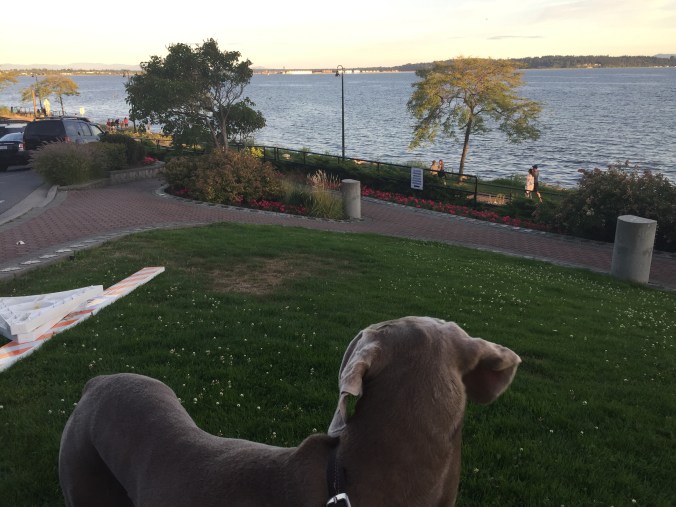
For the first six weeks, we were here, we lived in an Airbnb on a “no exit” street, which means it dead-ended into the ocean. There was a cut through to a lovely city park with off-lease trails that was a popular spot for dog walkers. My dog, Hunter, and I walked there several times a day, stopping often to relish the view, observe the abundant and unfamiliar flowers and trees, and stop at one of the many benches that faced the ocean and the Olympic Mountain Range in the distance. Often, other dog owners greeted my dog and me and often ask how old he is or what breed.

Our new neighborhood is bustling: a shopping mall a block away, a middle school on the adjacent street, and lots of people walking to the bus stops, coffee shops, and a college campus that is a few blocks further down the same street. Walking the dog isn’t done as leisurely as walking through the park trails and rarely does someone speak.

I’d driven past a golf course and noticed a walking trail that wasn’t far in the other direction. Hunter and I set out on a different walk down the same busy street that took us there. We passed several “senior” apartments along the way. It’s not unusual here to see ladies behind walkers or pulling carts with groceries or gentleman on scooters or even gray hair peeking out from bike helmets as riders pass in designated bike lanes.

So, that’s what happened. We walked along the narrow sidewalk and moved aside to make room for the lady and her walker coming our way. And she stopped.

The lady stopped to ask about Hunter. She talked to him and told him what a good dog he was. She stroked his head and patted his back gently. Then, she told us, the dog and I, that it was so good, just to get to pet him. She smiled and I did too, as we both went on in opposite directions.

I felt lighter. Such a simple thing, in the everydayness of my life, made a difference in the day of the lady we stopped to greet. The encounter wasn’t planned; it was an organic act (mostly on the dog’s part) that emerged from being out and responsive to one person, paying attention. It was abundance.

To just be in what is.

Lament

This Presence is so immense, yet so humble; awe-inspiring yet so gentle, limitless, yet so intimate, tender and personal. I know that I am known. Everything in my life is transparent in this Presence. It knows everything about me –all my weaknesses, brokenness, sinfulness –and still loves me infinitely. This Presence is healing, strengthening, refreshing –just by its Presence. It is nonjudgmental, self-giving, seeking no reward, boundless in compassion. It is like coming home to a place I should never have left, to an awareness that was somehow always there, but which I did not recognize.            Thomas Keating, Open Mind, Open Heart

 This is the prayer that frames the beginning of my centering prayer practice—when I choose to do it. Lately, I haven’t been making that choice.

I left an awareness of the immense presence that knows me. My weaknesses, brokenness and yes, sinfulness—a word I reluctantly use—are evident to me. I am judgmental, selfish and desperately trying to manage my way, and also the way of those closest to me.

At the beginning of August, a few weeks after arriving in our new city, I happened to listen to a podcast on grief. Grief exposes us. I hadn’t fully acknowledged that I am grieving the loss of my job, giving away all my books that implicate my professional self, and the material stuff we were rid of that I’d put emotional, financial, and physical effort into, and the settled-ness that I longed for and I thought I was achieving.

As I listened, I realized my need to create space to more consciously grieve, to even invite grief, because it was surely coming out in other, not so life-giving, ways.

Barbara Brown Taylor says that sadness does not sink a person. It is the energy a person spends trying to avoid sadness that does that. So what do I do with the sadness I feel? The seemingly unexplainable sadness that I think I should magically work my way out of? Are these feelings self-centered? Are they just “in the way” of moving on to the abundant life I imagine?

Lament is a word I sometimes casually use. I lament a lost opportunity and I lament how I fail to be the person I think I should be. According to an online dictionary lament (noun) is a passionate expression of grief or sorrow and as a verb means to mourn, to express one’s deep grief about or express regret or disappointment over something considered unsatisfactory, unreasonable, or unfair.

The origin of the word lament, from French and Latin, meant to weep and wail. According to a scholarly view of lament I learned that the performance of lament is viewed as a practice of an “other” less civilized group or person. No wonder the use of the word has been drastically reduced in our lexicon over the last hundred or more years. And more than that, lament as a response to grieving seems not only archaic, but also not understood in our contemporary lives of faith.

The Christian response to loss seems to be that we should have more faith, we should repent for making something more important than God, and we should be grateful for what we do have, for God’s grace and blessing. And, I have felt shame for wallowing in my sadness and for not skipping on by my losses to the grace of living.

The stories of Job and Hannah from the Old Testament are two instances I have encountered lately of faithful people pouring out their sadness to God, unedited, without rationalizing the blessedness of life. Hannah (1 Samuel: 1) poured out her anguish unedited by the exceeding kindness of her husband and the misunderstanding of the priest. Job’s lament allowed him to express his anger with God and to engage deeply with a personal God.

Before reflecting or editing is key here. I want to acknowledge that I do reflect and edit what I feel that tends to either suppress or glorify my sadness. Allowing myself to feel sorrow and express that sorrow is not a lack of trust in God.

Walter Brueggemann names the Psalms that are laments “Psalms of disorientation.” I can identify with that naming. Disorientation more aptly describes my need for lament. These Psalms of disorientation call “attention to the reality of human loss and human pain without making moral judgments about whose fault it is—it is simply a given of human life that needs to be processed theologically. The disorientation I am experiencing might be God’s invitation to lament.

I am lamenting losing my job and comfortable home. While I know it is for the better for both Mitch and me (whoops, reflection slipped in), it is a loss particularly of an identity and an illusion of settledness and a sense of imagined community and purpose.

I am lamenting things we gave away—things I felt sure about in the moment—my patio furniture that was old but comfortable and that would have filled one of my two outdoor patios, the green rug that I was tired of and that then looked so good after the movers left, the stereo cabinet my uncle made that somehow provided a sense of history but only held the TV. I recall my prayer at the time: to know the right thing to do when I needed to do it and to have people and situations that need what I have to become apparent. I desperately want to trust that this was true.

I just finished reading Medicine Walk by Richard Wagamese that is a story of deep lament. Sixteen-year-old Franklin Starlight is asked to accompany his estranged alcoholic father on his journey toward death. Along the way, Franklin cares for his dying father and painfully witnesses his father’s lament of a life of love and loss. His father recognizes that he held words better in his head than being able to speak them, but finds the courage to pour out the story of his life as they travel. At one point the father mourns:

Jimmy used to say we’re a Great Mystery. Everything. Said the things they done, those old-time Indians, was all about learnin’ to live with that mystery. Not solving it, not comin’ to grips with it, not even trying to guess it out. Just bein’ with it. I guess I wish I’da learned the secret to doing that.

 To have the courage to feel and pour out our sorrow even when we don’t understand, even when we are disoriented, even when we would rather push it down in search of something new takes trust. The danger is to hold on only to those moments that bless us and avoid these dark ravines. In Longing for Home, Buechner ends with this ineffable mystery that we know the divine presence in our experience of unknowing.

Not solving it, not comin’ to grips with it, not even trying to guess it out. Just bein’ with it – the divine presence who knows and hears my grief and still loves me infinitely.

Just Listen!

A good thing about keeping a journal/writer’s notebook/morning pages (it isn’t just one thing) is that I don’t have to rely on my memory. I can re-read my writing to re-live, in hindsight, my inside as well as the outside story in retrospect.

Two months ago, on June 1, 2018, Mitch and I were immersed in doing what we needed to do to be ready to move to Canada in just 6 weeks. We had planned to come back to Victoria at the end of June to do immigration work and look for housing. We planned to visit Mitch’s family in Alabama at some point before moving in July and I would drive to Ohio and Indiana to deliver some furniture to our daughter Margaret, visit my spiritual mentor, Margaret, on the way to Indianapolis, and then support my friend Stacy as she defended her dissertation on June 15. Needless to say, we were overwhelmed with a to-do list.

As of today, August 2, 2018, much has been accomplished. We’ve been welcomed here and settled in as much as can be settled in this temporary space. We signed the lease on the quite lovely house we will rent, in September, in a convenient location, we didn’t even know about when we first visited.

However, I’ve started to have pangs of panic as I realize that there is still immigration work to begin for a more secure status. I realize I don’t know how much the actual moving of our stuff later this month is going to cost. I do not know that I have the correct paperwork for our belongings to cross the border. I realize that I have to wait two more weeks before applying for a new driver’s license because my Tennessee license is not quite the required 2 years old, which is not a problem except that we noticed that our car tags have expired. I need a check on these raging uncertainties.

So, I happened to look back. On June 1, just two months ago, I wrote in my journal:

“God grant me the serenity” could be my prayer now, too, to accept the things I cannot change, the courage to change the things I can, and the wisdom to know the difference. Have the courage to ask for help when I need it – seeing my life through the lens of grace rather than fear and anxiousness.

Remember when we were going to move to Bloomington? The rental market was overwhelming and our house hadn’t even sold. Then, I don’t even know how it happened that Mitch found out about Byron’s house. He texted me the address and I couldn’t believe it – the location next to the park and walk-able to my work/school and a basement where we could store all of our stuff. Same with this house (our rental when our house sold in Bristol.) So, God, I guess I’m imagining that kind of synchronicity will happen again.

 BUT—ah—the what if’s. What if we don’t have a place? Mitch could stay with Gordon or in an extended stay hotel? But, none of that may happen. We’ve moved a lot and we’ve made it work. Always grace—somehow people and places have emerged, some have been better than others, but inside we have grown and even flourished. Buechner says that even my own life is not my business. It is God’s business. Leave it to God. It is an astonishing thought. It can become a life transforming thought.

 This newness we ARE being somehow called into is both risky and holy business. And, honestly, that is where I must be.

The eternal God is my dwelling place and underneath are the everlasting arms.

 I don’t need to add any more words—LISTEN, just listen, to my life.

Yesterday

Yesterday was officially my last day of employment.

I have to admit it did bother me a little. When I checked my email in the afternoon, just to see, I was met with: Username not found.

Well, maybe it is the last day of the kind of employment I know, which is perhaps an entirely different matter. Or, another way to frame this day in time is that I don’t know what I will be, here, now that I have moved. Maybe, too, in this unknowing, my intent is more accurately to live who I am, not what I do. Figuring out a life is complicated. Maybe all that figuring isn’t even necessary.

About ten years ago, I was determined I wasn’t going to be defined by a job laden identity. Instead, I shifted ever so slightly the context of my doing—a cerebral shift that, practically, didn’t accomplish much. I have an internal self and a self that acts (or not) in this world and the two aren’t effectively the same person. Maybe God sees another possibility.

I want to return to Tom Long’s commencement address that shoved me to reframe events of the past months of change. He elucidated three tenants of a parabolic habit of mind: abundance, reversal, and confrontation. Parables expose God’s grace, the extravagance of God’s blessing. In parables from around the world, there is also some kind of dramatic reversal of fortune at some point in the middle: peasants become princesses, the poor become rich in blessing, and the sinful are saved. Parables precipitate confrontation because they imagine a world in sharp contrast to the world in which we live.

This parabolic habit of mind engenders confidence in us that nothing is so hopeless that doesn’t merit the investment of our energies, our goodwill, our blessing and an imagination of abundance. We can imagine another way to look at things—beyond the deficits sedimented in time and circumstances. We have an opportunity to see the image God sees, that nothing can take away. Reversal is a possibility.

In my work in education, I have sought to create discourses of possibility that see each person from a strength perspective and propose pedagogical practices that equalize footings as people use their own stories and experience to make sense of the world. Maybe now my challenge is to broaden the reach of my convictions in this time and circumstance.

On Sunday, I met Stella. She has lived 96 years and considers herself socially and academically engaged in the world. In the brief time I chatted with her, she hinted at a significant journey with her daughter during the Second World War that she chronicled and a current unlikely friendship with an American State Department academic half her age. I could tell that Stella took risks: risking a journey across unknown places during wartime and risking an invitation to tea that birthed an unlikely relationship.

On the same day, I read that Ruth Bader Ginsburg, 85-year-old U.S. Supreme Court Justice, announced that since her senior colleague, Justice John Paul Stevens stepped down when he was 90, she thinks she has at least five more years—a bold possibility.

I have lived enough to learn over and over that I sometimes participate with God, and sometimes without my active participation, mysterious kinds of incarnate work move me from strength to strength—from one water hole that pops up to another in a seemingly barren place or in the seemingly abundant landscape where I find myself now. What I cannot even imagine might emerge. My challenge is navigating the paradox of doing and being still enough to not get too overwhelmed with all the pieces: the what if’s, the things I don’t exactly know what to do with, the considerable unknowns, and the steady provisions for everyday living.

The actual job for my husband, the geography of this place, and the risk of what can be are openings of possibility. A parabolic habit of mind pays attention to the abundance of the life force all around by being still and noticing the possibilities—even when we lose a job, move to another city (or country), and reach any age laden with expectation.

In Wisdom Way of Knowing, Cynthia Bourgeault, describes our real dying or surrender as an inner attitude to

…just let the fear come up and fall through it to the other side… The code word for this inner gesture, as I have already alluded, is surrender. In the Wisdom lexicon it specifically denotes the passage from the smaller or acorn self into the greater or oak tree self brought about through this act of letting go. The word surrender itself means to “hand oneself over” or “entrust oneself.” It is not about outer capitulation but about inner opening. It is always voluntary, and rather that an act of weakness, it is always an act of strength.”

Reversal. I might co-opt Isaiah’s words: It may be that the Lord will act for us (or in spite of us.) For nothing can hinder the Lord from saving by many or by few.

A reversal for me might be that I don’t have to get everything right. I’m here. God is here. I wonder what will happen next?

An Abundant Imagination

What if imagination let us live in a world where God has given us an abundance?

 In contrast to the “what if” questions I tend to ask after any proposed or real-time decision, this what if is a welcomed one, even if it seems fleeting to me. Tom Long asked the question in a commencement address this spring that was somewhat of a departure from the usual charge to graduates where imagined worlds do flourish. Dr. Long built his argument upon parables—a parabolic imagination—retelling briefly in this context the parable from the gospels of the sower, whom he said was confident of an abundant harvest to so recklessly distribute his seeds of promise. He recalled a history of faithful people who were and are not afraid to waste themselves and their love like God wastes his— an imagination of abundance—and to participate in that goodness.

Over the course of 5 ½ days, Mitch and I and our dog, Hunter, drove through Tennessee, Virginia, Kentucky, Illinois, Missouri, Kansas, Iowa, Nebraska, South Dakota, Wyoming, Montana, Idaho, and the state of Washington before crossing the border into British Columbia by land and then boarding the ferry for our final destination, Vancouver Island.   More than once we doubled back, so to speak, moving through Iowa to Missouri and Nebraska, only to find ourselves back in Iowa. Several times we traipsed north to get south, as we did when we almost went to Vancouver to catch a more conveniently timed ferry to Victoria.

 Now, we are here and I am searching for that imagination of abundance. It might be right in front of me.

We crossed into Canada through Blaine, Washington on Wednesday evening. Our plan had been to spend the night in Blaine and cross in the morning and catch an early afternoon ferry to Victoria when our Airbnb would be available. After an unexpected delay getting out of Seattle, we had some trouble finding dog-friendly accommodations—we thought we knew what we were doing.

“Might as well just go [through immigration] now, we are as ready as we will ever be,” Mitch advised. So, we weren’t quite ready. We dumped our perishable food, filled out the declarations of goods we were carrying with us, and put all our paperwork in an accessible place.

We placed Hunter in the dog crate outside the immigration office and went in. Well, actually we all went in and were reminded to put the dog in the crate near the door. As has been the case, we had our things in order even though the kind young immigration officer didn’t seem to need some of our anxious preparation. I’m still a bit concerned that he didn’t “stamp” our declaration of goods for the coming move of our household goods. Paperwork for our vehicle as a temporary import was accomplished and the dog welcomed with little fanfare.

We stopped at this park as we entered to attempt to enjoy the beauty instead of panicking about what we were doing. It was a very brief respite.

IMG_1668

We did panic. We made a few stickers to translate miles per hour to kilometers to monitor the speed limits, threw caution to the wind (financial concerns) and used our cell phone GPS, took out our colorful Canadian money and looked for a hotel and fast food as the sun was setting.

I don’t believe that God opens up parking places and hotel reservations. We searched online and drove around looking for a room for maybe 45 minutes that seemed like 3 hours as darkness fell around us. Finally, a possibility at the Days Inn—not a place I’ve been fond of in the past. After about 20 minutes more, we arrived and at least it was in the direction of the ferry terminal we would take the next day.

Hunter and I waited in the car and Mitch went inside. The time that passed made me hopeful that there was a room for us. Mitch came out saying they had no more dog-friendly rooms. “Had we tried the Ramada?” the clerk had asked, before saying. “We have a suite I can discount. Don’t take the elevator, go up the side stairs with the dog.” The room was the first door on the second floor and very nice—the most upscale hotel we’d stayed in on our trip that actually lived up to the updated photography on the website. We had a living room area, bedroom, and bathroom to spread out into after 5 days spent mostly in our car. We felt empowered to make reservations for the 1: 00-afternoon ferry to Victoria anticipating a more leisurely next morning.

Maybe I do believe there is some kind of synergy in the working of God and people and events in the unexplainable surrendering of our own efforts.

IMG_1671

The sun was high overhead, the water glistening, and the vistas breathtaking as we ferried to our final destination. Our host had our small furnished space ready when we arrived and a church member across the street brought a bottle of wine to welcome us, made sure we had what we needed in the coming days, showed us the eagle’s nest at the end of the street, and even cooked fresh salmon on the grill for us another evening. We meet the couple that we will eventually rent from tomorrow afternoon to finalize the details for the September move to a whole house—I didn’t imagine that would be possible here.

The moving of our household hasn’t worked out seamlessly like I imagined, but small bits of information keep us moving forward. Somehow, I had the presence of mind to go ahead and put our worldly possessions in storage in Tennessee and plan that this will unfold. I’ve fallen into some more “what if” questions and am reminded ever so gently to quell that chatter to make room for the voice I need most to hear. The message is to stay in that place of quiet, where I let down defenses and pretense, to surrender and not brace so that God can speak. All is right deep down that makes the rest of the decisions possible—that God and other people or maybe God through other people—is looking out for us. How to live in that kind of abundance that God has provided? Buechner says “that is the shelter God calls us to with a bale in either hand when the wind blows bitter and the shadows are dark.”

That is the life I have and continue to be enveloped in—EVEN when I am anxious and lose the calm assurance that this life provides for me. And each time, I encounter the fidelity of God: the love, and grace that I truly do not actually understand or appreciate that continues anyway—an imagination of abundance.