Whatever is true, whatever is honorable, whatever is just, whatever is pure, whatever is lovely, whatever is gracious, if there is any excellence, if there is anything worthy of praise, think about these things.
Photo by Brian Raymer, South Island SUP, on my paddle yesterday.
What if?
I’ve written and pondered the “What ifs” over a lifetime and while the details shift, the underlying core doesn’t.
My “what ifs” rise out of fear—worry that the worst or even the best might actually be possible. Arise from my desire to protect myself and my image of myself in relationships. Rise out of my penchant to protect, fix, manage, or control the lives of other people—some that I love and some that challenge my capacity to see them as whole people.
But, what if?
What if my whole being paid attention to the natural wonder around me—to the ways of being that rise out of generosity and care for myself and all other living things? What if my relationships become places where giving and receiving become one act of loving?
How would you live then? Mary Oliver asks in her book Devotion,
What if a hundred rose-crested grosbeaks
	flew in circles around you head?  What if
the mockingbird came into the house with you and
	became your advisor?  What if
the bees filled your walls with honey and all
	you had to do was ask them and they would fill
the bowl?  What if the brook slid downhill just
	past your bedroom window so you could listen
to its slow prayers as you fell asleep?  What if
	the stars began to shout their names, or to run
this way and that way above the clouds?  What if
	you painted a picture of a tree, and the leaves
began to rustle, and a bird cheerfully sang
	from its painted branches?  What if you suddenly saw
that the silver of water was brighter than the silver
	of money?  What if you finally saw
that sunflowers, turning toward the sun all day
	and every day—who knows how, but they do it—were
more precious, more meaningful than gold?
so I place them on what is beautiful in this world.
And I fold them in prayer,
and they draw from the heavens light.
Saint Frances of Assisi
I’m only on page 18; still in the introduction titled, “What Is It Like to Be a Fungus?” I also read the prologue and noted the 121 pages of notes and bibliography. This book is a considered scientific work; and yet, Saint Frances’ poetic prayer begins the epilogue and I have pondered for days the personal story that begins on page 14.
The author of Entangled Life, Merlin Sheldrake, tells a story about his friend, philosopher and magician David Abram, who was the house magician at Alice’s Restaurant (made famous by the Arlo Guthrie song). One evening, two customers returned to the restaurant after leaving and pulled David aside. They said that after they left the restaurant (and his magic show) the sky had appeared shockingly blue and the clouds large and vivid. Had he put something in their drinks? This continued to happen (minus any nefarious questions). After leaving the show, customers reported the traffic seemed louder, the lights brighter, the patterns on the sidewalk more interesting, and even the rain more refreshing. The magic tricks were changing the way people experienced the world.
According to David Abram, our perceptions work primarily by expectation. We use less cognitive effort to make sense of the world using preconceived images updated with small amounts of sensory information rather than engaging the work needed to form new perceptions. Our preconceptions create the ‘blind spots’ needed for David’s coin tricks to work. Eventually the tricks “loosen the grip” of our expectations on our perceptions. He concluded that the sky changed because the customers were seeing the sky in the moment rather than as they expected it would be. What we expect to see is different than what we see when we actually look. When we are tricked out of our expectations, we default to using our senses.
I believe we “see” with the whole of our lives and there is a gap between what we perceive and what is. We don’t just see with our eyes— we bring our preconceived notions to the news, our neighbours, and even what we think is true. How might we open to take in the beauty and sorrow with all of our senses including our heart, God in us.
Cynthia Bourgeault writes that “…as the heart comes alive as an organ of spiritual perception, we are able to perceive the invisible kingdom of love that surrounds us—and live it into being.” How do we nurture the Spirit of God in us that changes the way we see the world?
God in us—that heart that opens with gratitude, hope, and love, especially when we put our hands on what is beautiful in this world and fold them in prayer to draw from heaven’s light.
You can’t tell when strange things with meaning will happen. I’m [still] here writing it down just the way it was.
“You don’t have to prove anything,” my mother said. “Just be ready for what God sends.”
I listened and put my hand out in the sun again. It was all easy.
from William Stafford’s Last Poem, “Are you William Stafford?”
I can’t say how I live the life I’ve been given.
In my last blog, I said that the stories I’d been reading were about living the lives we’ve been given in great Love. In William Stafford’s last poem, written the day he died , I think he knows, too, our lives are a gift that we receive and also give.
In reviewing my day, a couple of nights ago, I went back through chance encounters and second chances I was given when I wasn’t quite ready for what God was sending my way.
On Monday, I left my house for the bus stop on my way to an eye appointment. At the stop, I was immediately greeted by a lady in her wheel chair. We chatted about the day, she told me where she lived and I told her the general area where I lived, just a couple of blocks from her apartment. For some reason, I told her about the Barred owl couple that I listen to every day.
Our bus arrived and she found her accessible seat and I settled a few rows away. I didn’t really notice my new friend, until I was almost at my stop. There were fewer people on the bus when she motioned for me to come over to the seat next to her and I did. She simply said, “I want to come over and see the owls. Are they in your front yard?” I was surprised.
“No, they are in the back but I have a long driveway that goes to the back.”
“I’m Leigh, she said.” I told her my name. “Are you sure I can get there?” I assumed she meant to my house or down my driveway using her wheel chair. So I told her yes and pulled the cord for my stop.
“What’s your address?” she asked as I was getting up to start toward the door. I told her, she repeated it, and I walked toward the front door of the bus when I should have exited the back. I suppose I was more distracted by our conversation than I realized.
My stop is at the corner of Quadra and Pandora where tents and carts filled with their owner’s belongings line the sidewalks and grassy median on Pandora Avenue. It is a heartbreaking area and also home to a family of people who struggle and celebrate with each other like a family. I wasn’t surprised but not quite ready for what came next.
I was remembering that I’d turned right instead of left last time I came to this intersection and I had to turn around and retrace my wrong steps. The traffic light had changed and I was just standing still when I should have started across the busy intersection. An angry voice behind me yelled, “What walk light are you waiting for?”
I apologized to the air in front of me and started across the street. I immediately wish I’d at least smiled at this person or something to change my own startled reaction. The man who had yelled at me was struggling to walk across the street and was too far behind me to hear my words. I turned left to drop off my glasses and continued walking around town until I picked them up again an hour or so later.
At the intersection of Broughton and Fort Streets, I heard someone yell my name. I turned to see Doug, a man from our church, coming toward me on his electric skateboard. He smiled and said it was so good to see me out. We chatted about recent changes in his life and how he was doing. Doug has some challenges, well we all do, yet his are a little more visible. He boldly shares his fears and his hopes for his life and specifically his relationship with God. I asked how he learned to maneuver his electric skateboard. He compared his approach to “dancing with the board,” closing his eyes and getting the feel for it. What a beautiful way to describe what I imagined to be a difficult balancing act, especially on busy downtown streets.
After picking up my glasses, I made my way to my bus stop. A week before at this stop, I noticed a man filling his backpack with some groceries. He came toward me holding an unopened box of cookies and asked if I’d like to try one—they were really good. I said no thanks and he went back to his belongings on the bench. I felt ashamed I hadn’t accepted his kindness. So I mentioned I hadn’t seen that particular kind of cookies or something like that.
He opened the end of the box and held out the wrapped tray inside. “They are really good, try one!” I reached to open the end of the package as he carefully held his side. He pushed the tray forward and I took the top cookie. “No, take the whole row, you can’t just eat one!” I took all three in the stack and thanked him. He turned back to continue filling his backpack. I ate one, it was tasty, chocolate and raspberry. I put the other two in my coat pocket. My bus passed by because I wasn’t standing at the curb. The kind man’s bus came next. I waited 30 minutes longer for my bus and was glad I’d honoured his kindness.
Could I have so quickly forgotten what I’d learned that day? This week at the same bus stop, I saw a younger gentleman who clearly had some physical challenges that kept him from meeting anyone eye to eye. He laboured to walk with his cane and large backpack that rested on his back parallel to the ground. He stopped and leaned on the trash can for support. I was standing a few away behind him waiting for my #2 bus that was due in just a few minutes.
When #28 bus stopped, a lady got off slowly with her walker and looked directly at me and smiled. She went straight to the gentleman leaning against the trash can and bent over to look him straight in the eye, “Are you alright?” He nodded. She smiled and went on her way living her life with great love.
You can’t tell when things with meaning will happen. We are ever connected in this wondrous luminous web.
It seems like the best books I’ve read lately are, at there core, about abandonment, sorrow, and how our hearts ache. And yet, the hearts of the people in those stories also break open with love that defies understanding. All My Puny Sorrows and The Summer of my Amazing Luck by Miriam Toews and The Color of Water and Deacon King Kong by James McBride are stories of redemption and living the lives we’ve been given in great Love.
We all have “holes in our lives,” Miriam Tower writes, and “people like to talk about their pain and loneliness in disguised ways.” Maybe it is that we (I) really can’t honestly say what our holes of longing are but we get a lump in our throat or tears that stay in our eyes, or heaviness in our heart when we encounter that empty place. Pay attention to those tears, or whatever physical manifestation gets your attention.
I wonder if that is what happened to me the other day. I was retreating into an episode of “Escape to the County,” a twist on those house hunting shows. Except in this one I glean a bit more. I learn a little more about the United Kingdom where the episodes are filmed and, instead of the focus on finding the right house, the host explores the features of a community and offers the seekers experiences to get to know the locals. The goal seems to be to get a glimpse of what their life might be like in that place.
In this case, the life change seeking couple were invited to the community Waffle Restaurant where “good food and doing good go hand and hand.” The owner explained that the thrust of the business was to reach out to the lonely and promote opportunities for people to come together, to chat with people they might not otherwise encounter. A sign on the wall of the establishment featured a quote from Mother Theresa, Loneliness and the feeling of being unwanted is the most terrible poverty. The poster reminded those in the place about their ‘waffle work’. The locals in this community call it “wafflin” a play on the words ‘talking everyday talk’.
I think it was when the owner said, “reach out to the lonely” that the tears in my eyes disguised a hole in my life. Perhaps that is what we all long for, a place to belong and be ourselves. Perhaps, I wished to be part of a community of people that met each other intentionally with that kind of reciprocal care.
Both Miriam Toews and James Mc Bride spin stories of redemption, finding goodness in unlikely places and circumstances, seeing people as God must see them. Or as a member of the street community where I live said in a local documentary, “Sitting with Grace:” “You’d find so many of our negatives would fall away because you’re utilizing our strengths instead of going after us for our weaknesses.”
I believe I did that, maybe, in my life as a teacher; finding the strength and interests of some who were only seen as someone to be fixed, remediated, turned around from whatever path they seemed to be traveling that others didn’t understand or bless. I have a little more trouble giving that acceptance in the general population, to those who might have obvious advantages or even members of my own family. Perhaps, I don’t sometimes give that grace to myself.
In The Color of Water, James McBride concludes that “at the end of the day there are some questions that have no answer and then one answer that has no question: Love rules the day.” In McBride’s Deacon King Kong, the goodbye often used with members of Deacon’s local congregation, “I hope God holds you in the palm of His hand,” is painted on the back wall of the church for the world to hear. Maybe I don’t have a better way to fill our holes.
I hope God holds you in the palm of her hand. And I know what a capacious hand it must be.
I might have been in grade 11 when I wrote my most ambitious paper for English class. I explored the question, “Is honesty always the best policy?” I have vivid memories of weaving through the stacks in our school library (after visiting the card catalogue) and intently trying to walk both sides of an answer. This wasn’t a casual topic choice for me and I can’t actually say what life experience fuelled my fascination with honesty. I still remember the wondering and researching but looking back I didn’t have an inkling about how reading and writing were, quite honestly, saving me.
We all have the responsibility to live honestly—whatever that means. Over many years, I’ve circled around the concept of living “unselfconsciously” to alleviate fear and self judgement and second guessing about what is and what could be. Which brings me to my idea to go back 5 years and post raw material from my 2018 notebook and, as I wrote, to unselfconsciously listen to my life.
I planned to lift the words out of the pages of that notebook and into the blog without striving to find the perfect word to describe whatever internal story I was spinning. The truth is that in my last blog (December 7, 2023) I changed 2 words that I couldn’t seem to say again. They seemed tired and out of touch with what was my deepest desire.
In my old notebook was the familiar trope, “to have a successful and meaningful life.” Even though I said I would not edit the old writing entries except to include context, I changed those words. I changed the words “successful and meaningful” to “good?” with a question mark as another letter.
I suppose the question mark was my own disclaimer that “good” isn’t any clearer than “successful and meaningful” and that is definitely not what I hoped to describe. The idea that we hold the ability to strive, achieve, and “make” a life is a mistaken one. Sure those things happen but they aren’t the consequential parts. Perhaps, our life is response, moment by moment, born out in loving and honest relationship.
And as it happens, I was reading Mary Oliver’s book of essays, Winter Hours. On pages 19-20, she writes,
For [inherited responsibility] is how I feel, who have inherited not measurable wealth but, as we all do who care for it, that immeasurable fund of thoughts and ideas from writers and thinkers long gone into the ground— and inseparable from those wisdom’s because demanded by them, the responsibility to live thoughtfully and intelligently. To enjoy, to question—never to assume, or trample. Thus the great ones (my great ones who may not be the same as your great ones) have taught me— to observe with passion, to think with patience, to live always care—ingly.
Johanna grinned. “The natural thing would be to worry, fret over him, try to make things easy… So I have to choose to let him walk the path he wants to walk. Choose to be confident that I raised him with the principles that will save him. Choose to believe in him. And ultimately choose to not worry— the ultimate unnatural act for a mother.”
“Faith,” Claire said.
“Courage,” Johanna said. “Faith is what we earn when we have enough courage to face what is in front of us.”
From Dream Wheels by Richard Wagamese
I remember somewhere I heard, “even though it didn’t really happen it is true.” It’s probably in Dennis Sumara's book, Why Reading Literature Still Matters. Richard Wagamese’s books do matte
This is true: Faith is what we earn when we have enough courage to face what is in front of us. It is like the words to the Taize chant, La Tenebre: Our darkness is never darkness in your sight The deepest night is clear as the daylight.
What does it mean to have courage? So much of what causes me to get stuck, to react, to not act, and ultimately to have a less than abundant life is the result of being afraid. My son asked me what I was afraid of —I said I didn’t know and then I confessed that I did.
I am afraid of the what if’s—- predicated by the worst case scenario more often than not. I am afraid of perception and judgement, other people’s but mostly my own. My own view of what constitutes a good? life that is skewed by the world of achievements, of relatively short lived trouble. The bottom line, maybe, is the illusion of control, being able to effectively manage a life.
There are lots of reasons to be afraid— but none of them are true.
Courage is choosing: choosing to let be, choosing to trust others to make choices as they see their lives unfolding, choosing to believe in each other without fear.
As I’ve been with my adult children, I realize so painfully how my fear did try to protect and rescue, how my fears limited possibility and my acceptance of the person. That is not quite an accurate reading of the world or even what is before me.
In the novel Dream Wheels, (and in my own life), the mothers Johanna and Claire see the immense challenges that a life altering accident and life altering moral choices that have given them every reason to worry, to fret over their children, to coddle and protect. Having the courage to let another walk the path he wants to walk, to believe in the possibility.
There is another world view— where what seems weak, unreasonable, inexplicable that we can pay attention to is filled with holiness. God is with us. That is the truth.
I write every day in my “notebook” that serves many purposes.
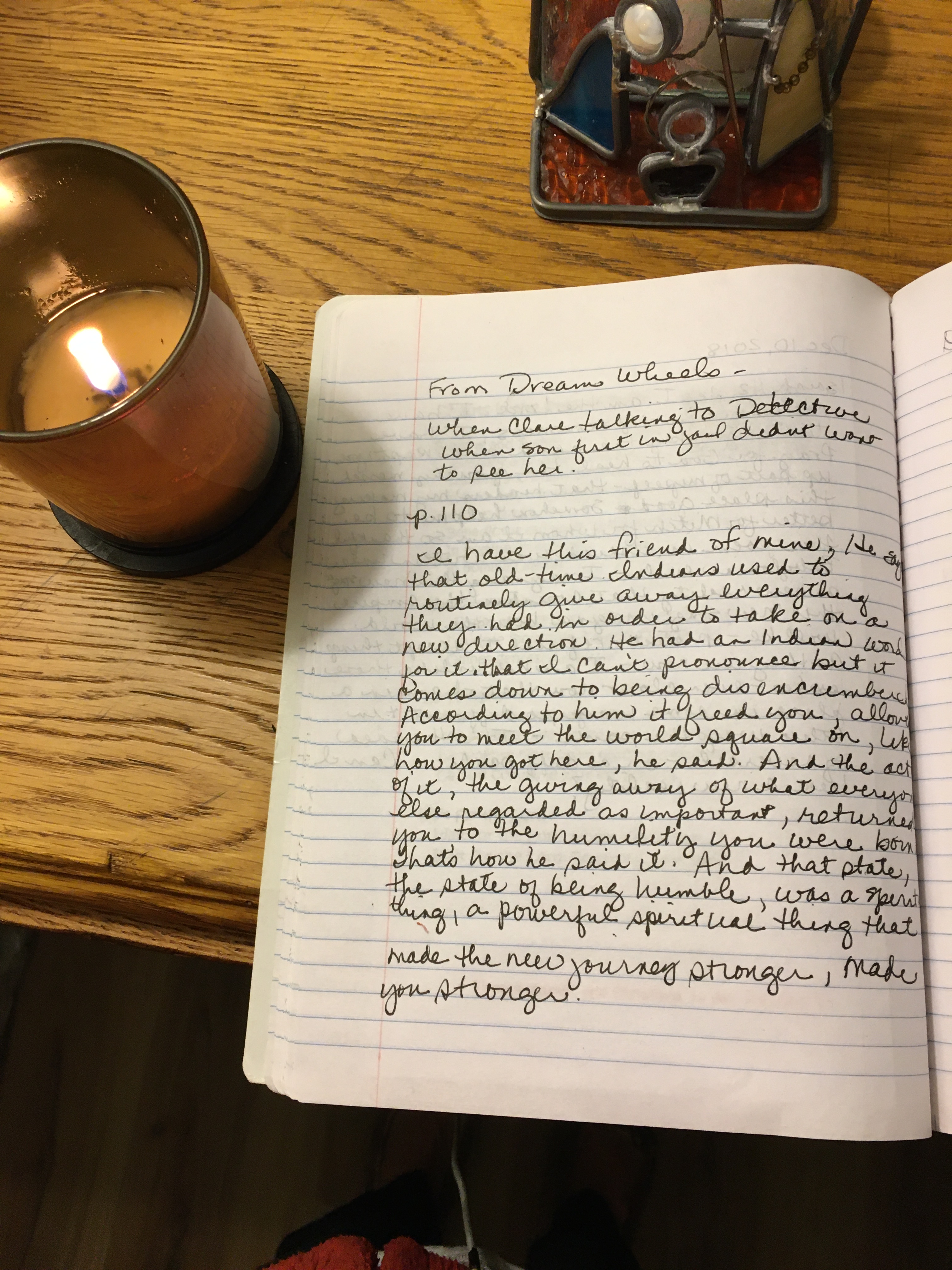
I record circumstances of my life, other people’s stories I hear, what I’m thinking, what I my wonder about and my prayer-like reflection. I also use my notebook as a “commonplace book” where I copy snippets of other people’s words from whatever I am reading. Sometimes I remember what has captured my attention and often, when I look back, I’m again surprised how those words help me make sense of my world again. That was the case when I saw the quote from Richard Wagamese’s novel, Dream Wheels. This is what I wrote 5 years ago:
December 11, 2018

 Claire is talking to a Detective when her son in jail didn’t want to see her — Dream Wheels, by R. Wagamese

I have this friend, he says that old-time Indians used to routinely give away everything they had in order to take on a new direction.  He had an Indian word for it that I can’t pronounce but it comes down to being disencumbered.  According to him it freed you, allowed you to meet the world square on, like how you got here, he said.  And the act of it, the giving away of what everyone else regarded as important, returned you to the humility you were born in.  That’s how he said it.  And that state, the state of being humble, was a spiritual thing, a powerful spiritual thing that made the new journey stronger, made you stronger.

I think of things— things that seem right and then I talk myself out of them.  Do I really trust God if I second guess the things that seem like ideas from my heart?  No, I rely on my own understanding.

Psalm 25: 4-5  Make me to know your ways…lead me in your truth, and teach me.

I will learn by responding to the things put before me— kind of a paradox—let go of figuring things out.
Now, as I look back, Claire’s words speak a little differently to a five year older me. Perhaps, giving away everything— what everyone else regards as important— could also mean giving up expectations or former ways of being in the world, like our profession or doing what we think counts. Do I spend more time wondering how to live my life instead of actually living it?
Mitch asked a question in his sermon this week that seems to fit me here: “Will we be so caught up in meeting expectations that we miss the hope that God offers to us?” …disencumbered, to meet the world square on.
December 8, 2018

Advent Silent Retreat at University of Victoria Multi-faith Center

(this is what I heard)
Lectio Divina  Reading: Mary’s visit from the Angel
Asked to do what never done before, in favour with God
But___, How can that be?  I’m ____
Nothing is impossible with God
Here I am Lord - Let it be done to me according to your design

(this is what I wrote in the quiet time)
Here, I am being called to something else, something I’ve never done before.
I said that when I knew I wouldn’t be staying in my job at the University, throughout November, December, January, February, and March.  Then, I got bogged down in the uncertainties when Spring came and I knew we might be moving to Victoria. How crazy is that— to have that awareness when you didn’t know where we would be, but then to lose that sense when things became clearer for Mitch’s new job possibility.

We’d taken a trip to St. Louis and I was disoriented, I did’t know what to do with myself.  The semester had just ended.  I went through both the pain and great hope of graduation season and was thankful for Tom Long’s Baccalaureate speech.  I decided to do what I knew was right, even at the last minute, to have the insight and courage to go to graduation when I said I would not go.  I was in that quiet place but my heart was not quiet.

Mitch and I revisited Victoria in anticipation of our move that led to the agony of planning our physical move— the brace with which I entered and stayed until it was finished.  Giving things away and I’m still living with the uncertainty of those decisions, still second guessing and not letting go.  I’m still somewhat unwilling or unable to claim this place as our own, my own, my dwelling place for this time.  The trips to family have actually made the separation of things and place even more acute—the unsettledness.  Even with new sure friendships and all those here who have evidenced their care.  I don’t know if I’ve given in, let my guard down so to speak, keeping myself apart, unconnected and unsure.

And now I come to this day, to the few things I have done.  I come to this day of connection with other contemplatives.  How quickly I was welcomed by giving me responsibilities to set up the space, to offer food, and even to welcome others when I was the new one.  To know that I do have gifts to offer.  I thought I would go to the spiritual eldering thing but that hasn’t actually materialized, the times and distance did not work out.  So is this contemplative space where I might find a place to be?  The chimes are calling us back to the group— I’ll keep listening.

my post in January 2019 expanding this notebook entry: https://lindacoggin.com/2019/01/01/advent-listening-for-a-new-year/
I have to confess that when I had the idea to blog excerpts from my old notebook I kept 5 years ago, it seemed like a good one. Then, today, the idea didn’t seem as engaging when my doubts surfaced. I’m going to stick with it, though, because I have learned that fear robs me of joy even when I’m not exactly sure what I’m afraid of.
My notebooks over the years are a respository of my interaction with what I am reading. From scripture to the latest novel, other peoples’ words teach, encourage, challenge, and surprise me and I record these conversations in my daily writing. It is difficult and generative for me to not edit those conversations and let them be. So here is…
Monday, December 3, 2018 (part 2)

The title of today's Advent reading (Celebrating Abundance by Walter Brueggemmann) was "Outrageous God."  The scripture, Isaiah 65:17-19

What I will learn to trust.

The first verse began, "I was ready to be sought out by those who did not ask, to be found by those who did not seek me."

I want that for XXXX-- to find God's spirit amid the recovery of self.  And for me, too.  All of us "walk in a way that is not good, following our own devices."

These verses seem to be words of judgement and consequences that are difficult to hear.  I want the fairy tale.  Yet, God is always present in our lives whether we ask or know or not.

The first verses of Isaiah 65 are our rebellious lives and the consequences but then there is a turn.  In verse 16-- blessing and faithfulness-- where "former troubles are forgotten and hidden from sight."

My re-writing as I let the poetry of verses 17-19 seep into my bones and heart and vision.

For I am about to create
   new reality for you
The former things you fear will
   not be in the forefront or
   come to mind
Be glad and rejoice forever
   in what I am creating
   for I am about to create
   your life as a joy
   and its people as a delight
I will rejoice in the new
   reality and delight in my family
No more shall fear be the
   basis for my relationships
No more will fear be my
   dwelling place.

The poem in Isaiah is outrageous, Walter B. says, and mine is too.  And I'm learning from the stories of Advent I am not the one who decides or orchestrates what is possible.

What I hear in Walter Brueggemmann's words is that in Advent we receive the power of God that lies beyond us-- the gospel's resolution to our spent "self- sufficiency," when we are at the edge of our coping.

It is good news that counters our cynicism that imagines no new things can enter our world.
Another snippet from my notebook I started closest to 5 years ago. As I said in the last post, this was a year of great change. Mitch and I moved from the southeastern United States to Vancouver Island in British Columbia, Canada. Both of our adult children also experienced significant changes in their lives that year.
The notebooks I’ve kept over the years are sometimes journal like and also are records of all kinds of reading and pondering. Just so you know, I’ve practiced my own version of the Ignatian spiritual practice of The Daily Examine and I write that in my notebook, too, and that’s what I did a bit on this day.
December 3, 2018

So what can I be grateful for in the past 24 hours?  Mitch-- who steadily calls me back from worry, from ignoring my own life, the part of his sermon on Sunday when he said, "We are not in charge or even know what is possible."

Mitch asked a question in his sermon, "How do we prepare ourselves to again birth the impossible into our lives and into our world?" Sometimes I feel like it is my job to provide God, myself, and my family a reality check.  Me thus deciding what is possible or not--actually I don't even go to fairy tales anymore.

I am grateful for a renewed sense of living my own life in Christ, even in the pain of now.  I am thankful for learning my way around this community and for this home.


 Attentive to Joy