Lament

This Presence is so immense, yet so humble; awe-inspiring yet so gentle, limitless, yet so intimate, tender and personal. I know that I am known. Everything in my life is transparent in this Presence. It knows everything about me –all my weaknesses, brokenness, sinfulness –and still loves me infinitely. This Presence is healing, strengthening, refreshing –just by its Presence. It is nonjudgmental, self-giving, seeking no reward, boundless in compassion. It is like coming home to a place I should never have left, to an awareness that was somehow always there, but which I did not recognize.            Thomas Keating, Open Mind, Open Heart

 This is the prayer that frames the beginning of my centering prayer practice—when I choose to do it. Lately, I haven’t been making that choice.

I left an awareness of the immense presence that knows me. My weaknesses, brokenness and yes, sinfulness—a word I reluctantly use—are evident to me. I am judgmental, selfish and desperately trying to manage my way, and also the way of those closest to me.

At the beginning of August, a few weeks after arriving in our new city, I happened to listen to a podcast on grief. Grief exposes us. I hadn’t fully acknowledged that I am grieving the loss of my job, giving away all my books that implicate my professional self, and the material stuff we were rid of that I’d put emotional, financial, and physical effort into, and the settled-ness that I longed for and I thought I was achieving.

As I listened, I realized my need to create space to more consciously grieve, to even invite grief, because it was surely coming out in other, not so life-giving, ways.

Barbara Brown Taylor says that sadness does not sink a person. It is the energy a person spends trying to avoid sadness that does that. So what do I do with the sadness I feel? The seemingly unexplainable sadness that I think I should magically work my way out of? Are these feelings self-centered? Are they just “in the way” of moving on to the abundant life I imagine?

Lament is a word I sometimes casually use. I lament a lost opportunity and I lament how I fail to be the person I think I should be. According to an online dictionary lament (noun) is a passionate expression of grief or sorrow and as a verb means to mourn, to express one’s deep grief about or express regret or disappointment over something considered unsatisfactory, unreasonable, or unfair.

The origin of the word lament, from French and Latin, meant to weep and wail. According to a scholarly view of lament I learned that the performance of lament is viewed as a practice of an “other” less civilized group or person. No wonder the use of the word has been drastically reduced in our lexicon over the last hundred or more years. And more than that, lament as a response to grieving seems not only archaic, but also not understood in our contemporary lives of faith.

The Christian response to loss seems to be that we should have more faith, we should repent for making something more important than God, and we should be grateful for what we do have, for God’s grace and blessing. And, I have felt shame for wallowing in my sadness and for not skipping on by my losses to the grace of living.

The stories of Job and Hannah from the Old Testament are two instances I have encountered lately of faithful people pouring out their sadness to God, unedited, without rationalizing the blessedness of life. Hannah (1 Samuel: 1) poured out her anguish unedited by the exceeding kindness of her husband and the misunderstanding of the priest. Job’s lament allowed him to express his anger with God and to engage deeply with a personal God.

Before reflecting or editing is key here. I want to acknowledge that I do reflect and edit what I feel that tends to either suppress or glorify my sadness. Allowing myself to feel sorrow and express that sorrow is not a lack of trust in God.

Walter Brueggemann names the Psalms that are laments “Psalms of disorientation.” I can identify with that naming. Disorientation more aptly describes my need for lament. These Psalms of disorientation call “attention to the reality of human loss and human pain without making moral judgments about whose fault it is—it is simply a given of human life that needs to be processed theologically. The disorientation I am experiencing might be God’s invitation to lament.

I am lamenting losing my job and comfortable home. While I know it is for the better for both Mitch and me (whoops, reflection slipped in), it is a loss particularly of an identity and an illusion of settledness and a sense of imagined community and purpose.

I am lamenting things we gave away—things I felt sure about in the moment—my patio furniture that was old but comfortable and that would have filled one of my two outdoor patios, the green rug that I was tired of and that then looked so good after the movers left, the stereo cabinet my uncle made that somehow provided a sense of history but only held the TV. I recall my prayer at the time: to know the right thing to do when I needed to do it and to have people and situations that need what I have to become apparent. I desperately want to trust that this was true.

I just finished reading Medicine Walk by Richard Wagamese that is a story of deep lament. Sixteen-year-old Franklin Starlight is asked to accompany his estranged alcoholic father on his journey toward death. Along the way, Franklin cares for his dying father and painfully witnesses his father’s lament of a life of love and loss. His father recognizes that he held words better in his head than being able to speak them, but finds the courage to pour out the story of his life as they travel. At one point the father mourns:

Jimmy used to say we’re a Great Mystery. Everything. Said the things they done, those old-time Indians, was all about learnin’ to live with that mystery. Not solving it, not comin’ to grips with it, not even trying to guess it out. Just bein’ with it. I guess I wish I’da learned the secret to doing that.

 To have the courage to feel and pour out our sorrow even when we don’t understand, even when we are disoriented, even when we would rather push it down in search of something new takes trust. The danger is to hold on only to those moments that bless us and avoid these dark ravines. In Longing for Home, Buechner ends with this ineffable mystery that we know the divine presence in our experience of unknowing.

Not solving it, not comin’ to grips with it, not even trying to guess it out. Just bein’ with it – the divine presence who knows and hears my grief and still loves me infinitely.
Just Listen!

A good thing about keeping a journal/writer’s notebook/morning pages (it isn’t just one thing) is that I don’t have to rely on my memory. I can re-read my writing to re-live, in hindsight, my inside as well as the outside story in retrospect.

Two months ago, on June 1, 2018, Mitch and I were immersed in doing what we needed to do to be ready to move to Canada in just 6 weeks. We had planned to come back to Victoria at the end of June to do immigration work and look for housing. We planned to visit Mitch’s family in Alabama at some point before moving in July and I would drive to Ohio and Indiana to deliver some furniture to our daughter Margaret, visit my spiritual mentor, Margaret, on the way to Indianapolis, and then support my friend Stacy as she defended her dissertation on June 15. Needless to say, we were overwhelmed with a to-do list.

As of today, August 2, 2018, much has been accomplished. We’ve been welcomed here and settled in as much as can be settled in this temporary space. We signed the lease on the quite lovely house we will rent, in September, in a convenient location, we didn’t even know about when we first visited.

However, I’ve started to have pangs of panic as I realize that there is still immigration work to begin for a more secure status. I realize I don’t know how much the actual moving of our stuff later this month is going to cost. I do not know that I have the correct paperwork for our belongings to cross the border. I realize that I have to wait two more weeks before applying for a new driver’s license because my Tennessee license is not quite the required 2 years old, which is not a problem except that we noticed that our car tags have expired. I need a check on these raging uncertainties.

So, I happened to look back. On June 1, just two months ago, I wrote in my journal:

“God grant me the serenity” could be my prayer now, too, to accept the things I cannot change, the courage to change the things I can, and the wisdom to know the difference. Have the courage to ask for help when I need it – seeing my life through the lens of grace rather than fear and anxiousness.

Remember when we were going to move to Bloomington? The rental market was overwhelming and our house hadn’t even sold. Then, I don’t even know how it happened that Mitch found out about Byron’s house. He texted me the address and I couldn’t believe it – the location next to the park and walk-able to my work/school and a basement where we could store all of our stuff. Same with this house (our rental when our house sold in Bristol.) So, God, I guess I’m imagining that kind of synchronicity will happen again.

 BUT—ah—the what if’s. What if we don’t have a place? Mitch could stay with Gordon or in an extended stay hotel? But, none of that may happen. We’ve moved a lot and we’ve made it work. Always grace—somehow people and places have emerged, some have been better than others, but inside we have grown and even flourished. Buechner says that even my own life is not my business. It is God’s business. Leave it to God. It is an astonishing thought. It can become a life transforming thought.

 This newness we ARE being somehow called into is both risky and holy business. And, honestly, that is where I must be.

The eternal God is my dwelling place and underneath are the everlasting arms.

 I don’t need to add any more words—LISTEN, just listen, to my life.

Yesterday

Yesterday was officially my last day of employment.

I have to admit it did bother me a little. When I checked my email in the afternoon, just to see, I was met with: Username not found.

Well, maybe it is the last day of the kind of employment I know, which is perhaps an entirely different matter. Or, another way to frame this day in time is that I don’t know what I will be, here, now that I have moved. Maybe, too, in this unknowing, my intent is more accurately to live who I am, not what I do. Figuring out a life is complicated. Maybe all that figuring isn’t even necessary.

About ten years ago, I was determined I wasn’t going to be defined by a job laden identity. Instead, I shifted ever so slightly the context of my doing—a cerebral shift that, practically, didn’t accomplish much. I have an internal self and a self that acts (or not) in this world and the two aren’t effectively the same person. Maybe God sees another possibility.

I want to return to Tom Long’s commencement address that shoved me to reframe events of the past months of change. He elucidated three tenants of a parabolic habit of mind: abundance, reversal, and confrontation. Parables expose God’s grace, the extravagance of God’s blessing. In parables from around the world, there is also some kind of dramatic reversal of fortune at some point in the middle: peasants become princesses, the poor become rich in blessing, and the sinful are saved. Parables precipitate confrontation because they imagine a world in sharp contrast to the world in which we live.

This parabolic habit of mind engenders confidence in us that nothing is so hopeless that doesn’t merit the investment of our energies, our goodwill, our blessing and an imagination of abundance. We can imagine another way to look at things—beyond the deficits sedimented in time and circumstances. We have an opportunity to see the image God sees, that nothing can take away. Reversal is a possibility.

In my work in education, I have sought to create discourses of possibility that see each person from a strength perspective and propose pedagogical practices that equalize footings as people use their own stories and experience to make sense of the world. Maybe now my challenge is to broaden the reach of my convictions in this time and circumstance.

On Sunday, I met Stella. She has lived 96 years and considers herself socially and academically engaged in the world. In the brief time I chatted with her, she hinted at a significant journey with her daughter during the Second World War that she chronicled and a current unlikely friendship with an American State Department academic half her age. I could tell that Stella took risks: risking a journey across unknown places during wartime and risking an invitation to tea that birthed an unlikely relationship.

On the same day, I read that Ruth Bader Ginsburg, 85-year-old U.S. Supreme Court Justice, announced that since her senior colleague, Justice John Paul Stevens stepped down when he was 90, she thinks she has at least five more years—a bold possibility.

I have lived enough to learn over and over that I sometimes participate with God, and sometimes without my active participation, mysterious kinds of incarnate work move me from strength to strength—from one water hole that pops up to another in a seemingly barren place or in the seemingly abundant landscape where I find myself now. What I cannot even imagine might emerge. My challenge is navigating the paradox of doing and being still enough to not get too overwhelmed with all the pieces: the what if’s, the things I don’t exactly know what to do with, the considerable unknowns, and the steady provisions for everyday living.

The actual job for my husband, the geography of this place, and the risk of what can be are openings of possibility. A parabolic habit of mind pays attention to the abundance of the life force all around by being still and noticing the possibilities—even when we lose a job, move to another city (or country), and reach any age laden with expectation.

In Wisdom Way of Knowing, Cynthia Bourgeault, describes our real dying or surrender as an inner attitude to

…just let the fear come up and fall through it to the other side… The code word for this inner gesture, as I have already alluded, is surrender. In the Wisdom lexicon it specifically denotes the passage from the smaller or acorn self into the greater or oak tree self brought about through this act of letting go. The word surrender itself means to “hand oneself over” or “entrust oneself.” It is not about outer capitulation but about inner opening. It is always voluntary, and rather that an act of weakness, it is always an act of strength.”

Reversal. I might co-opt Isaiah’s words: It may be that the Lord will act for us (or in spite of us.) For nothing can hinder the Lord from saving by many or by few.

A reversal for me might be that I don’t have to get everything right. I’m here. God is here. I wonder what will happen next?

An Abundant Imagination

What if imagination let us live in a world where God has given us an abundance?

 In contrast to the “what if” questions I tend to ask after any proposed or real-time decision, this what if is a welcomed one, even if it seems fleeting to me. Tom Long asked the question in a commencement address this spring that was somewhat of a departure from the usual charge to graduates where imagined worlds do flourish. Dr. Long built his argument upon parables—a parabolic imagination—retelling briefly in this context the parable from the gospels of the sower, whom he said was confident of an abundant harvest to so recklessly distribute his seeds of promise. He recalled a history of faithful people who were and are not afraid to waste themselves and their love like God wastes his— an imagination of abundance—and to participate in that goodness.

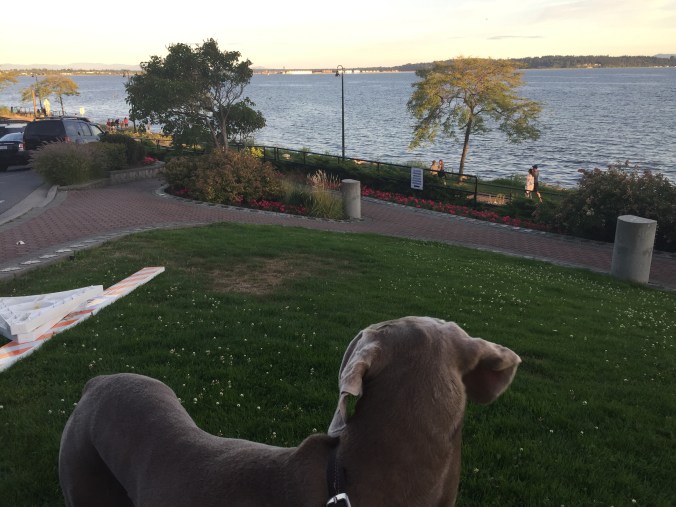
Over the course of 5 ½ days, Mitch and I and our dog, Hunter, drove through Tennessee, Virginia, Kentucky, Illinois, Missouri, Kansas, Iowa, Nebraska, South Dakota, Wyoming, Montana, Idaho, and the state of Washington before crossing the border into British Columbia by land and then boarding the ferry for our final destination, Vancouver Island.   More than once we doubled back, so to speak, moving through Iowa to Missouri and Nebraska, only to find ourselves back in Iowa. Several times we traipsed north to get south, as we did when we almost went to Vancouver to catch a more conveniently timed ferry to Victoria.

 Now, we are here and I am searching for that imagination of abundance. It might be right in front of me.

We crossed into Canada through Blaine, Washington on Wednesday evening. Our plan had been to spend the night in Blaine and cross in the morning and catch an early afternoon ferry to Victoria when our Airbnb would be available. After an unexpected delay getting out of Seattle, we had some trouble finding dog-friendly accommodations—we thought we knew what we were doing.

“Might as well just go [through immigration] now, we are as ready as we will ever be,” Mitch advised. So, we weren’t quite ready. We dumped our perishable food, filled out the declarations of goods we were carrying with us, and put all our paperwork in an accessible place.

We placed Hunter in the dog crate outside the immigration office and went in. Well, actually we all went in and were reminded to put the dog in the crate near the door. As has been the case, we had our things in order even though the kind young immigration officer didn’t seem to need some of our anxious preparation. I’m still a bit concerned that he didn’t “stamp” our declaration of goods for the coming move of our household goods. Paperwork for our vehicle as a temporary import was accomplished and the dog welcomed with little fanfare.

We stopped at this park as we entered to attempt to enjoy the beauty instead of panicking about what we were doing. It was a very brief respite.

IMG_1668

We did panic. We made a few stickers to translate miles per hour to kilometers to monitor the speed limits, threw caution to the wind (financial concerns) and used our cell phone GPS, took out our colorful Canadian money and looked for a hotel and fast food as the sun was setting.

I don’t believe that God opens up parking places and hotel reservations. We searched online and drove around looking for a room for maybe 45 minutes that seemed like 3 hours as darkness fell around us. Finally, a possibility at the Days Inn—not a place I’ve been fond of in the past. After about 20 minutes more, we arrived and at least it was in the direction of the ferry terminal we would take the next day.

Hunter and I waited in the car and Mitch went inside. The time that passed made me hopeful that there was a room for us. Mitch came out saying they had no more dog-friendly rooms. “Had we tried the Ramada?” the clerk had asked, before saying. “We have a suite I can discount. Don’t take the elevator, go up the side stairs with the dog.” The room was the first door on the second floor and very nice—the most upscale hotel we’d stayed in on our trip that actually lived up to the updated photography on the website. We had a living room area, bedroom, and bathroom to spread out into after 5 days spent mostly in our car. We felt empowered to make reservations for the 1: 00-afternoon ferry to Victoria anticipating a more leisurely next morning.

Maybe I do believe there is some kind of synergy in the working of God and people and events in the unexplainable surrendering of our own efforts.

IMG_1671

The sun was high overhead, the water glistening, and the vistas breathtaking as we ferried to our final destination. Our host had our small furnished space ready when we arrived and a church member across the street brought a bottle of wine to welcome us, made sure we had what we needed in the coming days, showed us the eagle’s nest at the end of the street, and even cooked fresh salmon on the grill for us another evening. We meet the couple that we will eventually rent from tomorrow afternoon to finalize the details for the September move to a whole house—I didn’t imagine that would be possible here.

The moving of our household hasn’t worked out seamlessly like I imagined, but small bits of information keep us moving forward. Somehow, I had the presence of mind to go ahead and put our worldly possessions in storage in Tennessee and plan that this will unfold. I’ve fallen into some more “what if” questions and am reminded ever so gently to quell that chatter to make room for the voice I need most to hear. The message is to stay in that place of quiet, where I let down defenses and pretense, to surrender and not brace so that God can speak. All is right deep down that makes the rest of the decisions possible—that God and other people or maybe God through other people—is looking out for us. How to live in that kind of abundance that God has provided? Buechner says “that is the shelter God calls us to with a bale in either hand when the wind blows bitter and the shadows are dark.”

That is the life I have and continue to be enveloped in—EVEN when I am anxious and lose the calm assurance that this life provides for me. And each time, I encounter the fidelity of God: the love, and grace that I truly do not actually understand or appreciate that continues anyway—an imagination of abundance.

Dwelling in Sunsets

This is the time you’d like to stay.

Not a leaf stirs. There is no sound.

The fireflies lift light from the ground.

You’ve shed the vanities of when

and how and why, for now. And then

The phone rings. You are called away.

SABBATHS 1998, Wendell Berry


We were in the basement organizing the boxes that I have repacked since our move just 4 months ago. Going through everything we own, getting rid of what no longer seems necessary, letting go of memories tied to objects we don’t need, not being sure about so many details of the big move we will soon make – I have been anxious and sad and angry and afraid and critical and inadequate. I haven’t shed but am entrenched in the vanities of when and how and why.

When I walked up the five steps from the underground room where I’d been sorting through my material life, I was confronted with the glorious sunset holding the beauty and promise of another day that had unfolded before me. I called Mitch to come up and see. He tried to capture the awe in this picture that, of course, you cannot do. I can only sense the presence of beauty and grace and promise at that moment when I pay attention.

E8FF6832-5210-48FB-894E-83A0FB158B7A

The next day, I attended the healing service and Eucharist at the Episcopal Church where our friend is the rector. When I entered the chapel, a stained glass image of Jesus with outstretched hands looked me straight in the eye. Looking directly into that face, I repeated the verse from Deuteronomy that I’ve been clinging to for months. The eternal God is your dwelling place, and underneath are the everlasting arms.

This is the third move we’ve made in 2 years. I do feel displaced and distracted. We will stay in a comfortable efficiency Airbnb for 6 weeks when we arrive in Victoria until the house we are renting is available. As I close boxes, I realize I won’t see my own books, use my own coffee cups, or sit in my morning chair for a while.

This transition has been particularly challenging. I imagined when we bought our house 2 years ago that we were settling in for the long haul. When our house sold and we moved to this rental, I was both grateful and grievous. I unpacked only what was absolutely needed to get by for a few months. Over the last few weeks, we’ve reordered, given away, and sold stuff in anticipation for a new way of life; yet, the anxiousness about getting there and all I don’t know has plagued me.

Parker Palmer has a new book fittingly titled, On The Brink of Everything. I have only read the beginning pages but the title is enough right now.

The sunset I witnessed last evening was not the end. That breathtaking color was a prelude to rest, to let go of the anxiousness of the day and be grateful for another kind of dwelling place— in the moment when I am able to shed the vanities of when and how and why, for now. To rest in a place that is not tied to a particular house, or city, or job, or even stage of life. Parker encourages me to reframe the changes that come with age and experience as a passage of discovery and engagement, and I could add enlightenment,

Look around…see the courage with which so many live in service of human possibility. Old age is no time to hunker down… [it is] another word for nothing left to lose, a time of life to take bigger risks on behalf of the common good.

Sunsets speak. Maybe I can stay in these moments of beauty and awe—to dwell there even for a moment that encourages the rest and assurance I need when the phone rings again. The everlasting arms are underneath.

Let It Be

I gain insight from my yoga practice that I didn’t ever imagine when I began. Somehow the physical practice embodies, for me, living truths of a life of faith. During the last weeks of spring, I found myself drawn to restorative and yin practices; I guess I needed this slowing of my mind and body. Typically these styles of yoga involve holding poses for longer periods. I recently read that restorative yoga moves us from letting go to letting be.

 I have experienced a deeper listening —for me it is listening to my life and to God—during the slower paced yoga class because there is a suspending of time involved.

So, I was a bit surprised by what I heard last week when I ventured into a class that I knew to be physically challenging—Strength & Flow—that is the opposite of the contemplative practice where I was seeking solace. After a series of vinyasa flows, our teacher said, “Rest in down dog.”

A downward facing dog is technically considered a resting pose I suppose, however, it is filled with subtle alignment and awareness. It deeply stretches your hamstrings, shoulders, calves, arches, hands, and spine while building strength in your arms, shoulders, and legs – not exactly resting? In this instance, I was not actively moving, taking time to pay attention to my body and breathing. To me, the reality that your heart is higher than your head is not just a physical manifestation but also a metaphor to which I might need to pay more attention.

Not only did my teacher commend us to rest in our downward dog, she added, “you are also building strength.” She paused, laughed a little, and almost to herself reflected that this synergy of resting and building strength is a good metaphor for life.

In this blog, I’ve engaged ideas of letting go and loosening my grip but not much about letting things be. For the first time maybe, after thinking about my teacher’s comment, I’m considering how these stances are intertwined or evolve to strengthen us in our faithful living.

I have been anticipating change for months since I found out my job would be ending. For months, I’ve waited and wondered and watched as my husband did the job search. Now that we know where we are moving, the certainty compared to the searching seems, in some ways, more challenging. This is the biggest move we’ve made—traversing 2789 miles, across an international border, and there is no road to actually get there since it is on an island.

I’ve been waking up early, or even in the middle of the night, a bit anxious about all the things I don’t know or can’t imagine at this point in time. I am not able to sort out all the nuances of figuring out what we really need to move, what to get rid of altogether, how to find a place to live and one thing informs another. Until we spoke with the immigration lawyer last week, I hadn’t even thought of the steps involved in actually crossing a border and considering where and how and when. Letting go. Letting be?

I’m reconsidering what it means to be in a wilderness—in the place, real or imagined, where I am not the one in control. It doesn’t mean that I don’t have any control.  There is a difference—the synergy of rest and strength.

What happens if I let things be? What happens if I just do some things each day that I can actually do, here and now, and not fret over the labyrinthine decision making process?

Scott Russell Sanders, in his book Staying Put, proposes a third response to the duality of flight or fight when we encounter challenges. He describes simply his decision to remain on his front porch when foreboding weather waked his senses and tornado sirens screamed in his Midwest neighborhood. Instead of retreating to the basement like sensible people would do, he chose to stay put and continue enjoying his dinner. What kept him there, he said, was “a mixture of curiosity and awe” and a desire to “see what comes.”  Sanders continues,

Psychologists tell us that we answer trouble with one of two impulses, either fight or flight. I believe that …my own keen expectancy on the porch arose from a third instinct, that of staying put. When the pain of leaving behind what we know outweighs the pain of embracing it, or when the power we face is overwhelming and neither fight not flight will save us, there may be salvation in sitting still. And if salvation is impossible, then at least before perishing we may gain a clearer vision of where we are. By sitting still I do not mean the paralysis of dread… I mean something like reverence, a respectful waiting, a deep attentiveness to forces much greater than our own.

 It is now six weeks before my husband is supposed to begin his new job. We have no place to live in the new city. We aren’t sure how we are physically moving. We aren’t sure when. Resting or letting things be doesn’t seem like an option. Considering the lilies (Matt.6: 28), unlike Emily Dickinson, is a commandment I’ve been breaking.

A small house in our new city is three or four times the cost of what we just sold our house here. On a recent, and my only, trip to Victoria, my husband and I drove around neighborhoods and mostly looked at the outside of apartment buildings and got a feel for different neighborhoods  We toured a house divided into apartments and two single houses for rent. They stood side by side in a neighborhood of both houses and low-rise apartments in a coveted location close to downtown and blocks from the ocean. The houses were slated to be torn down in the coming year, hence the month-to-month lease and any pets allowed policy. However, just like another inquiry I made via email, I was told, “vacancy rate is less than one half of 1% here, so it is likely these will be gone quickly.”

For thus said the Lord God, the Holy One of Israel. In returning and rest you shall be saved; in quietness and in trust shall be your strength (Isaiah 30:15). These reassurances are so easy to say but have to be re-lived with intention, over and over, when anxiousness and fear invade insight. Spiritual practice at its simplest is a moment-by-moment learning to respond to risk or opportunity another way.

So, like in the downward dog position, I have engaged my muscles a little by perusing rental sites, occasionally. I’ve spent a good bit of time getting rid of what we don’t need. However, the challenge comes in resting in this position, knowing that there is little, if anything, I actually control. I have to depend on God, on other people, on time unfolding, and on the fidelity of remembering that our needs have always been met throughout 39 years of marriage.

Resting in a strength building position is not doing nothing or being anxious about everything.  It is being open, noticing, and yielding to make room for possibilities to emerge. This stance makes it possible to see enough light to keep walking even when the roads aren’t there

 Now to have the courage to take this lesson again off the yoga mat and experience the surrender of letting be, with reverence, a respectful waiting, and a deep attentiveness to forces much greater than my own.

Empty-ness and Empty-ing

It is not God’s will that we should remain in need. He would fulfill all our needs by delivering us from all possessions and giving us Himself in exchange. If we would belong to His love, we must remain always empty of everything else, not in order to be in need, but precisely because possessions make us needy.

Thomas Merton, No Man Is An Island

 We are all of us like clay jars is the way I remembered it, and as time goes by, each jar gets cracked and broken and eventually crumbles away until there is not a single thing left of it except for the most important thing of all, the only thing about it that is ultimately so real that nothing on earth or heaven has the power even to touch it, let alone to destroy it, and that is the emptiness that the jar contained, which is one with the emptiness of all the other jars and Emptiness itself. Nor is that Emptiness ever to be confused with nothingness, but is rather whatever of its many names we call it by—nirvana, satori, eternal life, the peace of God.

Frederick Buechner, Crazy Holy Grace

Each day the first:

Each day a life.

Each morning we must hold out the chalice

of our being

to receive, to carry, to give back.

It must be held out empty—

for the past must only be reflected

in its polish, its shape, its capacity…

Lord, grant me the freedom to be an empty cup.

                        Dan Bagby (my own 20 year old self’s pastor)

The idea of emptiness keeps coming to me. That’s what happens when I write and read every day in the spirit of wrestling and wondering. Over some time, an idea is repeated over and over in different ways and somehow takes on a new shape. I just happened upon my college pastor’s meditation poem alongside the other quotations from Merton and Buechner in my reading the past few weeks.

Each day …holding out the chalice of our being. It must be held out empty—for the past must only be reflected in its polish, its shape, its capacity. Dan’s words, like Merton’s and Buechner’s, go on to speak of the freedom that our relationship with God grants us. Yes, it is a freedom that allows this kind of emptying of that, which holds me captive to my practiced way of living.

Empty-ness and empty-ing, are two words that hold new meanings in my life right now and, I think, in a life of abundance. Self-emptying—that empty place in the jar Buechner recalls from a Buddist story—means I empty myself of myself to be open to God and others. This idea of emptying myself of myself offers the possibility of NOT wondering what I will do next, wondering what other people thought or think of me, being concerned with most of the self-aggrandizing, comparing, and deprecating thoughts that fill my head when I’m not clearly paying attention to the moment.

Emptying has also been a literal pursuit that has challenged my perception and reality of what is necessary. I am literally emptying my life of weight—letting go of physical things like all the children’s books that filled a whole wall of my office. These books have enriched me and have served me in the past. But as they say in my yoga class, let go of what no longer serves you, and I believe that this is true at this time. In a larger conversation, that is what Merton and Walter Brueggeman in his writing are also saying. We become entrenched in our consumer-driven way of living and belonging that cause us to be too connected to our possessions, things, the ideology of successful accumulation that feeds the scarcity mentality I feel in keeping stuff.

In an act of emptying, I invited two of my graduate students to come get all of the children’s books and professional books in my office. Giving up this “stuff,” which was significant, was like releasing a burden, a way of life I have carefully cultivated. However, in this transfer of vocation, I also shared beloved possibilities for their lives. The act was a literal emptying and subsequent opening of my own self and way of being in the world.

Let go and let God seems so much like an easy platitude, an opt-out strategy. While it might seem to my striving worldview as not doing anything, it is actually doing the hard thing—emptying out the things that keep me tied to myself.

There are plenty of books in the library—well they don’t have all my sticky notes that tract my thinking. Maybe, I’ve been given the freedom for new thoughts to be had if I’m not clinging to those I’ve already recorded.

Come to us, Lord Jesus, to unsettle our expectations and certainties, open our hearts to bewilderment that we may be open to your wisdom; to inexplicable possibilities that You bring.                    Adapted from Brueggeman, A Way Other Than Our Own

Surprised by New Life

Lent is the journey of old visions of reality that have failed and being surprised by new life given in glad, inconvenient obedience.       

Walter Bruggeman, A Way Other Than Our Own

During this season of Lent, my intention has been to let go of myself and reopen to new possibilities. I am being invited into newness—well, it’s more like being forced into something else—since my job here is ending. And again, Walter Bruggeman’s words make a connection between giving up the old to make room for the new.  However, he has chosen words that nuance this age-old refrain in ways that transform my understanding of my own experience.

I certainly had a vision of what my life would be like when we moved to Tennessee from Indiana. I set out to do essentially the same job I’d been doing previously but in a new context, one that was more intimate than the large university to which I was accustomed. My vision of a quaint liberal arts college in the scenic surroundings of this Appalachian mountain valley is somewhat true. I envisioned the relationships I would have with my students in a smaller school and relationships with colleagues from across disciplines.

Yesterday, I had lunch with one of those colleagues whom I met even before classes began my first semester here. I relished getting to know her at our August faculty retreat.  Along with several others, we hiked up the mountain to witness the beauty and awe of these mountains where we live. Yesterday, much like that first day we met, our conversations turned quickly to things that matter: our families, our faith, and our sense and struggle of belonging.

I was immersed in newness when I returned from the retreat and school began that first year. I saw my new friend on occasion, but my vision of relationship was limited to passing conversations. I imagined inviting her and her family and other colleagues’ families over to my welcoming house to share a meal, but I didn’t. I imagined what it would be like to meet regularly at my house to support and challenge each other, but that didn’t happen. Now that this is my last semester, my friend and I met to catch up on our separate lives and lament lost opportunities, and for me, to catch a glimpse of our shared struggle to uncover what could be true in this life God has given to us.

Now, I am in the middle of Holy Week, at the end of the Lenten season, ready for new life because my old vision has failed. I use Bruggeman’s word failed that is beyond our everyday understanding of failure. Failure could mean I didn’t do enough or do the right things, checking off the boxes of my vision for a meaningful and successful life. However, that is not the compelling lesson of my faith in a power more intimate and deeper than what I do.

In the middle of the night, when I wake up, I often read to calm my raging mind. Last night, I read these words from Buechner’s A Crazy Holy Grace. He is remembering a time of fear for his very life and the calming assurance of a place of peace that doesn’t change our circumstance but changes our inside, that deep part of ourselves that is our self with God.

Two things, I remember, passed through my mind. One of them was the line from Deuteronomy, “underneath are the everlasting arms,” and for a few minutes I not only understood what it meant, but felt in my nethermost depths that without a shadow of a doubt it was true, that underneath, undergirding, transcending any disaster that could possibly happen, those arms would be there to save us if my worst fears [of death] were realized. And the other thing was a Buddhist metaphor that came back to me from somewhere. We are all of us like clay jars is the way I remembered it , and as time goes by, each jar gets cracked and broken and eventually crumbles away until there is not a single thing left of it except for the most important thing of all, the only thing about it that is ultimately so real that nothing on earth or heaven has the power even to touch it, let alone to destroy it, and that is the emptiness that the jar contained, which is one with the emptiness of all the other jars and Emptiness itself. Nor is that Emptiness ever to be confused with nothingness, but is rather whatever of its many names we call it by—nirvana, satori, eternal life, the peace of God. Suddenly… I found myself not only not afraid of what was going on, but enormously enjoying it, half drunk on the knowledge that yes, it was true. There was nothing to worry about. There was no reason for fear. It was all of it, all of it, and forever and always, good.

 So, even in the undoing of my vision of the life I imagined for myself here, even in my struggle to invite the kind of nourishing community of friends and sustaining work together, there is a place in me that is deeper than my vision of doing. Transcending my failure to invite my friend to my house or regularly meet together, I was touched by both disappointment and encouragement in that place inside me where God’s spirit is present. As we came together in a somewhat desperate move to rekindle that relationship I first imagined, I was surprised that all isn’t lost anytime we are obedient to the call of God to this present moment.

Not Yet, Reprise

I had the privilege to speak in chapel at King University in March 2018.  The following is what I said, a reprise of my last blog.

We are not who we were, and yet we are not who we will become.

I went for a walk in early spring when the snow was gone but leaves had not yet budded.

The light was clear and clean, falling totally unencumbered through the trees.

Yes, summer was coming, lush and unsubtle, but in that moment I found myself grateful and in love with the quickening.

Life is always lived between then and soon, right here and now, in the

Beautiful, not yet.                                                  Carrie Newcomer

Carrie’s music and poetry have named truths for my own life in the ways that only inspired words can do. She celebrates this time of year that has been kind of gray. Since the trees are still mostly bare, I do see the morning sky with different eyes. The sunrise is more visible through those bare branches that twist and turn toward the light. The trees let go of their leaves last fall (another Carrie song) so that there is room for new buds to grow. Letting go of the old made possible the new, however, Carrie reminds us that there is beauty to be witnessed in the in-between of winter bare and spring’s full buds. There is something to be learned in the here and now.

I am sort of in-between, right now. Perhaps you are, too.

We put our almost perfect house up for sale a month ago, anticipating a move this summer when my job here at King ends. I am in the company of those faithful and brave people whose contracts are not renewed for the coming school year. For me, it has been undulating emotion, certainly defensiveness, bravery at times, embarrassment because I’m not in control as the world of success expects, and yet, in all this, an amazing peace that I am okay.

Our house unexpectedly sold right away. I guess I should be happy about that, and I am a little. It has been a privilege to live in this place. We moved last week, during spring break, to a cozy rental, without a lease, another thing for which I am grateful.

We didn’t expect to be going anywhere. And to top it off, we really don’t know where we are headed… yet.   Women and men of faith have always been asked to leave safe places: to go to new lands, to unknown places God will show you, to receive new names, to take risks, and to take stands that are counter-cultural. I’m thinking maybe this place was a respite on that journey

I have been thinking about what I’ve learned here, what I will take with me from this place. You will do that too, those of you who will be graduating in just 7 weeks and those who will return but will also graduate next year or the next or whatever brings you to a next.

I remember the time when I was finishing my Ph.D., I was so focused on finding a job that validated my accomplishment. I thought that I needed a title from which to stand. I needed to put a “place,” an institution, behind my name along with my degree. What or how that denoted worthiness, I am not sure. I keep bumping up against the emptiness of this kind of thinking, of centering my life on accomplishments and doing as opposed to being who I am—not what a profession or place or group of people think I am or should be.

I continually struggle with whether things that happen are chance things or God’s things. What do I do and what does God do? After all my years of living, I’m not sure. My beloved Frederick Buechner reminds me, they are both at once, “incarnate in the flesh and blood of ourselves and of our own footsore and sacred journey’s.” There is no chance thing through which God cannot speak. God is present in all of our lives whether we believe in God or not and even when we are lost and don’t really know what is next. Most all of us, I would suspect, have felt a visceral wondering of what could be.

 During this season of Lent, I’ve been hanging out, so to speak, with Walter Bruggeman and his Lenten devotionals fittingly titled, A Way Other than Our Own. Lent is about noticing, Walter says, just like Carrie, and seeing differently. We have to decide to walk into the future or even beyond failure on terms other than our own. The scripture story from one of Bruggeman’s devotionals that we will read has always been strange to me, Matthew 15: 21-28. Jesus had just offended the elite Pharisees and perplexed his disciples and I think that maybe he went to the next place hoping for a break.

Listen for a word for your life right now.

21Jesus left that place and went away to the district of Tyre and Sidon. 22 Just then, a Canaanite woman from that region came out and started shouting, “Have mercy on me, Lord, Son of David; my daughter is tormented by a demon.” 23 But he did not answer her at all. And his disciples came and begged him, saying, “Send her away, for she keeps shouting after us.” 24 He answered, “I was sent only to the lost sheep of the house of Israel.” 25 But she came and knelt before him, saying, “Lord, help me.” 26  He answered, “It is not fair to take the children’s food and throw it to the dogs.” 27 She said, “Yes, Lord, yet even the dogs eat the crumbs that fall from their masters’ table.” 28 Then Jesus answered her, “Woman, great is your faith! Let it be it done for you as you wish.” And her daughter was healed instantly.   Matthew 15: 21-28 RSV

Now to me, Jesus doesn’t say what I would expect, him being Jesus and all that implies. He has just railed his disciples for worrying about Pharisees and not understanding themselves. And then he doesn’t seem so kind, really, to the Canaanite woman, an “outsider,” an “other’ to the Jewish people. First, he appears to ignore her shouts for help for her daughter as the story says he did not answer her at all.

His disciples wanted him to just get rid of her, begging him to send her away. And then he answers, “I was sent only to the lost sheep of the house of Israel.” Was he implying the focus of his ministry as the one sent to save Israel?

But she stands up for herself. Jesus offers, “It is not fair to take the children’s food and throw it to the dogs.” 27 She comes back, “Yes, Lord, yet even the dogs eat the crumbs that fall from their masters’ table.”

Walter Bruggeman says something powerful happens to Jesus in this narrative because of the woman’s persistence. She is clearly an outsider instructing an insider—and Jesus is willing to be in that moment. She explains to Jesus his larger vocation that up to this point he has not yet embraced—for his ministry to be enlarged. Jesus reached beyond his own people, beyond his perceived mandate, beyond his tradition, extending himself to this “other.”

Some of us are more able to embrace risk, to include others who threaten us and the way we see the world and ourselves. This means being open to new ideas, unforeseen circumstances and entering possibilities beyond ourselves, even those we fear. What might seem troubling or doesn’t make good sense is an opportunity for newness, for my life and relationship with the creator to be expanded.

How are we being summoned through the events or circumstances of our lives into newness—to be opened to an enlarged vision of being in relationship with God? This is lent and we are in a season on the way to new life. In this here and now, we are called to examine our passion, our suffering, our deaths and let go so that new life can grow.

For me, an illusion has cracked – what I see and what is have separated. I am able to be in this moment, ready for my ministry to be enlarged even though I have no idea where or how or when. And, right here and now, in the beautiful, not yet, I have opportunities that open me to new possibilities—like this one today.

I want to end with a prayer by Thomas Merton from Thoughts in Solitude. This prayer speaks of an enlarged vision of not knowning, of being open to newness and how to hold more loosely what we think makes our lives secure.

My Lord God, I have no idea where I am going I do not see the road ahead of me. I cannot know for certain where it will end, nor do I really know myself, and the fact that I think I am following your will does not mean that I am actually doing so. But, I believe that the desire to please you does in fact please you. And I hope I have that desire in all that I am doing. I hope that I will never do anything apart from that desire. And I know that if I do this you will lead me by the right road, though I may know nothing about it. Therefore will I trust you always though I may be lost and in the shadow of death. I will not fear, for you are ever with me, and you will never leave me to face my perils alone.

Thomas Merton, Thoughts in Solitude


Not Yet…

Carrie Newcomer’s new album is titled The Beautiful, Not Yet. She celebrates the time of year that seems mostly gray and lifeless, the days before spring is full. I do see the morning sky with different eyes now. The sunrise is more visible through the bare branches of the big tree in my yard, those branches that twist and turn toward the light. That tree let go of its leaves last fall (another Carrie song) so that new buds will soon appear. Letting go of the old made possible the new, however, Carrie reminds me that there is beauty to be witnessed in the in-between if we pay attention. Carrie notices,

We are not who we were, and yet we are not who we will become. I went for a walk in early spring when the snow was gone but leaves had not yet budded. The light was clear and clean, falling totally unencumbered through the trees. Yes, summer was coming, lush and unsubtle, but in that moment I found myself grateful and in love with the quickening. Life is always lived between then and soon, right here and now, in the beautiful not yet. 

 So, you might know where this is going if you know that I am sort of in-between, too.

We put our house up for sale a few weeks ago, anticipating a move this summer when my job here ends. The house sold right away. I guess I should be happy about that, and I am a little. It has been a privilege to welcome guests here, to sit on the porches, to come home here, and to watch the sun rise over the Holston Mountain through my kitchen window.

We didn’t expect to be going anywhere. And to top it off, we really don’t know where we are headed. Women and men of faith have always been asked to leave safe places: to go to new lands, to unknown places God will show you, to receive a new name, to take risks, to take a stand that is counter-cultural. Maybe this place was just a respite on that journey.

I have been thinking about what I’ve learned here, what it is that I will take with me from this place. But maybe Carrie’s song is reminding me to notice and rest in this moment when just because I don’t see anything doesn’t mean things aren’t happening. Pay attention.