The Hum of Home

I heard someone on the radio say that just as Hebrew is to Judaism and Arabic is to Islam, the body is the language of Christianity. I’ve been sitting with that wonder for a few weeks.

A sacred language is the particular language of revelation. In An Altar in the World, Barbara Brown Taylor says that wearing our own skin is not a solitary practice but one that brings us into communion with other embodied souls. She goes on to assert that God trusted, and I would add still trusts, flesh and blood to bring divine love to earth, maybe even using a body as an instrument of divine revelation.

What would it be like to know “more God” instead of “more about” God in our bodies?

 The Word incarnate. There is something precious and non-negotiable about this world and a divine heart within it. There is something profoundly to be noticed here, wonder’s presence. There is another way of conceptualizing the Word incarnate.

In a reflection on John 1: 1-14, Father Thomas Keating contemplates a material all-powerful vibration of the Eternal Word of God,

Now that creation has evolved and life itself has occurred, it seems that this initial vibration of the Word is still going on at the deepest level of everything that exists. This is the Word with whom every human being from the beginning of time has been in contact. This is the Word whose body, so to speak, is the universe, and in a more particular way, the human family. The eternal creative Word penetrates all creation as a kind of primordial “hum”. (You can almost hear it if you are quiet enough.)

Over the years, several physical practices have deepened my communion with God and my own body in this world. I write every day on paper using pencils and pens of varied colors and millimeters of ink that change the sensation and emphasis of the script. I write out each letter by hand, thoughtfully cross out the word that doesn’t represent what I am discovering, decide where to leave white space and page breaks, and mark up an emerging insight that I didn’t intend.

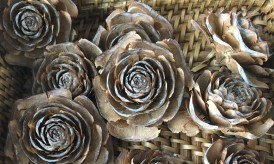
When I walk the dog, I stop to touch the smooth red and green underlay of the peeling bark on the arbutus trees that are native to this area. I pay attention to the unusual royal blue flowers that line the walk of my neighbor’s house. I pick up wooden rose pinecones and take them home for safekeeping before passing cars crush them. These seemingly ordinary things are, borrowing the words from Barbara Brown Taylor, “drenched in divine possibility.”img_0051.jpg
 

At the Luminous Wisdom School retreat I just attended, I’m thankful that Fiona, a participant like me, shared what seemed like a simply personal and particular physical challenge—that she was experiencing tinnitus and found herself filling each moment at home with music or a podcast to deaden the annoyance. The leader of our retreat and teacher of contemplative practices suggested that Fiona use the ringing in her ears as her “sacred word” during centering prayer. In centering prayer, one chooses a sacred word or another symbol of consent to God’s presence and action within. Returning to the word when our mind wanders and physical distractions occur. Fiona wondered aloud what it would be like to make sacred something that she found debilitating. I wondered what it would be like to imagine that sound as God’s presence.

In my case, I first noticed the cicadas in my ears several years ago. Initially, I only heard them later in the evening when I was reading in bed. I thought the sound might be some kind of utility buzz from the inner workings of the 50’s era house where we lived or maybe an odd noise from the decades-old television antenna that towered near my bedroom window. It wasn’t long before the ear insects showed up in church, too, in the beginning silence of prayer.

Over time, I’ve normalized the sound I hear that is always there, especially in the quiet. Most of the day, I don’t pay much attention to the gentle hum. When my mind is engaged in listening to something else, like the voices in my head, I don’t even know it is there. So, when Cynthia suggested that that sound could be the sacred word for prayer, I decided to try that alongside Fiona.

Astonishingly, the usual strain I experienced to choose and keep my focus on one sacred word melted away. I could physically feel the nano-second of release of other thoughts that my mind chose to grab and the seamless return to the noise that is always there awaiting my return. The insect-like noise doesn’t hold hidden meanings like my own wordsmithing of a sacred word does. Often, when I repeated my sacred word I found that more thoughts rushed in to further elucidate the meaning or justify my choice and both undermined the intention of centering prayer—to let go of distractions and to abide in God’s presence.

Could I listen, really listen, to that hum in my physical body to know “more God” instead of “more about” God?

In Richard Wagamese’s final novel, Starlight, the protagonist, Frank, is nurturing Emmy’s relationship with nature in which Emmy learns “to walk into the land fully open” and for the land to enter her. To me, the idea is akin to abiding in God and God abiding in me. After lessons on seeing, Frank expands the lesson to include deep listening.

…when you push your listenin’ out you can hear everything, I kinda figure it’s on accounta ya open yourself up to it all…

You get connected to what you hear. You become a part of it. It becomes part of you.

 In the deep listening, Emmy finds her calm center. God’s presence is a place to belong. That hum I can hear in my body is a tangible place, a spacious place to rest.

Listening to ringing in my ears is simple but not easy. This kind of listening requires no judgment, no analysis of what God is saying; it is simply consenting to and resting in the presence and action of the spirit. Maybe that is the ending of my story of the hum for now—that listening to whatever is God in us is to seek that presence in our body and to experience the spaciousness of creation. I can hear the hum.


Free to Let Be

It’s over for now. When I look back on the previous blog, my reluctant approach and actual fear of arranging rideshares for a retreat seem so trivial. Now, the riders and drivers are matched. I worked on this task for almost a month. In the past few days, people I love have faced much greater and life-changing circumstances and choices that make what I’ve been concerned about seem even more inconsequential.

When I was a teenager, I had the 5-year question. Faced with a challenge, a decision, or an embarrassment my internal response would ask, “Will this matter to me in 5 years?” As a 16 year old whose parents seemed to have deserted me, the question gave me a sense of rationality and control. Now, almost 50 years later, I wonder …

I don’t have words to explain what I wonder. “It” skirts between what some call synchronicity, or maybe the will of God, or what is meant to be—but none of those are exactly it. My ever-evolving question is what do I do and what does God do in my life? What I am certain about is that it isn’t that simple. The unexpected is never quite explainable. However, what can I take from these patterns of my life?

In the rideshare task, the most recent “matches” were made in thin air. Two riders, who had not responded to my initial email, suddenly, turned up needing rides. Both were coming via the airport; one of them landing on Tuesday, a few hours before the retreat, which was being held at a remote Education Center that was a two-hour drive away. The other was coming on Monday and would also like a ride back to the airport after the retreat was over on the following Sunday.

Miraculously-or not, I received an email from my friend Liz, that Sarah Smith was a possible new driver, not on my list. Sarah was away for the weekend so I had to wait several days to make contact with her. She had a small car, she said, so needed agile riders and, oh, could they be around the part of town where she lives? Miraculously-or not, Sarah was 15 minutes from the airport and the second rider was staying near the airport and an agile young mother. Yes, what seemed at least improbable was serendipitously and graciously arranged.

Another congruent choice I made last week was to listen to an audio of one of Thomas Merton’s lectures to novices at Gethsemane from the mid-1960s that appeared on my youtube stream on our television, instead of watching yet another poor quality video retake of House Hunters. The audio begins with an everyday issue: how to take care to minimize bath towel usage each week. What evolves from that quotidian beginning, left me examining how circumstances unfold. And, yes, choices we make have a way of bringing rivers of thought and practice together.

In a dialogue of sorts with the young men entering the monastery, who seemingly have a corner on the “will of God,” Merton’s insights are liberating. I transcribed a portion of the lecture that gives insight to the unfolding of my life wondering.  I have taken some liberties with names (Linda for Alfie) and condensed Merton’s argument.

What is God’s will? We asked that question wrong, we ask as pagans not Christians. When we are asking what is God’s will, we are asking what is my fate? …In other words, we assume that God’s will is predetermined, see, that God has sat up there in heaven, in a secret office and he reached in the filing cabinet and he pulled out the files and looks in [Linda].

“Elijah and Michael,come over here, what’s the plan for Linda?” 

They get together and there is this secret plan, see, and Linda, who doesn’t even exist yet, is born, and she comes into life and reaches the age of reason and says, “I’ve got to find out the plan.” …When it comes to contingent affairs, where there is a matter of choice, what is God’s will? …

Merton says that what happens in our lives (my wondering question) is a matter of the freedom that God has given us and that the “will of God” in the life of a Christian is the work of both God and the person together. Merton calls the intersection of these two freedoms an invitation on the part of God. Whether it involves vocation or anything in life,

…you are not supposed to guess and you are not supposed to figure out, it is something you worked out by free response. And what are the indications for the invitation? You have to take them in their existential facts, they are there or they aren’t. In other words, what happens is there are concrete facts or reality that you run up against in life and these things are manifestations of what God has planned or the manifestations of his whole idea which isn’t a plan ahead of time so much either.

 …God, from a certain point of view, has no plan in the sense of a plan beforehand because there is no before and after with God, he works it out as he goes along. It is all one with him; there is no past, present, and future. We think in terms of having a plan and working it out because that is the human way of looking at it.

 A wise human being usually thinks before he acts and there is nothing wrong with that, see. I’m not saying you are not supposed to think. This question of an inexorable will completely determined beforehand which we have to meet up to is the idea not of God’s will but of fate. God’s will is free and our will is free. And God is inscrutable in so far as he is free because nobody knows; you don’t even know how your brother is going to act with his freedom. So you don’t know of course how God is going to act either with his freedom, what do you do about that? 

Do you have to know beforehand what God is going to do with his freedom? Where do you fit that in, I mean supposing he decides to blast you with a thunderbolt or something if he wants to, what about it?

Faith, hope, and love, this is where theological virtues come in, there you put the thing on a completely different plane, you see… When you are dealing with persons you are dealing with what is free. So when it comes to faith, hope, and love you accept God as one who loves you freely and you trust his love and you trust that his freedom is going to be the freedom of one who loves. And you trust love and it is a totally different dimension. You don’t ask love to guarantee its plans for the next 500 years. Love is love and you let it be love, that’s all.

The circumstances of my life, then, are all matters of life and death, really. If God sees no past, present, and future, all life is conflated into this very moment.  I’m learning in this seemingly small stakes rideshare arranging to let go—to practice not figuring it all out and to give space for lots of ways of “working out” that I don’t have control over, that I don’t know, that I cannot predict or even imagine. I’m practicing spaciousness—to be less bounded by time, and response, and even what is or not my responsibility.

Whether it is God’s choice, my choice, someone else’s choice, or the aligning of freedoms of choices, I don’t know. But I do know that I can trust that whatever it is, what some call the mystery, does evolve with or without my concerted effort. It is about letting go of the boundaries, like time, or whatever else occupies my attention in a state of brace—that keeps me looking and longing instead of living into.

That’s what I’m learning from the mundane to the miraculous, to lean into love, the miracle of a new day, a moment of wonder, even awe. Whether for 5 minutes, 5 years, or 5 centuries, to let it be. And, I’m sure it’s not over.

Learning to Lean In

I don’t know why I said I would do it.

I don’t even know why I said I would volunteer. Those words just came out in conversation one day because I really do want to expand the small space I inhabit.  I thought whatever the task might be, it would be one that would be more in line with my strengths, not my weaknesses. And when she offered that I might consider arranging rideshares for an upcoming retreat, I knew it wasn’t something I’m particularly good at doing, but I thought it would be okay.

On Monday, I received the “list” of those who had offered rides and those who needed a ride. I began contacting participants via email on Tuesday. The advice I was given was to contact first the people who have offered rides to find out where they will be and how flexible they are about meeting up with others. Then, I could contact those who needed rides. I didn’t exactly take that advice. I forged ahead and just emailed everyone the same day.

My reasons were good ones, I thought. First of all, I don’t like to email people I don’t know, so I wanted to get that initial awkwardness out of the way. I spent too much time making sure the message was not too formal or too familiar. Maybe the truth is that, in this case, I didn’t want to reveal too much of myself, for my fear to peak through, I just wanted to get the business done. In hindsight, I should have at least introduced myself.

I realized too late that some of the people I was emailing knew each other and had been in retreat together before and others were newer than I, and thought I knew something more. A few wondered if I just wanted a ride myself or had an “official” capacity that caught them unaware. A few didn’t even realize they had offered to give another participant a ride or now needed a ride themselves. Many had personal stories to share of sick friends, doctor visits, and international travel that made their journeys unique. What I thought was straightforward information, was not.

Geography was another unexpected challenge for me as a newcomer (but remember I didn’t tell anyone that simple truth). The retreat is “up island,” as they say here. There are several ferry routes that people can take from the mainland, surrounding smaller islands, and even within the island. Even for people who live on the island, I’ve quickly learned that I can’t assume the route by one’s location. On the Malahat (the portion of the TransCanada highway going up island), accidents or rockslides close the route at least once a month for hours at a time, essentially cutting off Victoria (the largest city) from the rest of the Island. There are no easy exits since the stretch of road rests perilously between higher elevations of forests and the ocean. The only option for drivers is to take a smaller ferry or a multi-hour detour. People are creative in travel, I’m learning, to avoid this highway, taking ferries in all kinds of configurations and the way there might not be the same way home.

The truth is that I’m carrying too much for this task. I’m carrying these practical concerns but I’m also holding on to fears like how I present myself to these people I don’t know. I was afraid of being too personal when actually the opposite (not introducing myself and my lack of knowledge about travel) caused more work to figure things out. I was thinking too much about the task instead of simply encountering gracious people with cars and riders with stories to tell. I’m paying more attention to the agony of my inadequacy, or at least the inability I perceive might be true.

Now, it is the next week and I’m trying to not carry too much of the burden of figuring it all out.  I’m learning to practice leaning in toward the Light, my Lenten desire. Leaning in toward the Light means that I have to let go of all the if’s, the things I don’t know yet.  I have to let go of the fact that I don’t know these people and to instead consider this task as a way to get to know someone and their generosity in sharing both a literal and spiritual journey forward. I am learning to lean into the advice and practiced wisdom from my new friend who asked me to do this. Leaning into the light means that I shake off the dust of uncomfortable-ness and self conscious-ness to see the wonder and witness of the light beyond myself.

Carry nothing but what you must

Lean in toward the Light

Let it go, shake off the dust

Lean in toward the Light

Today is now, tomorrow beckons

Lean in toward the Light

Keep practicing resurrection

Invention to Discovery

In her novel, Fugitive Pieces, Anne Michaels describes history as the gradual instant, when we recognize that things have continued to move and change even without our awareness. Our personal recognition of change might seem sudden, but it isn’t. Looking back we see how proclivities of our own and other people’s lives have shaped what now seems extraordinary. In an interview, Michaels answered the question: How does history inform the present?

It’s a moral question. In moral terms, there is no before and after, then and now. How we live determines how we will act at any given moment. Our ability to do the right thing is not going to just suddenly spring from us out of nowhere. Our doing the right thing is like a muscle. Morality is a muscle and has to be used. Our doing the right thing depends on how we have lived before that moment comes to us. History is the gradual instant, the gradual present… In other words, there is a responsibility in daily life, in that daily life is what becomes history. It is the source of the formation of the huge event. It’s not separate from how we live every day. People always ask, “How could it have happened?” “How did this happen?” when, in fact, it’s not so hard to see how it happened. History erupts from the present moment.

Spiritual insight, rather than an epiphany, is also a gradual instant. We recognize, over the course of time, moments in our own lives and intersections with other peoples’ thinking and living that bring depth and meaning. I believe these encounters are not solely from our own lived experience but are also gleaned vicariously through circumstances of others’ lives, both real and imagined. Stories, in all forms, matter—we use bits and pieces of other people’s stories that generate abundance in understanding our own.

I recognize the gradual instant that erupts from the accumulative layers of spiritual reading and writing that I have practiced for much of my life. I’m not sure when or how I came to recognize the process of my morning routine as a ritual. Over the years, the order and substance of this contemplative time has both evolved serendipitously and followed specific patterns that I took from others, building a kind of spiritual muscle memory as Anne Michaels describes.

When I read Richard Wagamese’s introduction to his book of meditations, Embers, I brought my own history of scared mornings with me. The author explicitly describes his morning spiritual practice that I wanted to use to refresh my own. I, too, read from several texts each day that over time have moved among devotional, scholarly, contemporary and spiritual classics and include scripture reading. It is a gift when I see connections and gain insight woven in between these texts.

Wagamese capaciously describes his morning ritual. The silence, the warmth and scent of his cup of tea, the rising smoke of his tribal medicines, and the shadows of dawn echo the sacredness. I wrote down for myself his protocol that is steeped in his Ojibway ceremony. And even though I don’t have such a rich heritage in my own experience, there is enough that is familiar that provides a foothold for me to pay attention to the ritual, the ceremony of the routine that made a difference.

I need the ritual. What and how I read, the order of reflection and prayer, writing down my thoughts and even showing up are part of my morning routine. A ritual, according to Frederick Buechner, is the performance of an intuition, the rehearsal of a dream, the playing of a game. The ritual of my morning allows me to practice listening to God, even if I am not always able to sustain that listening throughout the day. I discovered an order of ceremony in Richard Wagamese’s ‘morning table’ as he calls it that offered me new possibility.

Now, in the morning, I make a cup of coffee using my manual coffee grinder and my red ceramic pour over cup. I hadn’t thought of this as part of the ritual, using these tangible aromas, tastes, warmth, and breath to call myself to the scared presence of morning. After a more intentional order of three readings, I close my eyes and intentionally ask what the readings have to tell me that day. After a prayer of gratitude for all the goodness that is present in my life, I ask to take the sacredness of this ritual into the day to perform the role the Creator has asked of me.

On that first day of my own morning table, I read from Embers that in silence, I reclaim myself and that “allows me to move outward into the clamor of living.” The Buechner reading for the day reminded me that the gift of now is a process of discovery rather than invention. The Psalmist (24) encouraged a pure heart that doesn’t get caught up in trying to craft the vision of my life, nor lifting up my soul to what is false— both my invention. The thread throughout these readings is one of discovering rather than striving to do or be something.

I use my gifts to discover this life, to sit back and watch it unfold. When I create stories about other peoples’ lives and even my own life, I am inventing not discovering. Discovery is when I interact in real time and see the good and the challenges and meet both head-on—with goodness—trusting God, myself, and other people.

Discovery is when I find that glimpse of beauty I need in life to always see something anew. Using the Psalmist words, may that beauty seep into my bones and my subconscious—where stories come from. May I discover that that nourishes me quietly and calls me to something more worthy than the distractions of the day.

I won’t suddenly have a miraculous life…or maybe I will. As I look back over my life one day, I will see the gradual instant. The moment after I realized the ritual of discovery, with gratitude, to be ready to do what the Creator asks of me each day. Truths come gradually and at the same time, in the very moment when they make the most sense. As I write this, I realize how concretely this understanding is at the heart and praxis of my new morning meditation.

Discovery instead of invention came as a gradual instant, not a sudden knowledge, but a gentle emergence from the memories and practices I’ve been doing for a long time. My recent day of discovery wasn’t so sudden and yet, it was an epiphanous moment. It was a gradual building of my capacity to make connections, to hear what I needed to hear, maybe even the voice of God.

For more than thirty years, I have shown up to this time of meeting God and myself. It was an instant of recognition or maybe an instant of being able to name for myself that

Life is grace, for instance—the givenness of it, the fathomlessness of it, the endless possibilities of its becoming transparent to something extraordinary beyond itself.

Snowy Desires

d8IPeXRfS4KjtqlhsQae+g_thumb_6a3

We had over 55 centimeters of snow this month, most in the last week, an astounding record for my island home in the Pacific Northwest This is the view outside my back window. I love snow and the peacefulness of it’s falling. I cherish the chance to burrow safely inside. The evenings have been unusually bright with the illuminating snow cover. My friend here said she felt like a real Canadian now, instead of being associated with the usually temperate climate of Southern Vancouver Island.

For the past several days, I have stayed close to home. I’ve watched more TV than should be allowed and I’ve created meals from the bounty in my pantry to avoid going to the grocery store. The days have melted together, one indistinguishable from another.

Throughout the snowy week, I have avoided two dinner parties and coffee with friends and it was a relief. I struggle with the many invitations I receive and with the obligation I feel to reciprocate. I want the encounter to be more casual or spontaneous. Lately, I seem to have lost the desire to welcome that I thought I was finally cultivating where I used to live.

On one of my most recent cold mornings, what should have been a promise turned disheartenedly into a dilemma as I prayed a morning Psalm.

May he grant you your heart’s desire, and fulfill all your plans. (Ps. 20:5)

I have no desires or plans, I thought. Could that be true? I came face to face with the realization that I continue to define my life by a job or a career or a passionate role—even though I have written, read, and prayed against this stance for much of my adult life. Writing is a spiritual practice that takes me places I don’t know to go. And, on this day, at least 30 minutes of my too-much television viewing elucidated the possibilities I’d worked out through my morning pages.

One of the television shows I watch occasionally is Big Bang Theory. On a recent rerun, Penny reacts to her boyfriend Leonard’s passion for a TV show he wants to share with her. In a conversation with another member of their friends’ group, Bernadette, Penny laments that she doesn’t get that passionate about anything in her life.

Bernadette: Why does this bother you so much?

Penny: I don’t know. It’s just, he’s so passionate about so many different things. I just don’t get that way. Do you?

Bernadette: Well, sure. I’m pretty passionate about science. I remember the first time I looked through a microscope and saw millions of tiny microorganisms. It was like a whole other universe. If I wanted to, I could wipe it out with my thumb like a god.

Penny: See? I wish I had some of that fire in my life. I mean, I want to care about things and get excited like you guys.

Bernadette: Well, there’s no reason you can’t.

Penny: You think?

Bernadette: Absolutely. All we need to do is spend a little time and find something you’re passionate about.

Penny: Ugh, that sounds like a lot of work.

Penny is a brilliant character choice in this line-up. You see, all the other people in this close group of friends are accomplished scientists with the most advanced degrees and engaging research agendas that permeate their everyday interactions. Penny is a waitress at the local Cheesecake Factory and occasionally aspiring actress whose character continually butts up against the intellectual milieu and social ineptitude of the other characters. In this particular episode, the theme is re-conditioning or a kind of regeneration of sorts. Culminating this part of the story, Penny and her boyfriend Leonard revisit her lament with new insight.

Penny: See, that’s the kind of passion I didn’t think I had. But then I realized I’m passionate about you.

Leonard: Oh, my cute little tushy strikes again.

Penny: No, I’m serious. Look, I’ve always had these plans. I was gonna be in movies and live this glamorous life, and anything less than that just wasn’t worth getting excited about.

Leonard: Those things can still happen.

Penny: Oh, obviously it’s gonna happen. Yeah, a psychic at a bachelorette party told me so. Anyway, what I meant was, I shouldn’t wait, you know? I’ve got you, I’ve got Sheldon, all these wonderful friends. My life is exciting right now.

Leonard: That’s a big deal.

Penny: It is, isn’t it?

Leonard: So, does that mean we get to do stuff like talk about cool shows or get dressed up in matching costumes and go to Comic-Con?

Penny: Leonard, I had an epiphany, not a stroke.

Penny epiphany was far from looking at her life through a lens of grace or was it? Her desire and plans for a career will unfold, however, she shouldn’t wait to be passionate about the lives and relationships that enable her abundant living in the here and now. When I pondered my response to this verse in the Psalms in my writing pages, like Penny, I saw more clearly what was right in front of me.

So back to my desires and plans. I want to have a more healthy and whole relationship with my family—my son, my daughter, and my husband. I want to be less guarded with other people. I want to love God by honoring these people that are closest to me and not spend my imagination considering how they might live. My desire is to take myself off the hook and let them figure out the weakness and strength of a thing in their own way and in their own good time.

In response to the invitations to coffee, to dinners, to tea, and walks to explore this community, being gracious is not difficult. I don’t have to be an extrovert; I can be myself. According to the Rule of Benedict, humility is the admission of God’s gifts to me and to use these gifts for and with others.

Almighty God, to you my heart is open, all desires known, and from you, no secrets are hid: Cleanse the thoughts of my heart by the inspiration of your Holy Spirit, that I may perfectly love you, and worthily magnify your holy Name; through Christ our Lord. Amen.

Regeneration: A new lens for grace

According to an online dictionary, regeneration is the action or process of regenerating or being regenerated. Now, I know that using the same root word in the definition doesn’t tease out much understanding. The good thing about online definition finding is that I noticed on the side of the same page the biologic concept of ‘regeneration’ that was quite generative.

According to Wikipedia, in biology, regeneration is the process of renewal, restoration, and growth that make genomes, cells, organisms, and ecosystems resilient to natural fluctuations or events that cause disturbance or damage. Every species is capable of regeneration, from bacteria to humans.

The process of renewal, restoration and growth already sounds like a spiritual journey. The purpose of this regenerative process, to make us resilient to the natural fluctuations or events that cause disturbance or damage, sounds like the grace of God.

This past summer, right after we moved, I reread an old blog of mine where I gave myself some good advice: to see my life through the lens of grace rather than fear and anxiousness.   I know this does not change what is, but affords me another way to situate the circumstances of my life.

So, I particularly took notice when Anne Lamott wrote in Operating Instructions, that, that’s what grace is—the divine assistance for regeneration.

I will conflate biology and Anne’s definition of grace: God is guiding, directing, creating and a participant in the process of renewal, restoration, and growth so that I become resilient. Being resilient means I am able to face whatever is, in surrender, which seems the opposite of strength but, in the great paradox of faithfulness, is strength.

What does it mean to see my life through the lens of grace?

I am grateful that each circumstance, each experience, each moment is one where some part of me is growing, being restored, and renewed.  Grace.

Indomitably Expect

“It was your return ticket.”

That’s what Norma said to me when I told her about my recent experience flying back to Canada.

My flight was scheduled to leave the Ohio airport at 6:30 in the morning.  I have a US passport. I am a citizen of the United States.  However, when I attempted to check in online the night before I was to leave, I learned that I would be required to see an agent at the check-in desk before obtaining a boarding pass.  That hadn’t happened before.

The young man at the counter that next morning asked for documentation that I was a legal resident of Canada. It seems the airlines was concerned because I didn’t have a return ticket. And, like Norma reminded me, this was my return ticket. I knew when I arrived in Victoria, the customs agents would ask for my officially embossed paper that assured my easy entry. I was ready to prove my status then. But, I balked at the Delta desk attendant demanding that proof in order to leave Ohio for Minneapolis.

I don’t need to prove my worth as a parent, a wife, or teacher, or even a person of faith. So, why do I keep trying to do that?

I am not the noise—the inadequacy of the deep sleep dream I keep having—of not measuring up. Measuring up to what? That is my elusive question.

I can’t seem to break out of the breadth of ‘less than capable’ that I’ve experienced lately. When I consider the last year of my life, I see both moments of struggle or moments of grace. I just don’t see much that seems effectual—that I’ve done anyway. I want to generously be with my family and friends, while at the same time I shield myself from the risks of being less than I imagine.

Professionally, I had one project hanging on that keeps meeting roadblocks, not exactly of my own making. However, I keep wondering what I could do or have done differently to make the going smoother. In another situation in response to the Chinese church here in Victoria, I’m now filling in as the leader with an English language learners group. The participants are so gracious. The first meeting together that I planned would have been more appropriate for first graders. I don’t speak or understand their language and acutely feel my lack of practical insight about what to do in that two hours I will spend with them each Friday. What can I do differently to make this time generative for acquiring a new language in the cradle of supportive relationships?  I don’t know.

Unexpectedly for February in Victoria, today the sun is shining and it is cold. And for me, a wee bit of goodness is peaking through with the sun. I’m not sure I believe it, yet.

Simone Weil, Christian mystic, who died quite young, wrote:

At the bottom of every heart…there is something that goes on indomitably expecting, in the teeth of all experience of crimes committed, suffered, and witnessed, that good and not evil will be done to him. It is this above all that is sacred in every human being.

In the midst of my worry and doubt, I do desire the goodness that is lurking below the surface of every encounter, of every circumstance. I must remind myself that expecting goodness doesn’t mean a specific outcome. Expectations are a different stance and often lead me to disappointment, to those feelings of inadequacy.

In that English learner’s group, I had expectations for myself. I have the expertise, a Ph.D., in literacy, culture, and language, and even though adult language learners aren’t my calling, I thought I knew what to do. I had expectations for the three people I met previously that turned into eight eager learners in that first class I lead. I didn’t expect their generous spirits, the welcome and the safe space that we cultivated together despite my uncertain preparation. We unleashed goodness by sharing our inadequacies, whether real or perceived and our gratitude for the opportunity to be in a new city.

My heart still hurts for circumstances beyond my control in other parts of my life, for unknowns that keep surfacing. Someplace, inside of me, is that assurance that our lives are above the fray in which I often stay too long. How can I recognize God’s goodness that is deeper than my actions, thoughts, and fears?

Instead of feeling that I have to act or wondering what will work in response to living, the presence and peace of God offer me the opportunity to face what is. In surrender, I am opened to the serenity of faith, the courage of hope, and yes, the assurance of goodness.

Getting up on this cold morning, I was thankful for the quiet radiator at the top of the stairs. It’s gentle warmth unobtrusively permeates the air. I’ve taken to laying my clothes on it before I get dressed. I began the day both steeped in this warmth and agitated by a professional problem I could not solve on my own. I was grateful that I have colleagues who were witnesses to what I could do and offered their contributive presence no matter that they are thousands of miles away.

I also woke up from those all too familiar night induced worries.  This time about another person’s life that I love beyond reason. I was reminded, again, that he belongs to God. Later in the day, my dark thoughts were upended –people and circumstances were unfolding that countered my imagined fears.

Indomitably expect. Trust in goodness. No proofing yourself required.

The Rules

The rule teaches us to listen to the circumstances of our own lives. We have to begin to face what our own life patterns might be saying to us… When we are afraid, what message lurks under the fear…? …When we find ourselves in the same struggles over and over again, what does that pattern say…?

Joan Chittister, Wisdom Distilled from the Daily

 In her book about living the Rule of St. Benedict today, Joan Chittister is explicit about the possible patterns that the circumstances of our lives might reveal. Am I terrified of failure? Am I trying to cover up my weakness? Do I panic at the thought of public embarrassment or the sense of valuelessness that comes with the loss of approval?   Do I always begin things with great enthusiasm and abandon them before I am finished? Am I reluctant or afraid to change no matter how good or right the changes might be? Do I keep imposing the same unsatisfactory relationships with people from my past into the present ones? Have I ever really given myself, down deep, to anything except myself? What patterns do the circumstances of my life reveal?

In the quiet of my morning, I have times of insight, repentance, and gratefulness—then I go back to being the person who gets stuck in my own solitary world and am irritated or afraid when other’s inadequacies mirror my own. I ponder and even plan the perfect life I will live—in the near future, when I have established my house or have landed in a particular setting.  I long for a beautiful view and a big table to engender conversations and welcome for all kinds of people that just happen by. I imagine a life where I will have meaningful work to do at leisure. You know, that’s what I kind of thought before I moved here, to this place and house and people where I live now, at this moment.

I remember over 30 years ago, we lived in a newly built house with light blue carpet, south of a large metropolitan area. I remember writing in my journal that I wished for a house with hardwood floors on the other side of the city. Aside from the wooden floors, the houses on the other side of town were older, smaller, and required sweat equity to match the ease of lifestyle to which we were accustomed in our suburban neighborhood. I’m not sure what I was really searching to gain.

My last three houses have had hardwood floors: one with worn-out narrow oak planks, the next one gleaming newly refinished, and now the pine floors where we live have comfortable dog scratches already built in. Listening to the circumstances of my life might tell me that I sometimes imagine my life looking toward the next stage or location or configuration, particularly when those circumstances are challenging. I could also surmise that the substance of the floor I walked upon had little impact on how I lived beyond that surface.

I continue to encounter parallels between the wisdom of spiritual traditions that similarly require living the paradoxes. My life of faith moves unevenly between life and death, promise and struggle, solitude and community, and this present moment and the next. In his insightful look at The Promise of Paradox, Parker Palmer writes

Contradiction, paradox, the tension of opposites: these have always been at the heart of my experience, and I think I am not alone. I am tugged one way and then the other. My beliefs and my actions often seem at odds. My strengths are sometimes canceled by my weakness. My self, and the world around me, seem more a study in dissonance than a harmony of the integrated whole.

Dissonance. There is an attitude of mystery in the universe that guides every conversation and every common act. A contemplative awareness is possible that sanctifies the here and now when we accept the complexity and contradictions of our lives in contrast to the illusion that things are simple and we are in charge. Parker goes on to reflect that God sees through our illusions and delusions and meets us on the other side when it becomes clear that something has been leading us all along.

I’ve encountered this wisdom, over the years, in different forms. The Rule of Benedict challenges me to expose my ideas to the critical voice of wiser hearts, to seek community beyond my quiet morning reflection. In solitude and into community, we work out our connectedness to God, to one another, and to ourselves. The last few months I’ve been reading the words of an Ojibwe author, who has extended my community.  In one of his memoirs, One Native Life, Richard Wagamese recalls teaching from his Spiritual Elder:

Through the ceremony of the medicine bowl, he taught me how to pray in gratitude, to ask for nothing, to be thankful instead for all that was present in my life right then and there. Then he told me to take the spirit of that ceremony out into the world with me.

Anyone can be spiritual in a quiet room, but out in the world is where the challenge presents itself.

It’s the knowledge and acceptance of the mystery that surrounds us—and the awareness that allowing it to remain a mystery, celebrating it rather than trying to unravel it, engenders humility and a keen sense of the spiritual.  

Sister Joan Chittister adds to this mystery that the real monastic walks through life with a barefooted soul, alert, aware, grateful, and only partially at home.

Therefore the Lord waits to be gracious to me—the very contradictions in my life, the dissonance, are evidence of God’s mercy and mystery. Blessed am I when I wait; when I don’t strive to manage, figure out, and react to the noise of the world. My teacher will not hide. My eyes shall see my teacher, and my ears will hear a word behind me saying, this is the way, walk in it (Isaiah 30:21).

Listen and celebrate the mystery.

Listening for Home

img_0722It is easy to know what is good for someone else. It is difficult to listen and let them define themselves.
Joan Chittister, Wisdom Distilled from the Daily


The Walton’s.  I faithfully watched the show growing up, longing for a John-Boy, or maybe more truthfully, hoping that I was the John-Boy in my own family. I wanted that multigenerational experience that celebrated the bond of love despite each member’s individual expressions of living. Contrary to that close-knit household on television, in my mind, I separated myself from the woes of my own family. While I pretended large with my Aunt Bessie’s discarded elegant dresses and high heels, spray painted silver for my garage variety shows, I was suspect of her vivid storytelling, and the way she arrived at our house: her hulk of a car carelessly pulled up on the curb and her fifth of vodka safely tucked into her generous purse. As a teenager, I never wanted to not be in firm control of my life, as I perceived those closest to me who, like my Aunt Bessie, reacted to or escaped life’s tenuous balance.

It is easier to watch the show that is someone else’s life and to think that I know for certain how I would live that life, while not giving attention to my own.

I’ve been slowly working through Joan Chittister’s Wisdom Distilled from the Daily: Living the Rule of St. Benedict Today and reflecting on the weeks I’ve spent with each of my adult children over the past few months. The Rule involves listening to others needs and also teaches us to listen to the circumstances of our own lives.

I know how to meet life’s basic needs. I cooked and cleaned and consoled the weeks I stayed with my son and then my daughter during their own transitions. I also admit that I struggled to not say how I would manage any number of daily dilemmas that inevitably surface when you spend a few weeks with someone else. I am also aware of how I listened to the other person’s account of his or her day and made hidden judgments about the why or how or when or how much and all the while I was struggling to figure out my own why and how and when and how much.

Now that I have returned to the other world of my own house, I don’t quite know what to do with myself. I anticipated coming home and renewing my intention to live in the abundance of this, my new home.  I was reminded of the beauty of this island as the plane circled before landing. I thought I was ready.

I had (and have) plans to explore this unique city, to visit the Benedictine sisters on Shaw Island, to pursue a volunteer opportunity at The Contemplative Society, and to inquire how I might respond to a request to support the youngest readers at the Chinese church preschool. I do relish the opportunity for my own reading and writing and pondering, but also recognize the inwardness that I’ve hidden inside instead of seeking community.

All is not lost, though, in the days since my return. I have rearranged our dresser drawers, cleaned out and organized one kitchen drawer, did the laundry, and cooked one suspect and one glorious new recipe.  We attended our first Rabbie Burns Day Dinner (Scottish immersion) on Saturday and I was enveloped in the care of church folk who celebrated my return on Sunday. I’ve been invited to coffees, dinners, and an artsy group in the coming weeks. Yet, the truth is that I don’t know how to lean into this new life I’ve been given.

My truth is that I know how to keep knocking on the closed doors of the past year and  I know how to worry about the definition of my family that has also been re-invented in recent months. I’ve been trying desperately to survive the changes. I’ve been figuring out what is good for other people instead of listening and letting them define that for themselves. I’ve been figuring out what is good for other people because I don’t know quite what to do for my own life—this isn’t the same path I have coerced my way through the past few years.

One my plane trip home on Thursday, I was astonished by words that I’ve read before, yet heard for the first time. I cannot define or live another’s life and I am perplexed, again, how my human best tends to be at odds with the holy best.

To do for yourself the best that you have it in you to do—to grit your teeth and clench your fists in order to survive the world at it’s harshest and worst—is, by that very act, to be unable to let something be done for you and in you that is more wonderful still. The trouble with steeling yourself against the harshness of reality is that the same steel that secures your life against being destroyed secures your life also against being opened up and transformed by the holy power that life itself comes from. You can survive on your own. You can grow strong on your own. You can even prevail on your own. But you cannot become human on your own… the one thing a clenched fist cannot do is accept, even from le bon Dieu himself, a helping hand.

The Sacred Journey

I cannot manage nor imagine  “more wonderful still.”

I wasn’t just the oldest child in my family, like John Boy Walton. I thought I was the only adult, many times. I had to take charge of my own life.

Maybe it’s time to soften my jaw, to unclench my teeth, and to listen to and let be—all kinds of relatives.

Advent Listening for a New Year

2018 was a year of change. I turned 65, I lost my job, and we sold our beloved home, moved 4 times, welcomed and lost close family members and communities – events that offer an opportunity for deep listening.

I’m learning about my new home in British Columbia. Cascadia, the Pacific Northwest region of Oregon, Washington, and British Columbia, boasts that residents are spiritual and not religious, a distinction that shapes a way of life with the natural world. I also discovered that The Contemplative Society, that encourages Christian wisdom tradition, is based in Victoria, BC. I attended an Advent Silent Mini-Retreat this group co-sponsored with the Interfaith Chapel at the University of Victoria on a recent Saturday.

Being a bit cautious about riding the city bus for the first time to the University from my house and thinking the retreat started at 9:00 instead of 9:30, I arrived about 8:45. As synchronicity would have it, I helped Liz and Henri, who were leading the retreat, get the space ready. They welcomed me as an insider rather than as a first-time participant. We set up the kitchen area for a break and a light lunch, arranged tables in the outer areas, and carried chairs and pillows to the chapel space. Liz even asked me to greet people as they arrived when the time came, thus encouraging me even more to belong.

I risked entering into the day in this spirit of welcome and brought my most inward practices into community. And in that unfamiliar sense of community, I did newly experience familiar patterns I’ve cultivated over the years. I participated in chants in the style of Taizé, which were new to me, and familiar centering prayer and contemplative reading. A prayerful and reflective walk through the exposed shapes of the winter garden next to the chapel expanded my understanding of possibility in a season not usually associated with growth.

IMG_1938

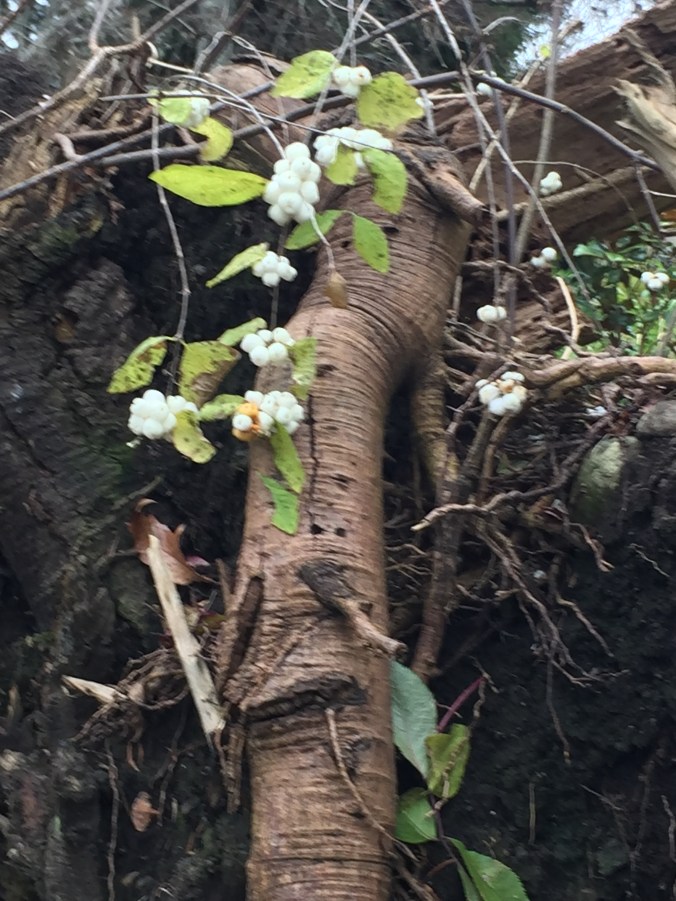
Snowberries in Finnerty Garden, University of Victoria

I’ve nurtured a way of reading and meditating on scripture, Lectio Divina, for many years. On this retreat, sharing that experience with others, I had to consciously listen, since I wasn’t the one reading to myself as is my usual custom. Liz, one of the retreat leaders, read Luke 1: 26-28. Slowly and deliberately, she read the scripture multiple times. I didn’t have the opportunity to see the words, so I noticed more acutely the ideas that stood out to me as I listened to this Advent story of Mary’s visit from an angel foretelling her role as the mother of Jesus.

I heard that Mary was favored by God and asked to do something she had never done before. For maybe the first time, I heard Mary question how this could be so, she wasn’t even married yet. Then I heard those familiar words, nothing is impossible with God, which I usually associate with Sarah’s, Hannah’s, or Elizabeth’s stories of the miracle of conception when that was their deepest wish, prayer, and impossibility. I heard clearly Mary’s answer, “Here I am Lord, let it be done to me according to your design.”

In the penetrating gift of silence that followed my hearing, I was able to attend to my own life alongside Mary’s experience. Here, in my new place, I also am being called to something else, something I’ve never done before. I said that, in so many words, last November and December and January and February and even March when I knew I wouldn’t be continuing in my job at the University. I knew my loss forced me to embrace newness.

But then, I lost sight. I got bogged down in the uncertainties when I knew where we might be going. How crazy is that to have that awareness of newness when I didn’t know where I would be—but then to lose that sense when the way became clearer that Mitch would take a job in Victoria.

When my last semester was completed in the spring, I was disoriented. I went through both the pain and great hope of graduation as my own ending. I was thankful for Tom Long, the graduation speaker, whose words were life-giving: go deeper, abundance, reversal, and confrontation.  I was thankful for colleagues who acknowledged my sadness with steadfast care and respect. I was thankful that I had the foresight to decide to do what I knew was right even at the last minute, to have the courage to go to graduation when I said I wouldn’t because I thought it would be too painful.

And then, in that quiet place, my heart wasn’t quiet as the veneer of anticipating newness began to buckle under the weight all that unknown—significant life changes for both our adult children, revisiting Victoria in anticipation of moving, the agony of planning another physical repositioning. I met these changes with brace rather than surrender to the newness being offered.

I lived the uncertainty anxiously, perseverating over the details of planning an international move. As I pondered what to give away or keep, what parts of life, as I knew it, would be coming along, my decisions were uncertain. I continue to second guess and hold old visions too tightly. I am still somewhat unwilling or unable to claim this place as our own—my own—my dwelling place for this time. The freedom to be able to make unplanned trips to be with family in their own states of change and challenge has actually made the separation of things and place even more acute—the unsettledness and disorientation renewed.

In my new home, I have passed over the signs of new life. The beauty of the island is muddied by my old dream of hardwood forests on old mountains that soothed my mind’s eye. Even with the fast and sure friendship of two women my same age and the unusual cast of characters who have generously shared their stories with me in my new home, I don’t know if I’ve given in—let my guard down so to speak. I lack the surrender to newness that keeps me apart and uncertain.

And now I come to this day, facing my impossibility. What do I hear? What is God’s word to me as I listen? I reread that scripture with my own eyes in the shadow of that new contemplative community I experienced at the retreat.

But she was greatly troubled… (v. 29)

Another translation says Mary was perplexed. Mary’s response bears similarities to my own of this last year – disorientation, not knowing, being afraid, even wondering how this can be.

How can this be since… (v.34)

Mary, too, is giving God a reality check. This thing you are telling me can’t be possible and here is the reason—this doesn’t make sense. However, it

…will be holy… (v.34)

What is happening to me is holy, of God, and not entirely my own doing.

Nothing is impossible with God. (v. 36-37)

The angel gives evidence of Elizabeth’s impossibility taking shape. Notice and lean into what God is already doing.

Here I am…let it be done to me… (v.38)

Mary simply was willing, available, and consented to God’s presence and action in her life. I’m reminded that these mothers celebrated the impossible that was right in front of them even though they could explain none of it. Even though I have not done so simply, am I able to let old certainties make way for the impossible?

The lesson is not new. In this life situation, whether I view it as a threat or an opportunity, I responded with brace, hardening, resisting and blinding myself to the unknown. Mary’s response was to accept the impossible as a willing and available participant in newness.

The chimes in the chapel garden called me back to the community following my listening walk. Keep listening.