Deep Down Rightness

It is time to get back to writing. Early in July, I wrote in my journal-ish notebook that I was struck with the notion of trusting the deep-down rightness of my life. You see, a lot of stuff worried me, some made me a bit fearful, most were things I could do nothing about, and some really didn’t matter to that deep-down rightness. The part I want to remember is that I get stuck on the surface of what seems real at the time—my experience, my reaction to change, and the inevitable unknown.

At about that time, Mitch was reading a book by James McBride, Miracle at St. Anna.  Being between books myself that day, I read the prologue of McBride’s book and wrote this quote in my notebook:

“…[ the newspaper] landed on the table…as if God had place it there, which He, in fact, had.”

My first thought, as I copied these words, was that having close friends in my life is a gift God has placed here for me. That day, Colina and I took the ferry to Vancouver to meet Sabine and her cousin from Nova Scotia for lunch. Sabine drove herself and her cousin Carolyn across the city to meet us at the restaurant near the ferry terminal. It was an occasion— a chance for me to meet Sabine’s closest family and her to meet us, Sabine’s close friends. Being included, I witnessed one of those times that called me to pay attention to the tears that pointed to the thinness of those few hours.

After our lunch, Colina and I boarded the ferry home and Sabine and Carolyn made their way back across the city. You see, a few days before our day together, I had read an excerpt from Buechner’s reflection on Psalm 23. I pondered how it reached a deep cord in me, again.  My friendship with this particular piece of writing over decades caught me anew.

Not at every moment of our lives, heaven knows, but at certain rare moments of greenness and stillness, we are shepherded by the knowledge that though all is far from right with any world you and I know anything about, all is right deep down.  All will be right at last.  I suspect that is at least part of what “He leads me in the paths of righteousness” is all about. It means righteousness not just in the sense of doing right but in the sense of being right—being right with God, trusting the deep-down rightness of the life God has created for us and in us, and riding that trust the way a red-tailed hawk rides the currents of the air in this valley where we live. I suspect that the paths of righteousness he leads us in are more than anything else the paths of trust like that and the kind of life that grows out of that trust. I think that is the shelter he calls us to with a bale in either hand when the wind blows bitter and shadows are dark.

That day in the sun with trusted friends was a moment of love and belonging, even when there were many things that were far from right in any of our worlds.  

Another time months before, the three of us stood outside Sabine’s house mere minutes before she would leave her home of a quarter-century without having found her new place, yet. We’d packed up her life until then and cleaned the house that had welcomed many over the years. The new owners were eagerly waiting at the end of the driveway to receive the keys to what would now be their new home.  

Sheltered by the hill as we walked out the door, Sabine paused and said, “Let’s pray.”

That moment brings tears of deep down rightness to my eyes even now, more than a year later. Three friends huddled together and each of us voiced our prayer of gratitude for the lives that were welcomed and cared for and made better through all manner of joys and struggles and abundance and loss, in this very place. I’m sure we prayed for whatever new place Sabine would find to continue her kindness and generous wisdom.  And she did. And after our lunch in Vancouver, she realized she would never get to live in that new home in Victoria.

There are a lot of things to be filled in at this point in the story, but these things are not needed for this telling. In the days between our prayers and when Sabine let go of her final breath in July of this year, from my side of our friendship, I witnessed boundless lessons of trust. 

When some of us get stuck on the surface of our experience, more than not, we create a story that is our perception rather than facing what is right in front of us. Sabine faced with courage and trust what was right in front of her. 

Buechner discerns the difference in being led not to “do right” but in the sense of being right—being right with God’s spirit, trusting the deep down rightness of the life God has and is creating within us and riding that trust, using whatever metaphor works for you. I want to step into that path of trust that takes away fear, just like the morning light, and rest in those moments when the shadows are dark. I forget. So for me, this is not a once for all decision but one I make one moment at a time. 

Another Lesson of Surrender

Our local newspaper’s recent “Faith Forum” reminded me that the “Kingdom of Heaven/God” is within us—now—at the very moment you are reading this.  

The Saturday article was written by a member, Matt, of the Christian Science Church in Victoria. I admit I don’t know much about Christian Scientists.  When I was young, I remember going with my dad to visit his friend Oak whom he’d known for years.  I knew we were going to visit because Oak’s wife, whom I’d never met, was dying.  I can still see in my mind the living room of their house when we entered, the stillness and the light that seemed especially dim.  I imagine that my dad and Oak talked but what I heard were moans and cries from another room.

I don’t remember how I knew this, whether I was told or simply overheard, that Oak and his wife were Christian Scientist and that she did not believe in treatment for the cancer that was taking her life.  I had no idea what that exactly meant, but I did sense the gravity of being in that living room.

I almost didn’t read this week’s faith forum titled, “The Way of Gethsemane and …” except that part of the title was “…and the lesson of surrender” and that caught my attention. The author told about his personal experience when he had a chance to pray with this idea of surrender. He was hiking in the Jordanian desert when one of his group collapsed suddenly, hitting her head on some rocks. As others panicked, Matt separated himself from the group to pray. He writes,

“I surrendered the surface picture—that a hiker had just collapsed onto the rocky trail and might now be injured.  Instead, I prayed to see the woman as spiritual, perpetually supported and cared for by an omnipotent, loving God.”

From my own perspective, this doesn’t mean that Matt prayed that the hiker not be seriously hurt. Everything doesn’t happen for a reason.  Stuff happens. He prayed that he would see her as a spiritual being loved by God. We have no control other than responding in love, trusting and attentive to the life force around us. 

What would it take for me to do the same with the “surface pictures” of stories I tell myself that are imagined or anticipated as true.  All my angst about other peoples’ lives and, yes, my own.  With my adult children, I make up stories about this and that based on what I know about them over the course of their lives, usually the troubling parts that I wish they wouldn’t have to suffer through and the ways I hiddenly want to manage and fix instead.

Could I simply see them as the spiritual being they are—perpetually supported and cared for by a loving God, even if they don’t always acknowledge that presence?  Could I let go of the ways I see them as needing “help” that hinders rather than gives life.

In the beginning of Matt’s forum article, he recalls Jesus’s agony in the Garden of Gethsemane, faced with sleeping disciples, betrayal and death.  Matt describes another side to this story that is “Jesus’s childlike surrender.” He writes that in today’s world where “fighting for ones’s rights or worldview seems a normal part of our existence,” surrendering seems radical.

I’m reminded of what I wrote in this blog in 2015 that I must absorb again. Surrender is not acquiescence, reluctantly yielding; it is an opening up to unknown possibility.  In Whistling in the Dark, Frederick Buechner explains sleep as surrender,

…a laying down of arms.  “Whatever plans you’re making, whatever work you’re up to your ears in, whatever pleasures you’re enjoying, whatever sorrows or anxieties or problems you’re in the midst of, you set them aside, find a place to stretch out somewhere, close your eyes and wait…”  

An inner yieldedness, surrender is not an outer state, like rolling over and playing dead, but setting aside or laying down all anxiousness, all the reasons “the surface picture,” as Matt calls the situation, isn’t the final truth.  Laying down all our inadequacies to stretch-out in God’s provision, whatever form that might take. To have the strength to let go—of control, of despair, of anything that keeps me from this reality that the Kingdom of God is within and among us.

Matt ends his article,

“for me, striving to surrender our human limitations in exchange for our God-given spiritual inheritance—the Kingdom of Heaven inside us—can bring only blessings.” Blessing indeed.

Cathedral of the Sea


During Holy Week, Mitch and I spent the week in Tofino, on the west coast of Vancouver Island.  It seemed a fitting week to be away.  On Wednesday afternoon, I took the short walk through the woods to Middle Beach.  From the balcony of our room, I could see I would probably be alone.  I took my notebook and my bare feet to to my seat on the driftwood log, writing under the influence of the connectedness of life here.

View of Middle Beach from our room balcony


I should have brought a camera to take a picture of this spot. Yet, it would only be a cheap copy of now. The ocean is loud and I cannot see anyone as I look around; only the deep blue of the water, the lace of surf as it touches the shore and the wide expanse of smooth sand. I’m back near the forest sitting on a large driftwood log. Once a robust tree, her strength my seat and her younger sister my footstool. 


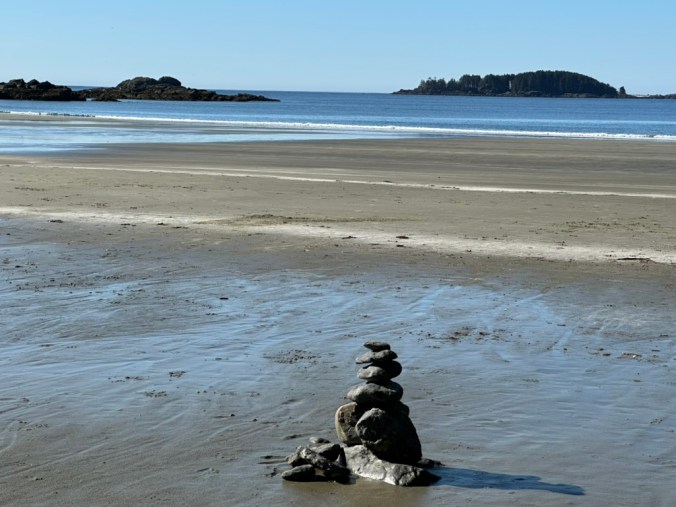
 In front of me, on the sand still damp from high tide, someone has stacked rounded stones. Sabine told me this was a thin place.  I know that, too.  My bare feet soak in the warmth of the sun and feel the pulse of the sea through the sand.

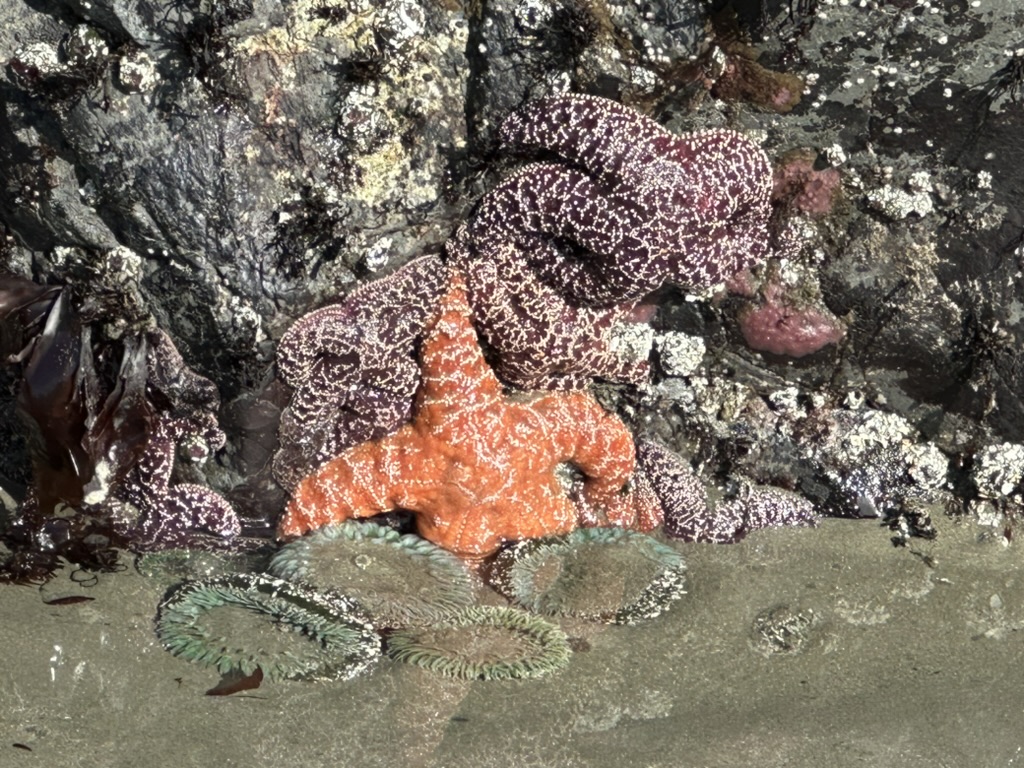
Earlier this morning, Mitch and I walked on Mackenzie Beach on the other side of the place we are staying.  At low tide we witnessed the sea life waiting the return of the tide that will change their lives. 

Walking where the waves broke shoreline I, too, felt the pull of the tidal water renew the life in me just like the sea stars and anemones and barnacles waiting on the rocks for the life giving water’s return.  I walked for as long as the beach lasted and gave way to massive black rock that blocked my way.

The reciprocal care between the earth and us is evident in unexpected ways. We place a rubber squid on the door knob outside our room. It is a signal that we don’t need the extravagant use of water resources to have someone change our sheets or wash extra towels during our stay. That little squid is a more compatible symbol of care and kindness for all life rather than the “DO NOT DISTURB” signal from another place and time.

We are blessed to be here during this “holy week” that isn’t any different than any other week here. The wonder never ceases. The troubles of the world seem non-existent for a moment. It’s easier to let go here; to know that the possibilities of my worries aren’t worth my attention, as they seem to be in the dark, when I forget to trust the unity of all things that doesn’t change. What does that compline prayer say?  Be present, O merciful God,…so that we who are wearied by the changes and chances of this life may rest in your eternal changelessness.

It’s easier to participate in the trust of the whole creation here—to have the strength to let go—of control, of despair, of anything that keeps me from this reality that I know in this moment. Yes, I can always return to this deep centre, trusting that the rope of Love will hold no matter what is pulling the other end.

Such A Place


“When we allow our souls to inhabit such places the world becomes too full to talk about and
we carry the silence home.”             

Silence, someone said, is the first language of God.

What I want to tell, I don’t have words to describe.  I wish I had a picture but it would not add much to convey my experience. As Richard Wagamese writes, it is one of those times when our soul inhabits the place that becomes “too full to talk about and so we carry the silence home.”  And I assure you, I have carried something forward from that day that I can’t name. 

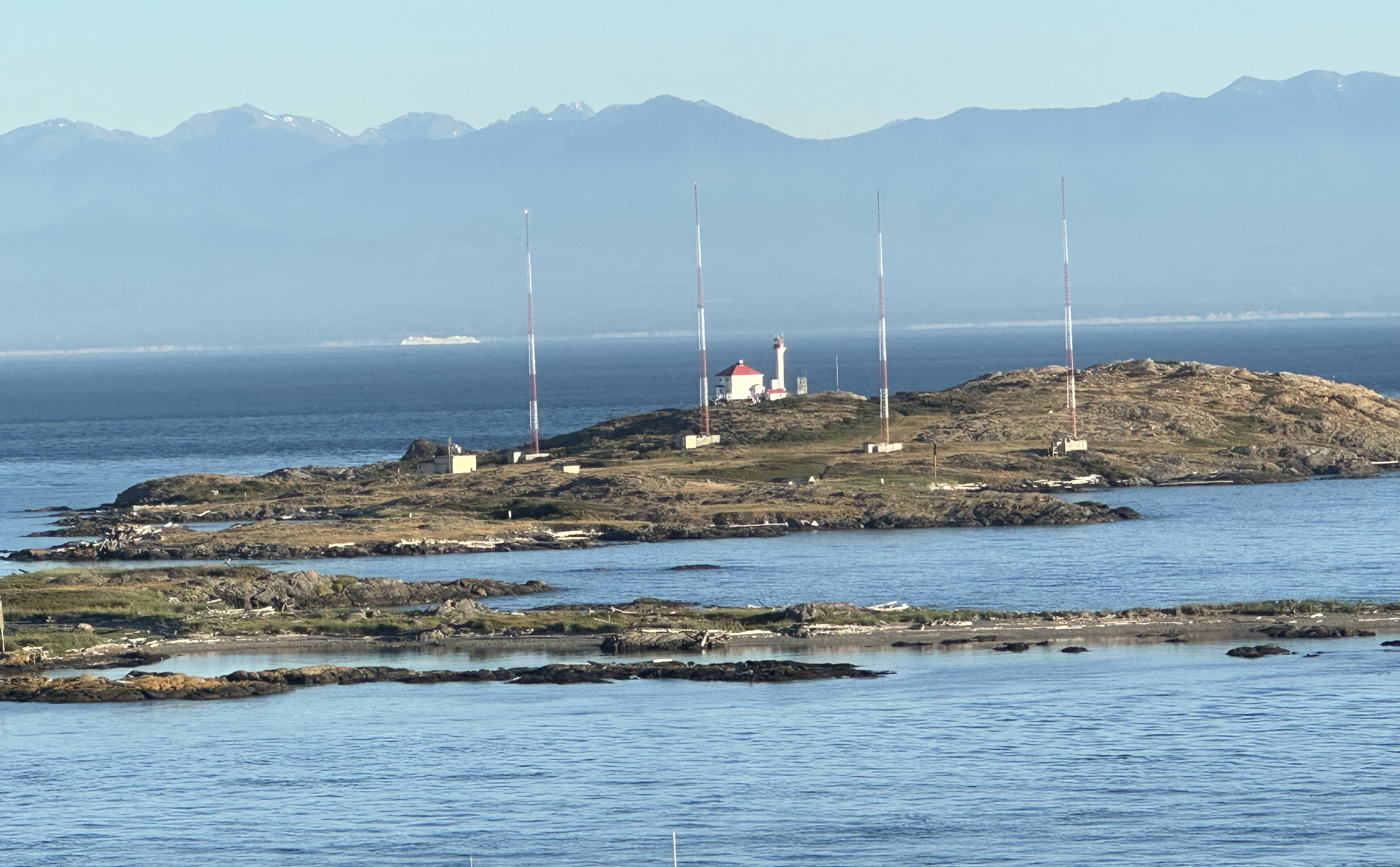
On Valentine’s Day, I went for a sunrise paddle.  It was frosty when I left my house and indeed the sun was coming up.  There were four of us on our paddle boards that set out from Gonzales Bay heading out to Trial Island. Sometimes, it is necessary to go north along the west shore toward McNeil Bay to find safe crossing through the channel to make our way east, depending on the conditions. With it’s lighthouse, keepers’ residence and data collecting equipment, the main island is in full view once we leave the bay. 

The stillness of the morning was breathtaking, the sun making a golden path to follow across the glistening sea.  However, it was not a silent morning; the loud barking of California Sea Lions, up from the South for the food to be had this time of year, echoed across the water. They are all males as I understand, young and in a party mood it seems.  As we approached the gap between the largest and smaller of the islands, we didn’t go close to shore or stay long; the sea was also full with seals that regularly congregate here. 

Melissa and I were a bit behind the other two paddle boarders as we headed back to Gonzales Bay.  I heard a curious splash behind me.  Turning just enough, I caught a glimpse of maybe three seals following behind my board, not too close, but I sensed their presence.  Then we both noticed groups of 3-4 seals on either side of us as well.  “Maybe they are making sure we leave,” we laughed.  But when they kept following us, we kind of settled in to their presence thinking maybe they were an escort, accompanying us as we headed back.  

The seals followed us across the channel and all the way back to Gonzales Point, around which we would enter the Bay. As we approached that spot where we would  make our turn, the seals seemed to congregate on the open side of the bay and seemed to be waiting for us to make our way toward shore. I’ve physically described the scene but I cannot explain how those seals’ presence affected me and the experience has stayed with me.  

Having those seals so attentive to us and us to them, I feel that they honoured us with their presence as we honoured them. Perhaps they imagined us as a less-obtrusive and grateful visitor. Oddly enough, almost every time I’ve paddled since then I’ve met a seal swimming near me that seemed to greet me eye to eye.  I’m sure they’ve always been around me but I have something new to hold in wonder.

When we encounter life around us with an attentiveness that is more than we can see with our eyes, as Wagamese contends, “we confront a power that is beyond our ability to negotiate with, to control, to change, alter, or arrange to suit us.” The prayer I chose months ago to end my meditative time seems a fitting forerunner to the life giving force of places “too full to talk about.”

Awaken us to the Oneness of all things, to the 
beauty and truth of Unity. May we become
aware of the interdependence of all living
things, and come to know You in everything,
and all things in You. For as we attune to your
Presence with us, we know not separation, and
joy becomes our dwelling place.

What a difference being calm and expectant, being open to the unfolding of this day makes.  

On Wednesday, I took the bus downtown and walked around breathing in the coolness of the morning and looking in shop windows; sensing the lives of those I passed in my Victoria.  This place welcomes that kind of meandering and sense of wonder.  I had forty minutes until my appointment to renew my driver’s licence and health card.  My appointment was at noon and let me just say that I was out by noon because I didn’t have my PR identification card.  

Mitch asked me before I left if I had that card and I said no.  “Did you need yours?”  I asked. He didn’t.  So, I was sure I wouldn’t need mine. But, I did need that card for the unexpected reason the kind lady assisting me explained.  She also took time to make me another appointment so I wouldn’t have to do that myself online and I walked out into the rest of my day.

I didn’t notice the sun shining in the harbour that greeted me right outside the door. Instead, I hurried toward the bus stop. I was too busy going over what I should have done and how I failed to finish what I’d set out to do. I continued to ruminate over how I’d wasted the bus ride downtown and the $6 fare spent. I had renewed my license five years ago and came expecting to efficiently renew again.  I’d carefully timed my appointment to avoid a perceived wait in the busy office. I had looked forward to a leisurely walk around town like I’d experienced every Sunday morning for years and now I just wanted to go home.

The next morning, I went to pick up shoes I’d purchased from my favourite online charity store.  Like new, less than half the price, just my size, and the money I paid went to support women in need.  Driving back through town on another lovely day, I decided to act on my renewed hope that I might try to just walk in and get my licence. I was already on Douglas Street and knew what street to turn on to get to my destination but where to park?  That’s definitely the advantage of riding the bus. 

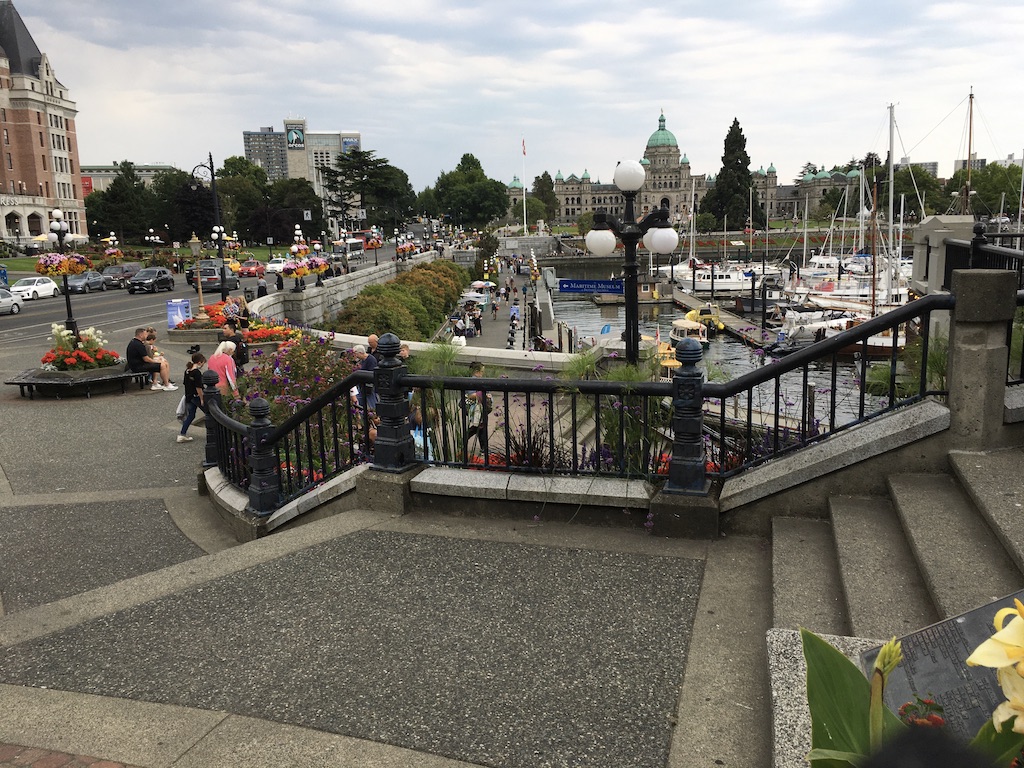
I turned on Yates Street because I saw the city parking garage sign. When I turned into the garage, I was surprised to find several open free 1 hour parking spots. I parked and made the short walk outside, I was already on ground level.  Leaving the dimness of the garage, it took me a minute to sense the way toward the water.  The office I needed is on Wharf street across from the Inner Harbour.  

Navigating my way down the adjacent alley, I soon recognized picturesque Bastion Square. I’d just read in the newspaper the square was being used as the set for a Hallmark Christmas movie.  That explained the half-decorated tree, wreaths and bows on the railings of Gage Gallery, our favourite small art collective.  Across the walk, people were packing up evidence of the movie’s seasonal transformation. I’d have to tell my friend Stacy, who regularly watches those holiday TV movies about unexpectedly coming into this very spot.

Walking a few more blocks, I arrived at my destination and paused to watch a float plane land on the water glistening in the morning sun.  I went straight to the check in and was encouraged to “pay attention to the monitor” because my number would be summoned immediately. “136” was already flashing as I turned the corner for the waiting, or in my case, no waiting area. I took about five minutes to present what was needed and answer a few questions. I quickly was directed to the photo area and pulled off my toque and glasses.  I had put my hat over wet hair this morning, so no telling what that picture would look like.  

When the photo taker turned the screen around so I could see the picture, which I couldn’t without my glasses, I thanked her and was on my way.  I walked again down Wharf Street toward my free parking spot grateful for my new shoes, renewed licence in record time, and for my life right here.  This time, I relished my walk on this spring morning along Wharf street, through lovely Bastion Square, and down the busy alley to the parking garage. I wasn’t even hindered when, at my next stop, a parking spot was a little harder to find. When I finished that errand, I had to wait for the ever-present road work just a few blocks from my house. I had time to notice the people making their way down the Avenue toward their own morning business grateful I’d finished mine.

A standing body prayer to begin each day:

Open me to Love and the gifts of this day 
(open arms wide)
To receive what I am given 
(bring arms in to cross over heart)
To offer Love back to this earth
(bend forward pressing palms to earth)
in gratitude
(raise arms, palms, and face toward sky)

Most days I read something written by Frederick Buechner: I have for more than 25 years. So, you would think I would remember. I came across a paragraph the other day that, for some reason, stood out to me this time as something that really matters now.  Buechner revealed a truth about God’s justice that perhaps runs counter to the emphasis we, or organized religion, usually place on “sin” in our lives. 

I’ve thought of many reasons why this particular bit of writing made such an impact on me.  I recently read the Honourable Murray Sinclair’s unconventional memoir, Who We Are: Four Questions for a Life and a Nation. Senator Sinclair was an Indigenous judge in Canada for 28 years and served as Chief Commissioner of the Truth and Reconciliation Commission. From these voices, I hear that justice can foreground restoration, community and healing that give back life. In contrast, the justice system most of us are familiar with takes away life, marks one as broken and separates from community. 

The first question Murray Sinclair answers for himself and asks us to answer is “Where do I come from?”  Along with the stories of our parents and grandparents, ancestors, and our real and mythological villains and heroes, he says that we also need to know about the story of the community of people to which we are attached but he doesn’t stop there. We need to know “our collective story—all the way back to our place in the creation of the world.”

For me that would be a version of the Christian creation story from Genesis. In the beginning God created the earth, all the creatures of the earth and then humans in God’s own image. God placed Adam and Eve in the garden with only one rule: don’t eat of the tree of knowledge of good and evil.  Depending on the telling, Eve or Adam and Eve break that rule and are cast out of the garden to fend for themselves it might seem. Here’s where I honestly have to consider the “spin” that each of us has inherited from tellings we remember from Sunday School to popular literature that elevates blame and consequences that shape our understanding of wrong-doing and correction.

Even after all these years of reading Buechner, I was taken by his retelling of God’s response to Adam and Eve’s transgression originally written in Whistling in the Dark: A Doubter’s Dictionary. In the entry “Psychotherapy,” Buechner relates the story of God finding Adam and Eve hiding when they realize their is no undoing what they have done. God’s actions give new meaning to ways of justice that restore, heal and offer life giving care.  

Buechner writes,

“But then comes the end of the story where God with his own hands makes them garments of skins and clothes them. It is the most moving part of the story.  They can’t go back but they can go forward clothed in a new way—clothed, that is, not in the sense of having their old defences again behind which to hide who they are and what they have done but the in the sense of having a new understanding of who they are and a new strength to draw on for what lies before them to do now.”

My sense of justice extends to how I see myself in relationship to what I do and do not do and how I treat others and the whole of creation.  I want to be told and to tell this part of our collective story that offers restoration, healing, and belonging even for us when we fall because we all will.

I found this blessing to reclaim God’s own hands to clothe us for whatever lies before us now. 

May the shadow of Christ fall on thee. 

May the garment of Christ cover thee.

May the breath of Christ breathe in thee. 

From Brendan by Frederick Buechner

Choosing to Remember

Wilfrid Gordon McDonald Partridge is one of those books that tell a precious truth in disguise.   In Men Fox’s children’s book, Wilfrid is a young boy who lives next to an “old peoples” home and he knows everyone who lives there.  His favourite person to visit is 96-year-old Miss Nancy and he tells her all his secrets. He heard his mother and father say that Miss Nancy has lost her memory.  Wilfrid doesn’t even know what a memory is so he asks everyone he knows to find out in his desire to help Miss Nancy find her’s.  Listen to the story here to discover what Wilfred learned and shared.   

In the past two weeks, I’ve been fortunate to listen myself to memories of four women in particular who have lived decades longer than me.  I realize how important it is for me to attentively listen to what I imagine is a mixture of fact and fiction lived out in their real lives. I envision the years have reshaped those memories. Like Wilfrid Gordon McDonald Partridge, we all refashion what we have been given to remember and to share.

I believe that what we remember is a way of listening to our lives. 

In A Room to Remember, Buechner writes,

In one sense the past is …over and done with, but in another sense,… it is not done with us. Every person we have ever known, every place we have been, everything that has ever happened to us— it all lives and breathes deep in us somewhere whether we like it or not, and sometimes it doesn’t take much to bring it to the surface in bits and pieces…Times too beautiful to tell or too terrible.

These are the kind of memories that come more or less on their own and apart from any choice we consciously make. But in A Room to Remember, Buechner proposes remembering as a conscious act for good in that the power of remembering becomes our own power.  And that is the essence of the stories my four dear friends choose to share with me.

Sometimes we are reluctant to talk about what really matters.  We don’t always tell the whole story.  Even in my journal, sitting alone, I disguise parts of my life because they are difficult to face. We leave out the parts that, for some reason, we are hesitate to say out loud.

The strength of the women who trusted me to listen is that they are remembering on purpose.  They are consciously recalling years that have gone by but are not gone.  Each story they share is felt and fresh and alive with both who they were at their best or their worst and who they have become. 

What do I choose to remember?

I, too, am encouraged to remember what makes me laugh and cry and warm with wonder. Remembering what is precious as gold with a new understanding of who I am and given new strength for what comes next.  

Blessing Our Dust

For me, Ash Wednesday is the most significant part of the Lenten/Easter season. The words from Genesis are simple bodily truth: “In the sweat of your face you shall eat bread till you return to the ground, for out of it you were taken; you are dust, and to dust you shall return.” The ashes on my forehead are real, tangible evidence of an unvarnished truth. The mark of that dust invites us to do the necessary work of caring for ourselves and others.

Early in the day, I made soup for the Inclusive Christians’ group at University of Victoria. The group attends to their “unique voice as a student group that centers queer and IBPoC voices, following the same Jesus who disrupts the status quo, making space for marginalized people.” As I chopped, roasted, and simmered, I consciously remembered those young people who will be nourished by one another when they meet later for communion and the soup supper.  

After dropping off our soup, my friend and I attended an Ash Wednesday Taize service—very little talk, space filled with silence, candlelight, and Taize chants.  Over and over, we sang words, sometimes in a language I didn’t understand that filled me with a sense of Holy presence.  “Come and fill our hearts with your peace, Come and fill us with Your love.”

The opening prayer of releasing seemed especially fitting to me. Let me unclench my fists and release what I’ve done recently whether for good or ill, what I haven’t done and what I need to do soon.  I release fear, anxiety, impatience, pride and everything that pulls me away from you, God. 

After the contemplation and the imposition of ashes, a reading of “Blessing the Dust” by Jan Richardson completed the liturgy. At the end we were asked to put our hand on the shoulder of someone near us. My friend and I briefly acknowledged each other and then my friend put her hand on the person seated alone in front of her. Thankfully, I noticed the woman I’d seen here many times who was also sitting alone.  I took a step toward her to place my hand on her shoulder. She put her hand over mine holding on for her life and mine. Her eyes, filled with generosity, met my gaze. We left in silence with no need for words.

When I returned home, I happened to read an old blog that reassured me about the troubles I sought to release— not to ignore them but to glimpse beyond how I perceive my life in this small window of time.

Cynthia Bourgault writes that “as the heart comes alive as an organ of perception, we are able to perceive the invisible kingdom of love that surrounds us—and live it into being.”

How do I nurture my heart to perceive the kingdom of love that surrounds me—and live it into beingI know quite well what I need to release.

What if?

What if?  

I’ve written and pondered the “What ifs” over a lifetime and while the details shift, the underlying core doesn’t.  

My “what ifs” rise out of fear—worry that the worst or even the best might actually be possible. Arise from my desire to protect myself and my image of myself in relationships. Rise out of my penchant to protect, fix, manage, or control the lives of other people—some that I love and some that challenge my capacity to see them as whole people. 

But, what if?  

What if my whole being paid attention to the natural wonder around me—to the ways of being that rise out of generosity and care for myself and all other living things?  What if my relationships become places where giving and receiving become one act of loving?

How would you live then?  Mary Oliver asks in her book Devotion,

What if a hundred rose-crested grosbeaks
flew in circles around you head? What if
the mockingbird came into the house with you and
became your advisor? What if
the bees filled your walls with honey and all
you had to do was ask them and they would fill
the bowl? What if the brook slid downhill just
past your bedroom window so you could listen
to its slow prayers as you fell asleep? What if
the stars began to shout their names, or to run
this way and that way above the clouds? What if
you painted a picture of a tree, and the leaves
began to rustle, and a bird cheerfully sang
from its painted branches? What if you suddenly saw
that the silver of water was brighter than the silver
of money? What if you finally saw
that sunflowers, turning toward the sun all day
and every day—who knows how, but they do it—were
more precious, more meaningful than gold?

How will you and I live then?

Our fingers imbibe like roots

so I place them on what is beautiful in this world.

And I fold them in prayer,

and they draw from the heavens light.

Saint Frances of Assisi

I’m only on page 18; still in the introduction titled, “What Is It Like to Be a Fungus?”  I also read the prologue and noted the 121 pages of notes and bibliography.  This book is a considered scientific work; and yet, Saint Frances’ poetic prayer begins the epilogue and I have pondered for days the personal story that begins on page 14.

The author of Entangled Life, Merlin Sheldrake, tells a story about his friend, philosopher and magician David Abram, who was the house magician at Alice’s Restaurant (made famous by the Arlo Guthrie song). One evening, two customers returned to the restaurant after leaving and pulled David aside. They said that after they left the restaurant (and his magic show) the sky had appeared shockingly blue and the clouds large and vivid. Had he put something in their drinks?  This continued to happen (minus any nefarious questions).  After leaving the show, customers reported the traffic seemed louder, the lights brighter, the patterns on the sidewalk more interesting, and even the rain more refreshing. The magic tricks were changing the way people experienced the world.

According to David Abram, our perceptions work primarily by expectation. We use less cognitive effort to make sense of the world using preconceived images updated with small amounts of sensory information rather than engaging the work needed to form new perceptions. Our preconceptions create the ‘blind spots’ needed for David’s coin tricks to work. Eventually the tricks “loosen the grip” of our expectations on our perceptions. He concluded that the sky changed because the customers were seeing the sky in the moment rather than as they expected it would be. What we expect to see is different than what we see when we actually look. When we are tricked out of our expectations, we default to using our senses.

I believe we “see” with the whole of our lives and there is a gap between what we perceive and what is.  We don’t just see with our eyes— we bring our preconceived notions to the news, our neighbours, and even what we think is true.  How might we open to take in the beauty and sorrow with all of our senses including our heart, God in us.  

Cynthia Bourgeault writes that “…as the heart comes alive as an organ of spiritual perception, we are able to perceive the invisible kingdom of love that surrounds us—and live it into being.”  How do we nurture the Spirit of God in us that changes the way we see the world?

God in us—that heart that opens with gratitude, hope, and love, especially when we put our hands on what is beautiful in this world and fold them in prayer to draw from heaven’s light.